Growth Autopilot
Growth Autopilot works best with apps that already generate revenue. If Adapty can analyze your financial metrics, its suggestions are more likely to be effective.
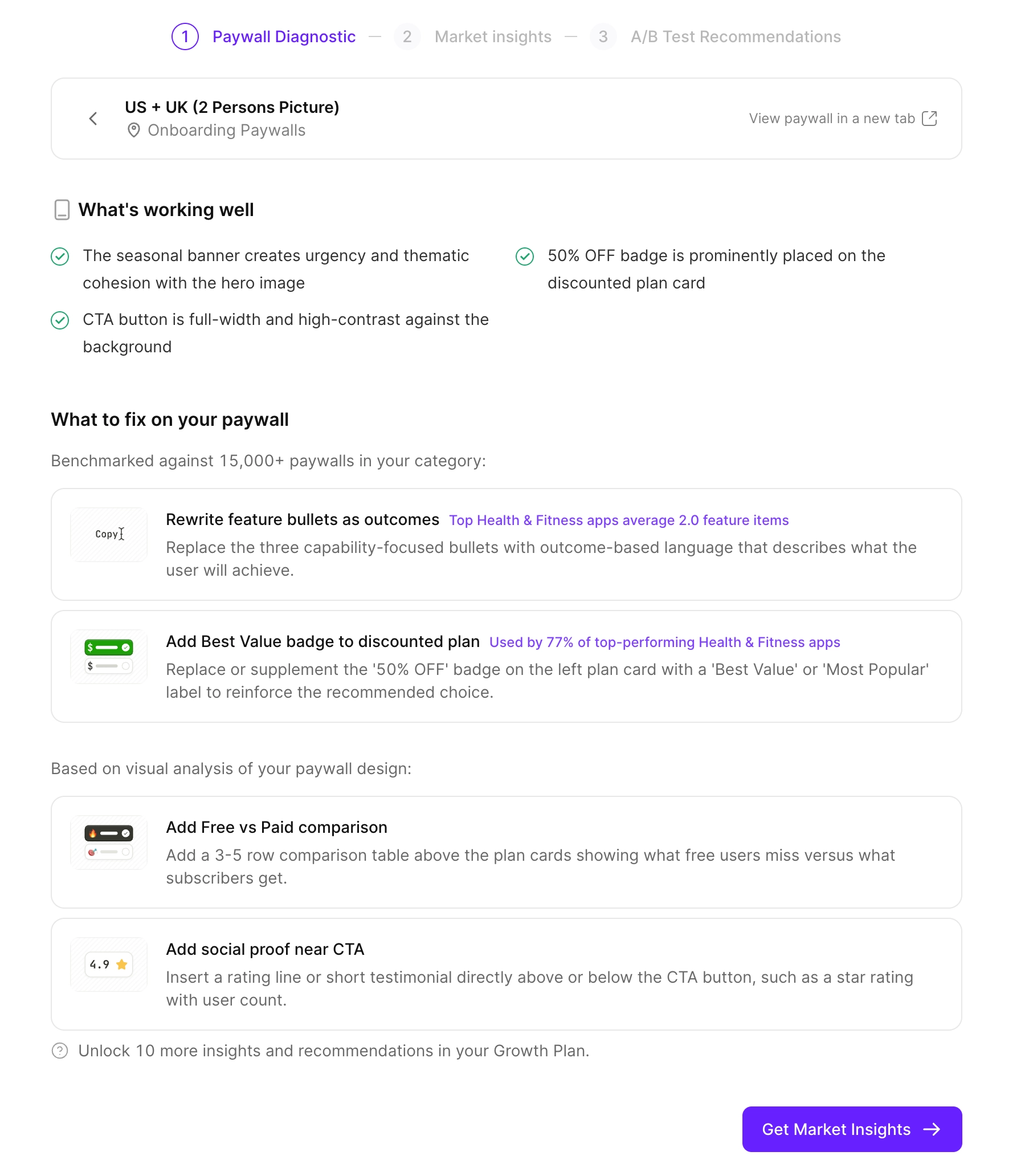
Growth Autopilot analyzes your paywall and builds a growth plan — a sequence of A/B tests you can launch. Each experiment builds on the previous winner. To create this plan, Autopilot collects and compares:
- Competitor pricing with country-level analysis: A bar chart of your subscription prices vs competitors, a comparison table of their offers (trials, pricing tiers, subscription periods), and price cards showing how far you are from the market average. Includes breakdowns for your top 5 markets by revenue.
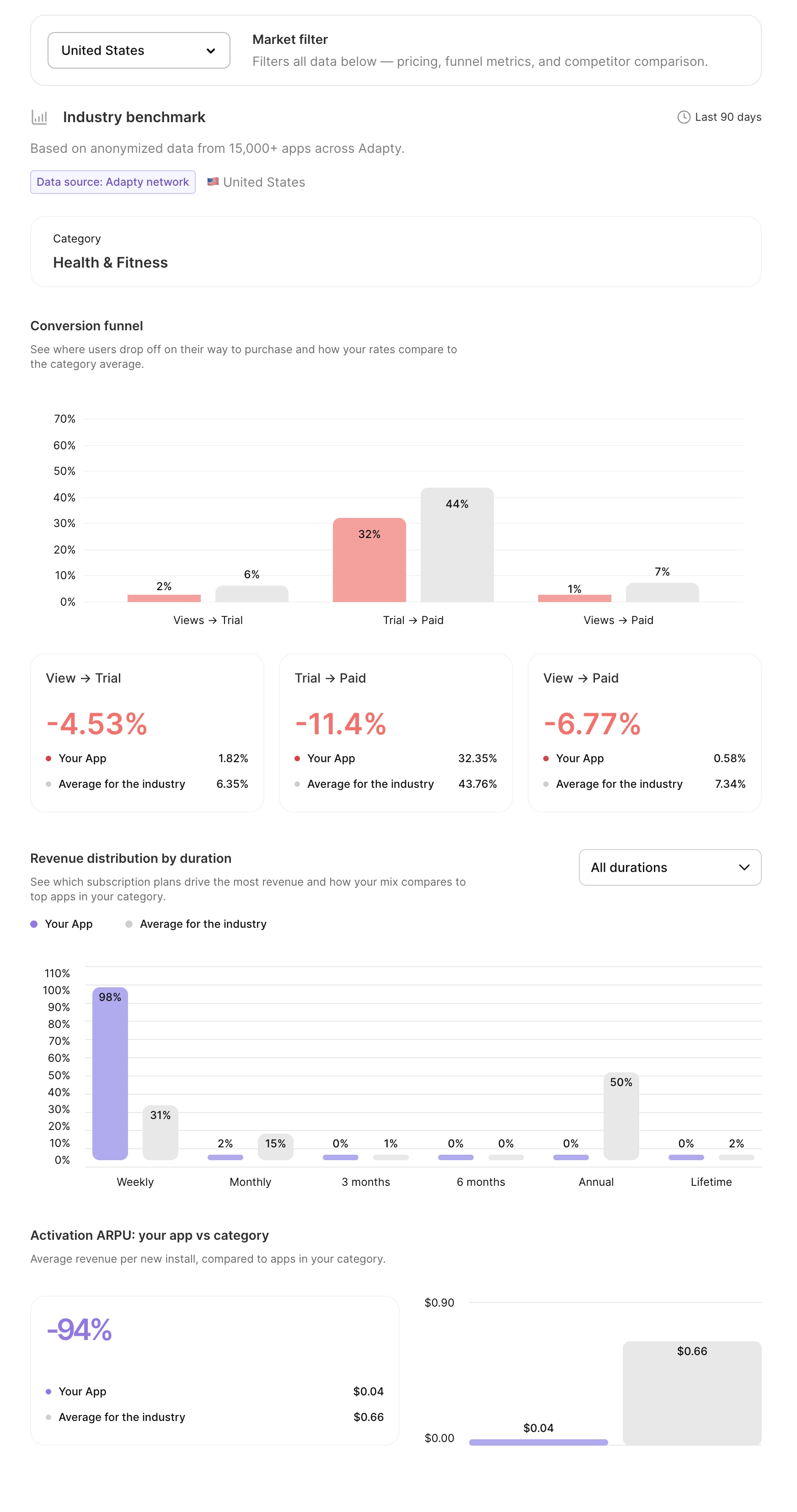
- Funnel effectiveness benchmarks: Your conversion rates (Views-to-Trial, Trial-to-Paid, Views-to-Paid) compared to the industry average for your app category and country, based on Adapty’s aggregated data across similar apps.
- Global pricing opportunities: Your next top 5 markets with conversion rates, purchasing power data, and specific pricing recommendations per country.
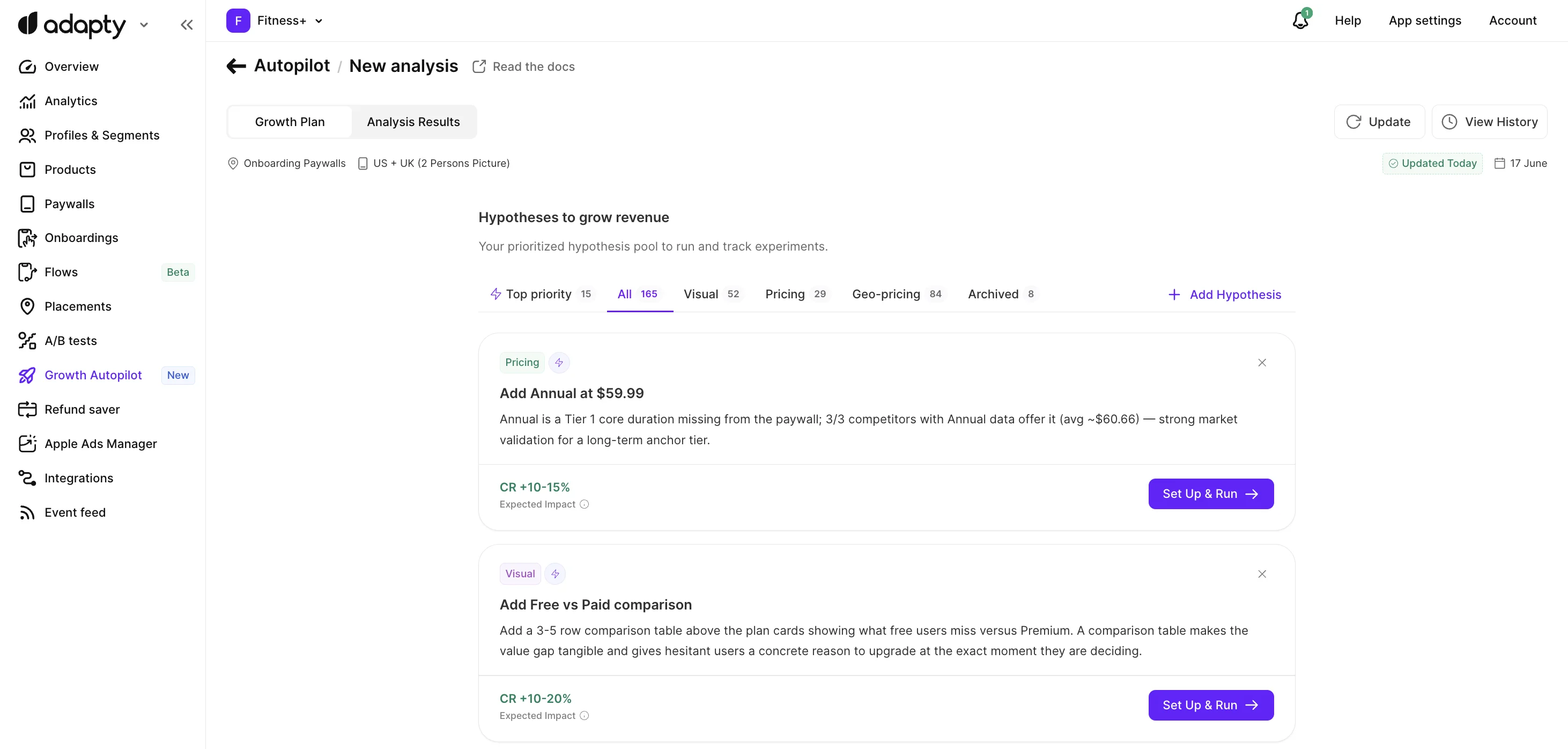
Based on this analysis, Autopilot generates a staged growth plan with specific hypotheses for each test — covering price points, trial configurations, and paywall design changes. Each hypothesis shows your current metrics compared to competitors and industry averages, so you can see exactly why the test is worth running.
Here’s how it works:
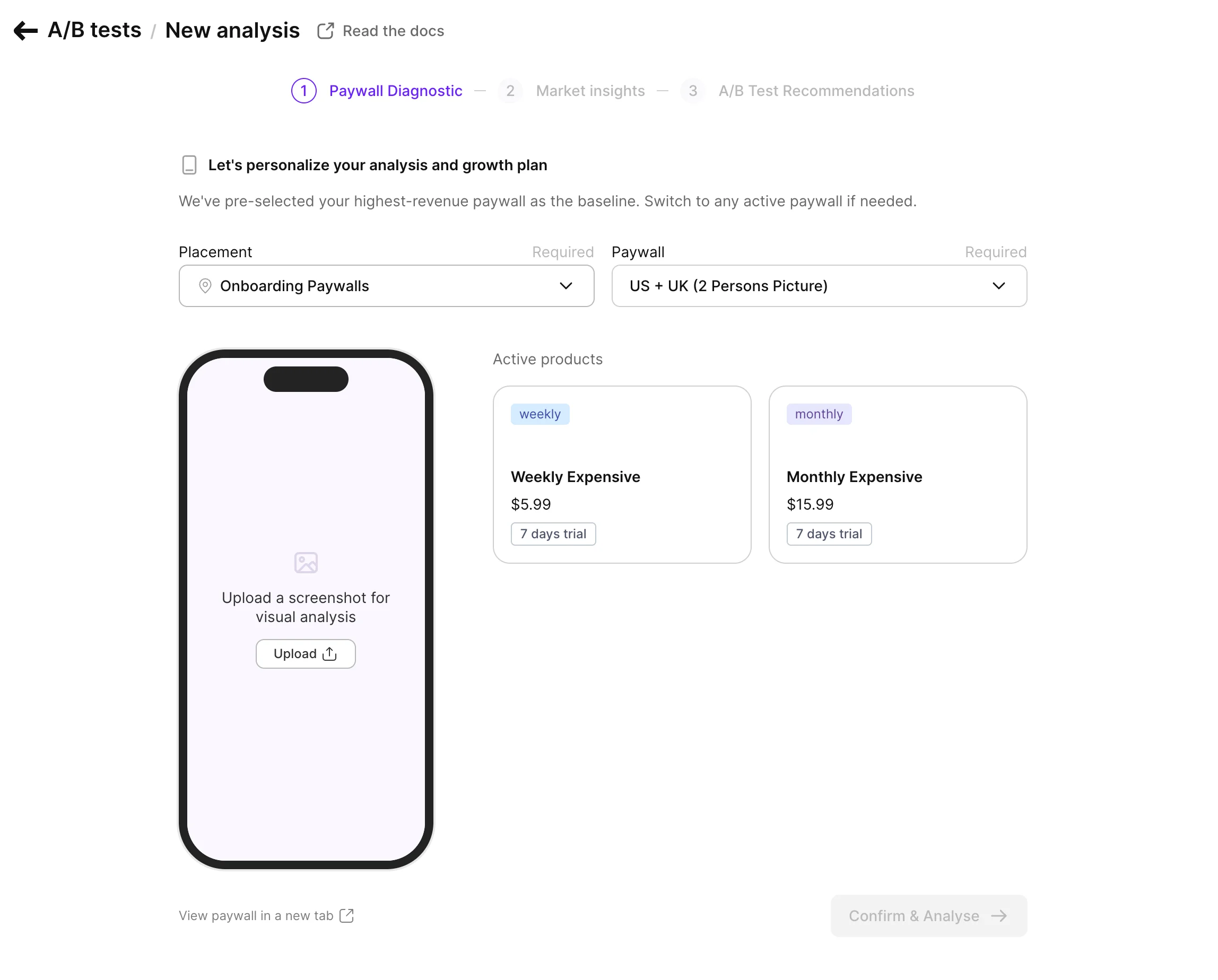
- Autopilot picks the live paywall with the most revenue from your largest placement. If your app hasn’t generated much revenue yet, choose the placement and paywall you want to analyze manually.
- It compares your prices and funnel effectiveness to top competitors and industry benchmarks.
- Based on the results, it creates a growth plan with A/B tests you can act on right away.
Run the analysis
Before you start, consider the following:
- To provide a single, consistent point of comparison, this analysis is based on the U.S. App Store. This allows us to benchmark all apps against the same large dataset, with prices shown in USD.
- This analysis focuses only on subscription products. Consumable in-app purchases are not included.
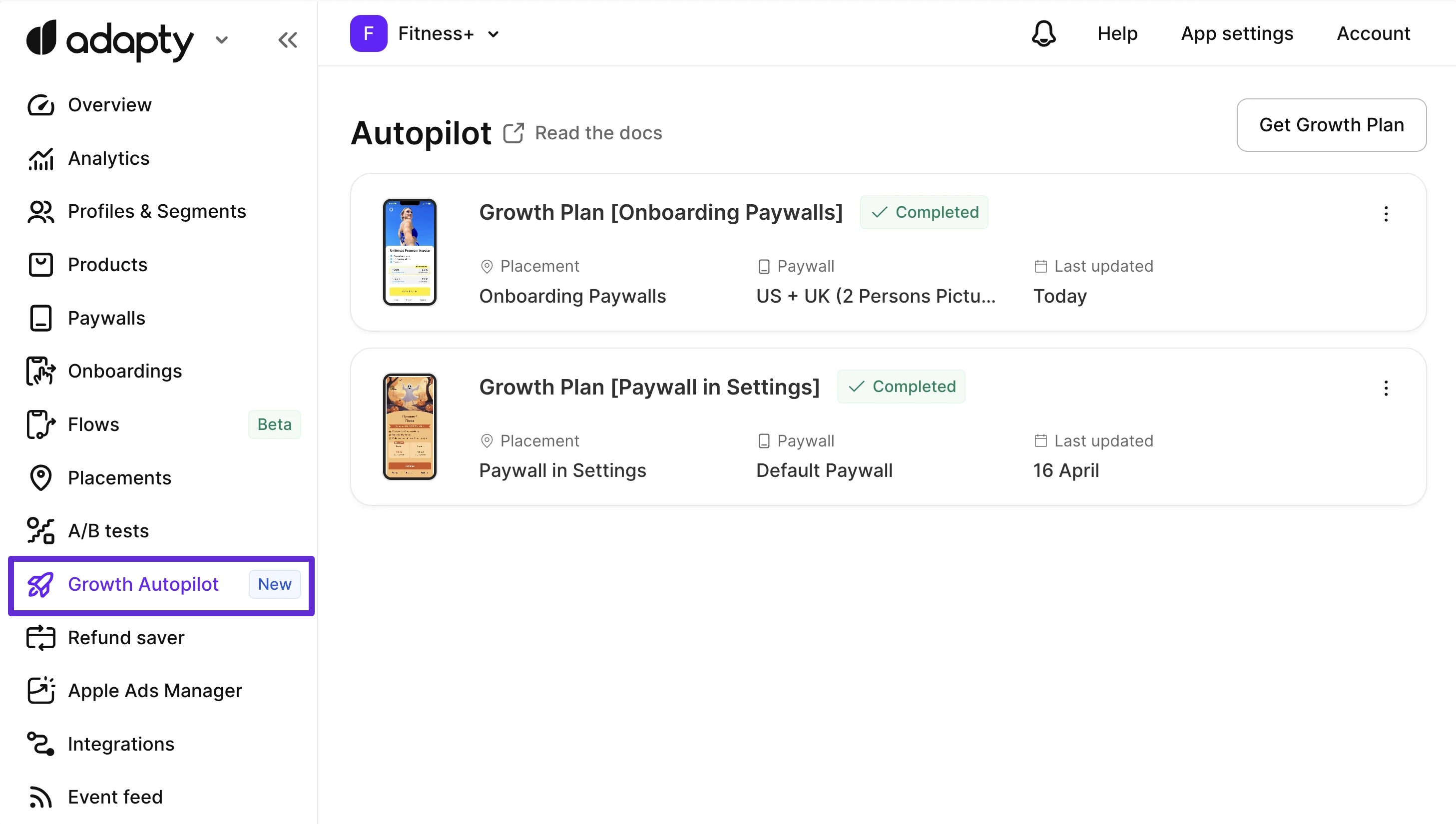
- Go to A/B tests from the dashboard sidebar and click Adapty autopilot.
- Adapty automatically selects the top-performing placement based on revenue data. If you’d like to analyze a different placement, select one from the Placement dropdown. Click Analyze this placement. Adapty will need some time to analyze your app — don’t leave the page, it won’t take long.
- Review your paywall. Adapty selects the top-performing live paywall for analysis. If you wish to analyze a different paywall, click Change Paywall and pick another option. You can only select a paywall from the placement chosen in the previous step. When ready, click Go to competitors research.
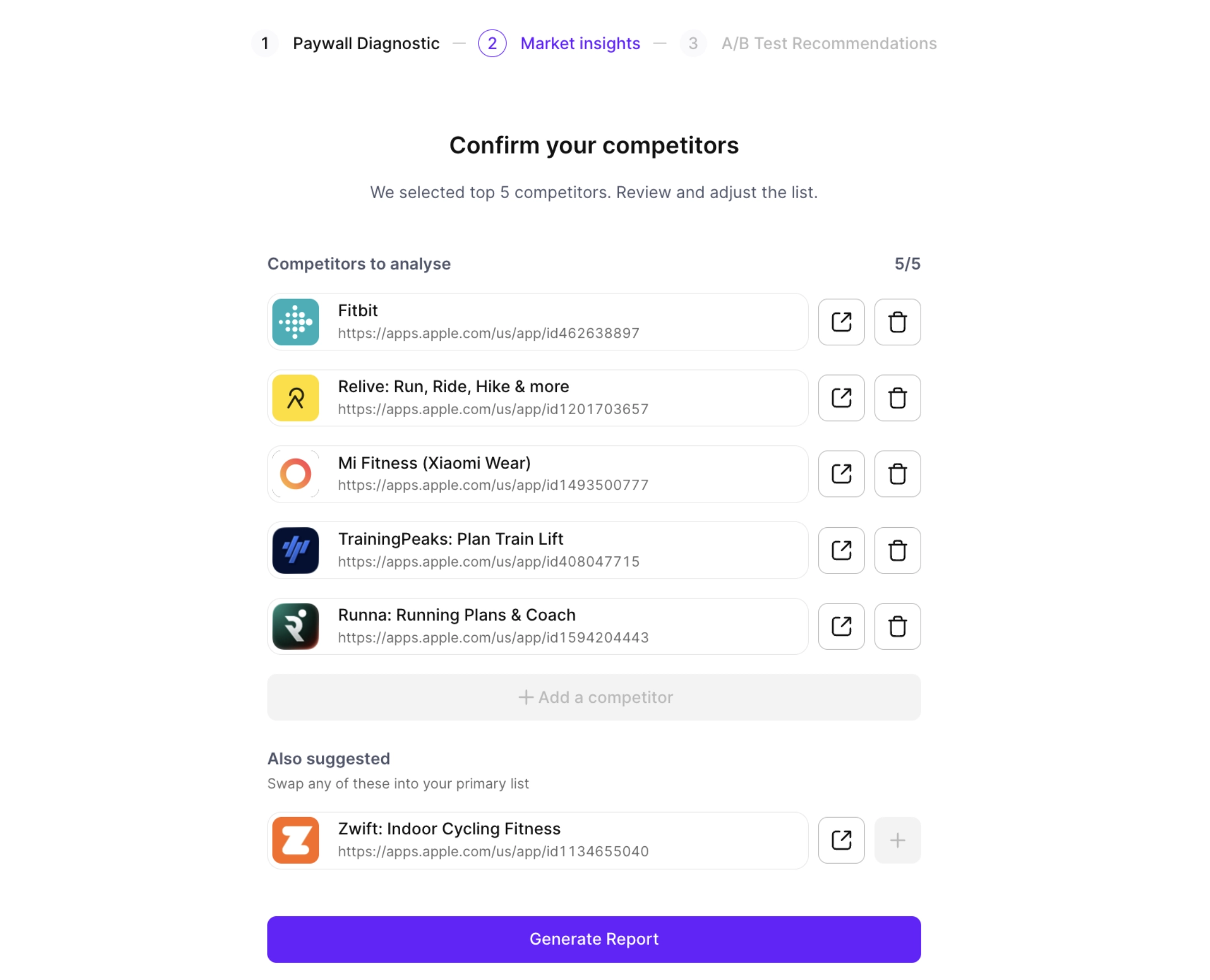
- Adapty suggests up to five competitors based on your app’s category and MRR. You can modify the list and manually add apps with an App Store link. We recommend selecting apps with higher MRR than yours. Click Generate report to confirm the list.
Your report is now ready. See Your report for a walkthrough of each section.
Your report
The report analyzes your pricing strategy from several angles. Each section below explains what the data means and how to act on it.
Paywall overview
The paywall overview shows key metrics for the paywall Autopilot selected for analysis:
- Active products: The subscription products attached to this paywall
- Conversion metrics: How effectively the paywall converts users
- Revenue by country: A chart showing how revenue is distributed across your top markets
Competitor analysis
This section shows how your pricing and subscription structure compare to competitors:
- Pricing chart: A bar chart of your subscription prices vs competitors, with the market average shown as a dashed line. Use the dropdown to switch between weekly, monthly, and annual views.
- Price cards: Your current prices with a percentage showing how far they are above or below the competitor average.
- Comparison of offers: A table listing each competitor’s free trial setup, pricing tiers, and subscription periods side by side with yours.
By default, results are displayed for the US market. To see how competitors price in other markets, use the country dropdown at the top. The dropdown includes your top 5 countries by revenue.
Funnel effectiveness
Below the competitor analysis, you’ll find a chart that compares your conversion funnel to the industry average for your app category.
This data is based on Adapty’s own aggregated metrics across apps in your subcategory and country — it’s not publicly available elsewhere. The chart shows your conversion rates — Views-to-Trial, Trial-to-Paid, and Views-to-Paid — next to the averages for similar apps in your category.
The country dropdown at the top of the page applies here as well, so you can check your funnel performance in different markets.
Global pricing opportunities
This section helps you identify which countries offer the highest revenue potential.
Adapty shows your next top 5 markets (excluding your main country) and provides data-driven pricing recommendations validated by the Adapty Pricing Index.
At the top, you’ll see your Global average baseline — the average percentage of users who convert from install to paid worldwide. Adapty uses this baseline to identify abnormal demand in specific regions.
For each country, Adapty shows:
- Conversion rate: How this country’s install-to-paid rate compares to your global average. A higher rate suggests users convert easily — the price might be too low for the value they see. A lower rate suggests users hesitate — the price may be a barrier.
- Purchasing power: Categorized as High, Medium, or Low based on the Adapty Pricing Index, which compares real transaction data from this country against the US benchmark. Low purchasing power means the market requires significant discounts (Index < 0.6). High means users typically pay prices equal to or above the US level (Index ≥ 0.9).
Based on these metrics, you’ll receive one of three recommendations for each country:
- Increase price: High conversion rate suggests room to capture more revenue
- Decrease price: Lower conversion rate indicates price sensitivity
- Keep price: Current pricing is well-balanced for this market
Your growth plan
Here’s what the growth plan includes:
Growth plan stages
Instead of testing everything at once, Autopilot creates a staged plan where each experiment builds on the previous winner. Each stage focuses on one change — a new price point, a trial configuration, or a design update — so you can see what moves your metrics.
Hypotheses
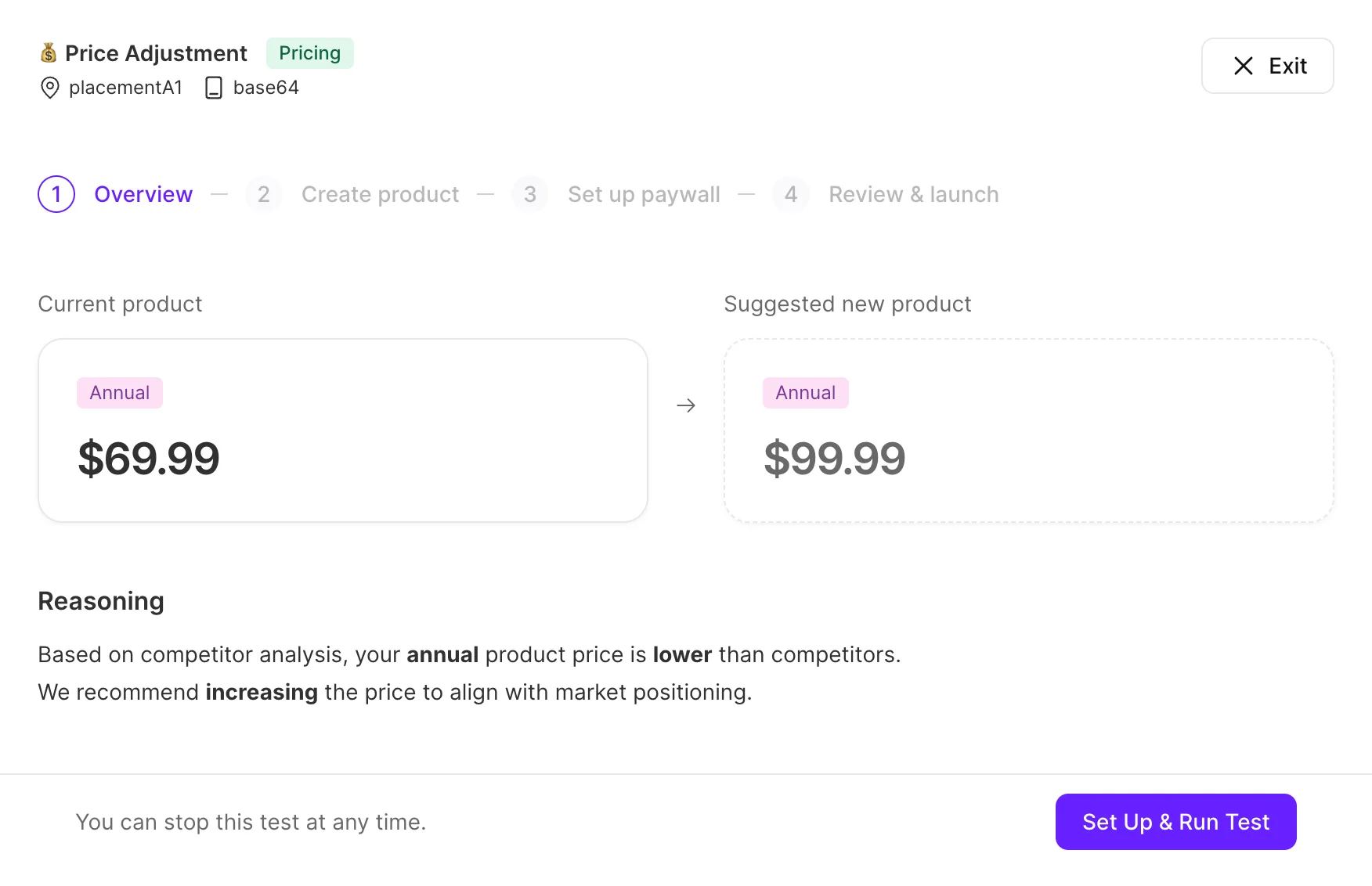
Every recommendation comes with a clear hypothesis that explains the reasoning behind it. You’ll see how your current metrics compare to competitors and industry averages. Each hypothesis highlights the opportunity Autopilot identified and which key metrics the test targets.
For a detailed look at how Autopilot analyzes your growth strategy and which data sources it uses, check out Growth Autopilot: How it works.
Get more ideas
To explore additional recommendations beyond the growth plan — such as country-specific pricing adjustments or paywall design ideas — click Get more ideas.
Once you’ve reviewed the growth plan, head to What’s next to start acting on it.
What’s next
To start with the first stage of your growth plan:
- Create new products right from the report or modify your existing products. You can automatically push your new products to App Store and Google Play right away.
- Duplicate your existing paywall and add products to it. You can also modify your paywall design according to the recommendations or generate a new one using the AI generator in the Adapty Paywall Builder.
- Launch an A/B test to compare how the new paywall performs against the current paywall.
The recommendations page shows you the target number of subscribers and the minimum duration for the A/B test. Follow these recommendations to get the most accurate data before you begin with the next stage. You will need to stop the A/B test manually.