
Installs
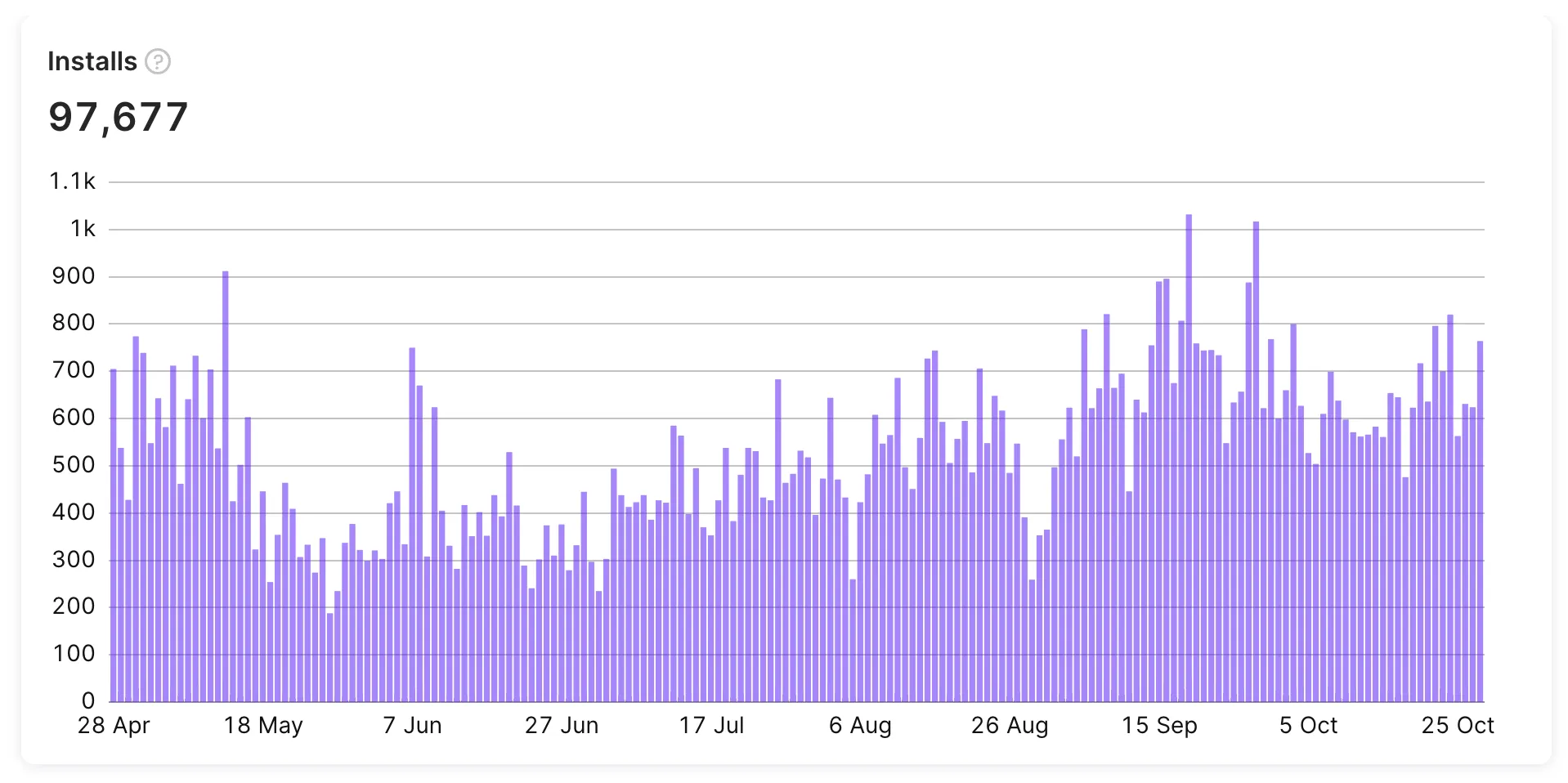
The Installs chart shows how many users installed your app over the selected period. What counts as an install — and how each install is grouped — depends on the install-counting setting.
This article explains how to select an appropriate counting mode, and how to reconcile the potential discrepancies between the different analytics sources.
What counts as an install
The Adapty SDK registers an “install” and sends it to Adapty when the user first launches your application.
This has two consequences:
- An install appears in Adapty when the user opens the app for the first time, which can be hours or days after they download it.
- If a user downloads but never opens the app, Adapty doesn’t count them.
Your reporting timezone in App Settings governs which day each install lands on. An install at 23:30 UTC on June 1 lands on June 2 if your reporting timezone is +02:00, while App Store Connect or Google Play may show it on June 1.
Counting modes
The Installs definition for analytics setting determines what counts as a new install. To change it, open App Settings → General → Installs definition for analytics.
| Mode | What counts | Example | 3rd party metric | Potential discrepancies |
|---|---|---|---|---|
| New device_ids (recommended) | Every app install — including reinstalls. Authentication, profile creation, and version upgrades don’t add to the count. | One user across 5 devices = 5 installs. Reinstalling on the same device = 2 installs. | App Store: Total Active Devices Google Play: Devices | Higher than the number of app downloads if reinstalls are common. Lower than the number of app downloads if many users download the app without opening. |
| New customer_user_ids | Only the first install per identified user. Additional devices and anonymous users don’t count. | One user across 5 devices = 1 install. Reinstalling, logging back in = no new install. Using the app without an account = no new install. | Sign-up stats from your app’s authentication system | Remains empty if you don’t identify users at all. |
| New profiles in Adapty (legacy) | Counts every install and reinstall, as well as anonymous profiles created on logout. | One user, one device, 3 logouts = 4 installs. | None | Higher than all external metrics. Counts each anonymous profile created on logout as an install. |
Use New device_ids unless you have a specific reason to switch.
Troubleshooting
Adapty’s count is higher than App Store Connect or Google Play
Two likely causes:
- Reinstalls. If your counting mode is set to New device_ids, Adapty counts both first launches and subsequent re-installs. App Store Connect’s “Total Downloads” only counts the initial download.
- First launch date ≠ download date. Stores attribute by download date. Late-opening users land on different days.
To compare more cleanly, open App Store Connect → Total Active Devices or Google Play → Devices. Those metrics are device-level and closer to Adapty’s New device_ids mode.
Adapty’s count is zero
If your counting mode is New customer_user_ids, but you don’t authenticate users iOS, Android, React Native, Flutter, Unity, Kotlin Multiplatform, Capacitor , Adapty won’t register any installs. In that mode, anonymous installs are excluded. Switch to New device_ids or implement user identification.
Adapty’s count differs from AppsFlyer or Adjust
MMPs attribute installs by their own SDK init or first-touch event. Those fire on a different schedule than Adapty’s first SDK launch — some discrepancy is normal.
Available filters and grouping
Main article: Analytics controls
- ✅ Filter by: Attribution, Country, A/B tests, Segment, and Store.
- ✅ Group by: Country, Store, Segment, and Attribution.
Similar metrics
For a side-by-side comparison of these metrics, see the Metric comparison table.