
Create placement
A Placement is a specific location in your mobile app where you can show a flow, paywall, onboarding, or A/B test. For example, a subscription choice might appear in a startup flow, while a consumable product (like golden coins) could show when a user runs out of coins in a game.
You can show the same or different flows, paywalls, onboardings, or A/B tests in various placements or to different user segments — called “audiences” in Adapty.
Read the Choose meaningful placements section for tips on picking the right placement.
You can also create placements programmatically using the Developer CLI.
Although the placement creation process is similar for flows, paywalls, and onboardings, you can’t create one placement that serves more than one type — each placement type processes different metrics. The type is fixed once the placement exists, so serving a flow where you previously served a paywall means a new flow placement with a new placement ID.
Create and configure a placement
-
Go to Placements from the Adapty main menu. Switch to the Flows, Paywalls, or Onboardings tab depending on the placement type you want to create.
-
Click Create placement.
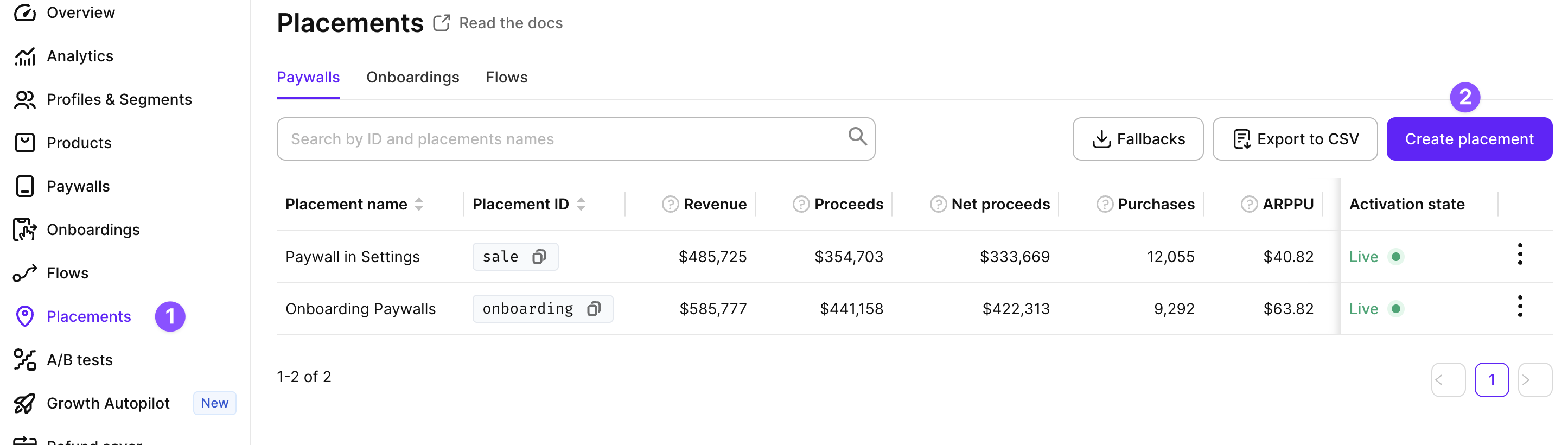
-
Enter a Placement name. This is an internal identifier in the Adapty Dashboard. You can edit it later if needed.
-
Enter a Placement ID. You’ll use this ID in the Adapty SDK to call the placement’s flows, paywalls, onboardings, and A/B tests. Placement IDs are unique across every placement in the app, whatever its type, and you cannot edit one later. They are also case-sensitive:
onboardingandOnboardingare two separate placements. Your app must request the exact ID you enter here.
Next, assign a flow, paywall, onboarding, or A/B test to the placement. Adapty supports audiences — user segments based on segments — so you can show different content to different user groups. If you don’t need targeting, the default All users audience covers everyone.
To proceed, ensure that you created a flow, paywall, onboarding, or A/B test you want to run and an audience, you’d like to specify.
- In the Placements/ Your placement window, add a flow, paywall, onboarding, or A/B test to display for default All users audience. To do this, click either the Run flow, Run paywall, or Run A/B test button (the label depends on the placement type), then select the desired flow, paywall, onboarding, or A/B test from the dropdown list.
- If you want to use more than one audience in the placement to create personalized content tailored to different user groups, click the Add audience button and choose the desired user segment from the list.
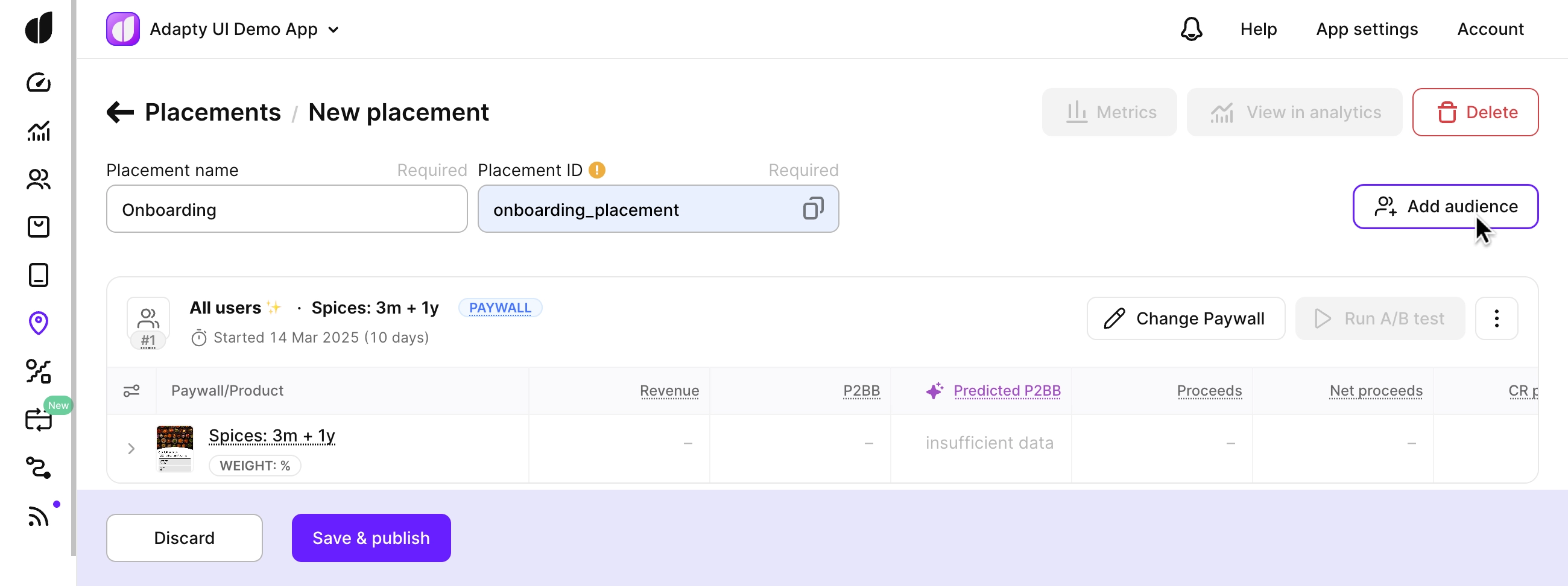
- Now add the flow, paywall, onboarding, or A/B test to show for this audience.
- Add as many audiences as you need.
- If you have more than one audience, check that the audiences have the correct priorities.
- Click the Save and publish button.
Once your placement is saved and published, you have everything you need — use the Placement ID in your app code to fetch and display it.
Next steps
Display paywalls in your app: iOS | Android | React Native | Flutter | Unity | Kotlin Multiplatform | Capacitor
Display onboardings in your app: iOS | Android | React Native | Flutter | Unity | Kotlin Multiplatform | Capacitor