How long until Apple Ads are profitable? A payback guide for 2026

TL;DR:
Apple Ads profitability isn't a fixed number of days. It's the cost of a paying subscriber measured against how fast that subscriber pays you back.
The ROAS curve climbs for months after install. Teams that measure at day 7 or 14 see a fraction of the real return and kill campaigns that would have paid back.
One app in our data went from never breaking even to profitable on day 61 by matching paywalls to Apple Ads keywords.
Three levers shorten payback: cheaper subscribers (country mix), higher conversion (Custom Product Pages and paywalls), and a long enough measurement window to see the return.
How long does it take you to conclude an Apple Ads channel doesn’t work?
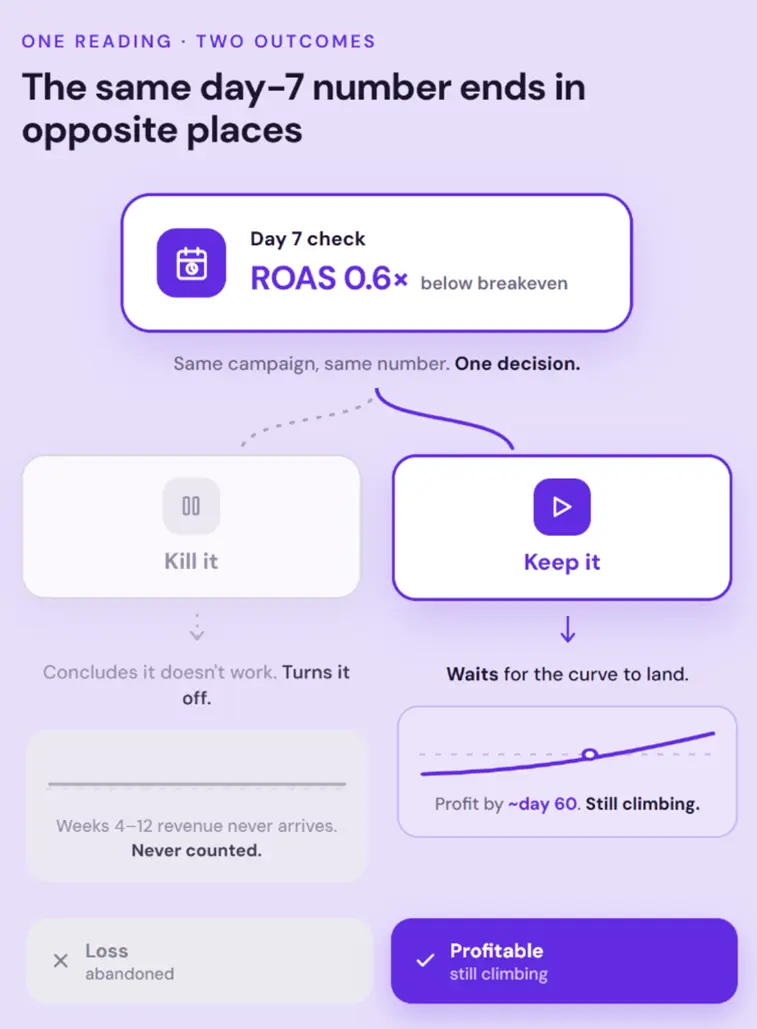
Let’s say you’re running Apple Ads for two weeks and see just 0.6 ROAS. It’s easy to guess that it’s time to switch the campaign off.
But what if you turned it off the day before it would’ve started compounding?
That’s what we wanted to check in our Apple Ads for subscription apps benchmarks report.
Turns out, the question "how long until Apple Ads are profitable?" has no single answer for a simple reason. Profitability isn't an event on a fixed date, but a curve.
Let’s see the structure behind the curve, how to move it, and the data from 1M+ ad groups.
What does "profitable" mean for Apple Ads?
Profitability comes down to two numbers:
- What a paying subscriber costs you to acquire
- What that subscriber is worth over their lifetime
ROAS (return on ad spend) is revenue divided by ad spend, and 1.0×, or 100%, is cash breakeven. Anything above it is profit.
The wider rule of thumb across the industry is an LTV-to-CAC ratio of about 3:1 for a healthy subscription business.
The payback period is the time it takes for the revenue from a cohort of users to cover what you paid to acquire them.
For subscription apps, that revenue arrives over months, not at the moment of install. So profitability is a moving line, not a single event, which is exactly why the two-week check kills good campaigns.
ℹ️For the foundations, see our guides to mobile app ROAS and customer acquisition cost
Why isn't there a single Apple Ads payback number?
Apple Ads payback depends on three things that vary enormously from one app and market to the next.
- What a subscriber costs. In our data, the cost per paying subscriber ranges from about $13 in the cheapest markets to $362 in the most expensive. A 28× spread.
- What a subscriber is worth. Year-1 LTV varies 2.7× by country, and it varies again by category, pricing, and plan length. Annual plans pay back faster than weekly ones.
- How fast they pay. Trial length, renewal timing, and retention all shape the revenue timeline.
Industry research is consistent that this takes time.
Analysis should extend well beyond 30 days, since channels that look expensive at first often deliver users with 2-3× higher retention over a 90-180 day window.
A single payback benchmark would be useless. The framework is what matters and it's worth recalculating with geo-specific LTV before you scale into any new market.
How does the Apple Ads ROAS curve behave over time?
It climbs for months.
The single most important thing to understand about Apple Ads payback is that the return keeps compounding long after the regular observation window.
Here’s what we found.
The curve keeps climbing past where most teams stop watching
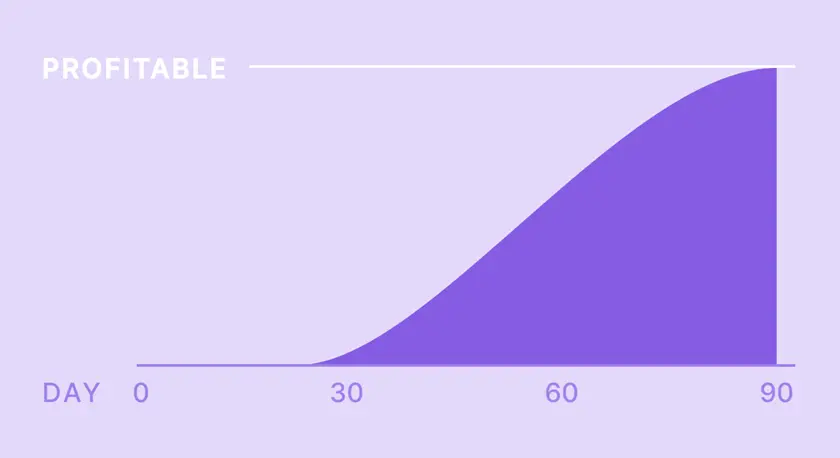
From our internal analysis, the ROAS curve runs from day 0 to day 92 and is still rising at the end.
Subscription revenue compounds as trials convert to paid and cohorts renew, so a campaign that looks underwater after a week can be solidly profitable by day 60.
The shape of the curve, not the day-7 reading, is what tells you whether a campaign works.
Why measuring at day 7 kills good campaigns
You read ROAS at day 7 or day 14 and you’re looking at the curve near its flattest, lowest point.
You see a number well below breakeven, conclude the channel is unprofitable, and turn it off. The revenue that would have arrived in weeks 4 through 12 never gets counted, because you cut the campaign way before that window.
Short measurement windows don't just underreport payback. They cause teams to abandon campaigns that were on track.
How to shorten Apple Ads payback
Payback isn't fixed, and you can move it in three ways.
Lower the cost of a paying subscriber
The same paying subscriber costs $15 in Brazil and $362 in Nepal.
Shifting spend toward efficient Tier 2-3 markets in Latin America and Eastern Europe may lower the cost side of the payback equation directly.
Benchmark against some better performing, underutilized markets and test them out if you have the budget.
We cover which markets pay back in our look at the cheapest and most expensive countries for Apple Ads.
Raise conversion through the funnel
Every point of conversion you add shortens payback, because each dollar of spend produces more paying subscribers.
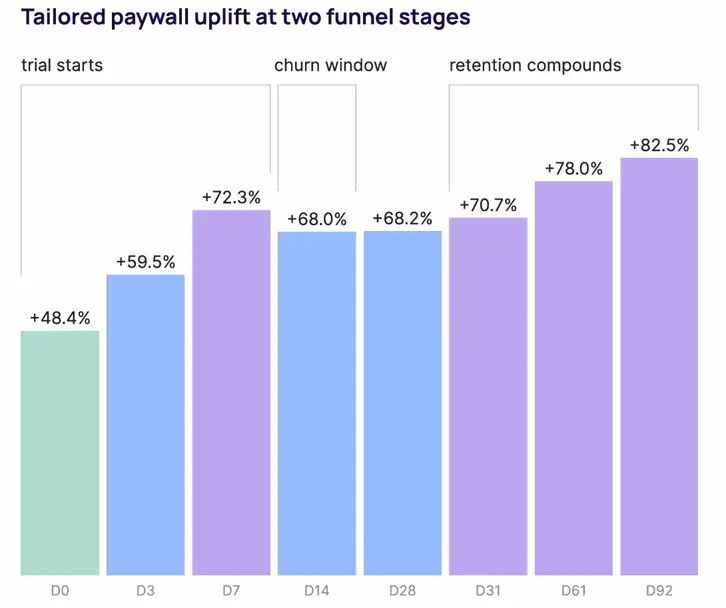
We found that Custom Product Pages lift downloads 23% on the same spend, and tailored paywalls lift install-to-trial 41% and trial-to-paid 24%.
Those compound into more paying users from the same ad budget, which pulls the breakeven date forward.
Measure long enough to see the payback
The cheapest lever is patience.
Extend your measurement window to day 60 or 90 before judging a campaign, because that's when subscription revenue kicks off.
A campaign that looks unprofitable at day 14 is often profitable by day 60, and the only way to know is to measure that far out.
How fast can Apple Ads payback actually happen?
Fast, when the funnel is built for it.
An AI video app spent a full 93-day window never reaching breakeven, even at day 366. The channel was producing cheap installs and almost no paying subscribers, because every user hit the same generic paywall regardless of what they searched for.
After rebuilding the funnel with Adapty, matching paywalls to the keyword intent behind each search, the same channel crossed breakeven on day 61.
Net revenue grew 218% while ad spend scaled 63%, paid subscribers grew 3.8× at 57% lower cost per subscriber, and the app expanded from 3 market groups to 57 countries on the same unit economics.
💡📈 Another payback turnaround: Glam AI Glam AI was waiting 2-3 months to break even on Apple Ads. By restructuring its campaigns by country and cutting wasted broad-match spend, the team pulled break-even inside the first week and grew net revenue 211% on 5.5% less spend. Read the Glam AI case study.
How Adapty helps you measure Apple Ads payback
Apple's dashboard can't show you payback, because payback is a revenue-over-time question and the dashboard stops at the install. It shows you what a tap cost. It can't show you when, or whether, that tap turned into a subscriber who paid you back.
Adapty Apple Ads Manager extends attribution past the install to the trial, the subscription, the renewal, and the lifetime value behind every keyword, campaign, and country. It tracks cohort ROAS out past day 90 and predicts LTV before a user completes their first month, so you can see a campaign's payback trajectory early instead of guessing at it from a day-7 number.
ℹ️ 📊 See your payback curve, not just your day-7 ROAS Adapty Apple Ads Manager ties Apple Ads spend to trials, subscriptions, renewals, and cohort LTV by keyword, campaign, and country, so you can watch a campaign's ROAS climb toward breakeven instead of killing it on an early reading.
What this means for your Apple Ads strategy
Apple Ads profitability is a curve, not a date. The biggest mistake isn't a high cost per tap or an expensive market. It's reading the curve too early and killing a campaign that was on its way to breakeven.
Measure to day 60 or 90, lower the cost of a subscriber through market mix, and raise conversion with matched pages and paywalls. To see your payback trajectory keyword by keyword instead of guessing from an early ROAS reading, try Adapty for free.