
Glam AI

Welmi
Highlights
- Net revenue grew 218% while ad spend scaled 63%
- Paid subscribers grew 3.8x at less than half the acquisition cost
- Active markets expanded from 3 geo groups to 57 countries
AI Video is a top-tier app in the AI video generation category, with strong organic demand and a recognizable name in the App Store. The app turns text prompts and images into AI-generated videos, animations, and short-form visual content.
The team was investing in Apple Ads to drive demand into paid growth, and while the installs increased, the revenue remained behind. Three months later, after rebuilding the funnel with Adapty, the channel was profitable for the first time.
This is what changed.
A high-intent channel running into a one-size paywall
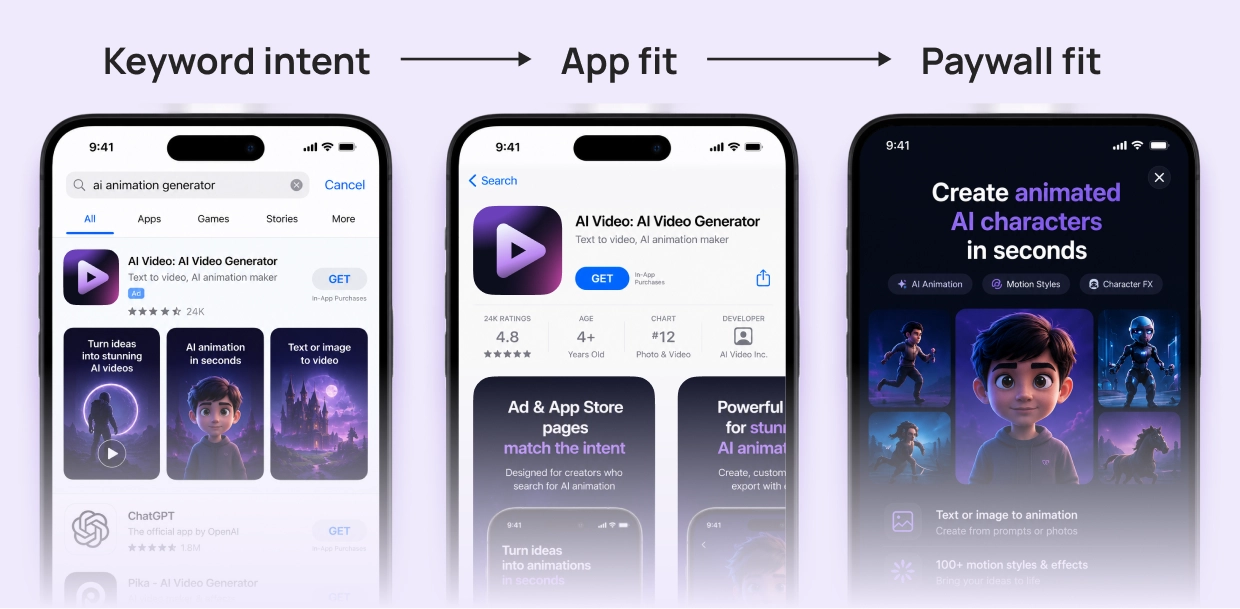
Apple Ads was doing its job as a traffic source. Users were typing the highest-intent queries in mobile UA, “AI video generator”, “text to video AI”, “AI animation”, finding AI Video, and installing. Apple’s attribution framework made the search keyword available on the first app open.
The monetization layer wasn’t using any of it. Every install hit the same onboarding and the same paywall. A user searching for an AI animation maker and a user searching for an AI photo editor saw an identical screen.
The numbers across that first 93-day window tell the rest of the story:
- Volume showed up, but paying users didn’t.
- ROAS never reached breakeven, even after a full year on day 366.
- Cost per paying subscriber made scaling mathematically impossible. Every new dollar spent widened the loss.
- Geographic expansion was stuck. Every new market just scaled the losses.


The team had the right channel and the right users. The screen in between needed the work, specifically, the 30 seconds after install, where intent gets converted or wasted.
Carry the search signal all the way to the subscribe button
Adapty replaced the one-paywall-for-everyone setup with three pieces working together: campaign management, keyword-level revenue tracking, and paywalls that match the intent behind the search.
Doing this without Adapty means stitching three separate vendors together: an Apple Ads management tool, an MMP for attribution, and a paywall A/B-test tool. The engineering work to wire them up usually costs more than the lift the team expects to get back. Most subscription teams look at that math and skip the project.
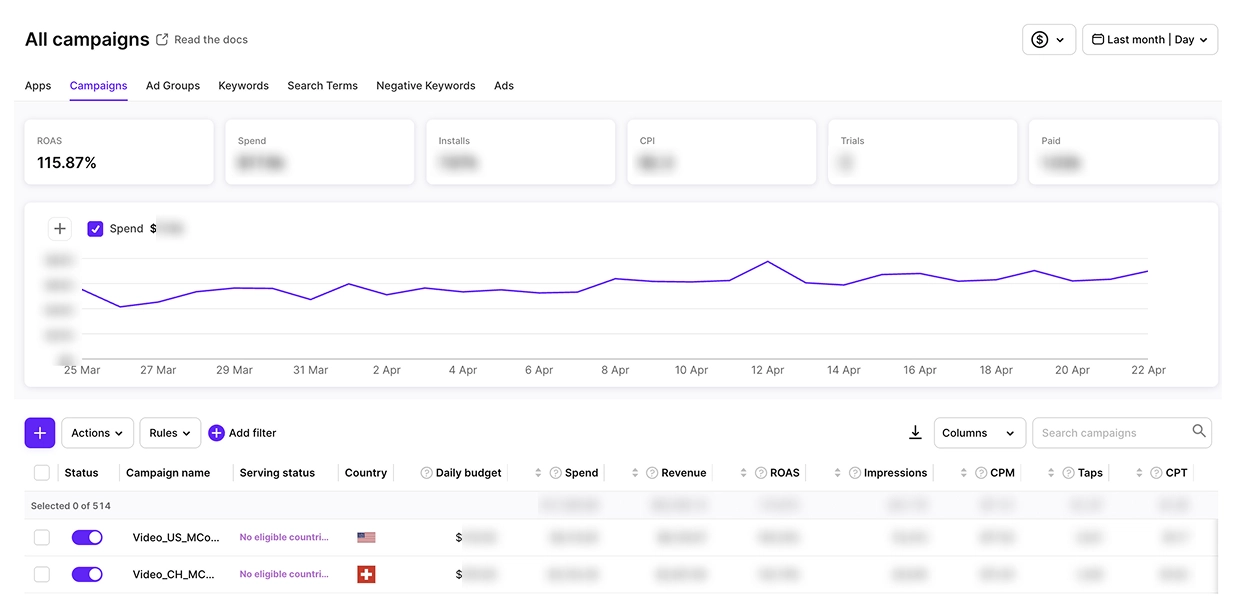
Apple Ads campaign management, in the same dashboard as the paywall
The team runs Apple Ads campaigns directly through Adapty Ads Manager: bids, budgets, keyword expansion, and geo splits. Rule-based automation handles keyword lifecycle actions — enable, pause, or add as a negative without manual reconciliation. That’s how 514 active campaigns stay operable without a dedicated team behind them.
The Overview Page puts every campaign-layer change in the same view as the revenue it produced. The “what changed” and the “what it earned” sit next to each other, in the same product, on the same dataset.
Going from 3 geo groups to 57 country markets used the same machinery. Market Intelligence surfaces competitor keyword data and search demand for new markets in the same dashboard, so building the keyword list for a new country took minutes instead of weeks. Each new market is a campaign, not an integration.
Keyword-level revenue, no MMP
Apple’s native dashboard stops at install. Adapty extends attribution past install to trial, subscription, renewal, and lifetime value per keyword, per ad group, and per campaign. This is what makes keyword-to-paywall attribution possible: the same identifier that triggered the ad impression carries through to the paywall the user sees, and onward to the subscription event.
The team can see which search terms produce paying subscribers and which produce installs that never convert. That’s the prerequisite for spending intelligently. Without it, ROAS is one aggregate number with nowhere to push on.
Paywalls matched to keyword intent
The paywall a user sees depends on the intent cluster behind the search:
- A user who searched “AI video generator” sees a paywall leading with video creation, AI video templates, and output quality.
- A user who searched “text to video AI” sees the text-to-video flow on top, with prompts and example outputs.
- A user who searched “AI animation” sees a paywall built around motion, animation, and character generation.
- A user who searched “AI photo editor” sees photo editing features first, with video as the upsell.
The team didn’t build a unique paywall for every keyword. AI Video runs three to five intent buckets, each mapped to a cluster of related queries. That’s the Pareto point: enough differentiation to match the top-of-funnel intent, few enough variants to stay manageable.
The whole funnel, from keyword detection to paywall assignment, was configured in Adapty’s dashboard in days, with no changes to the app codebase.
Revenue tripled. And the ROAS curve hasn't flattened
Two equal 93-day windows: the baseline and the Adapty period. All revenue figures are net of Apple’s commission and country-level taxes.
The ROAS gap widens over the life of a cohort
ROAS doubling is the headline. The sharper finding is what happens to that gap as a cohort ages.
If the lift were only about showing a better paywall at checkout, the gap between the two periods would stay flat across the cohort. Instead, it grows. The biggest improvement is at day 28 and beyond. Intent-matched users not only subscribe more often. They stay subscribed longer.
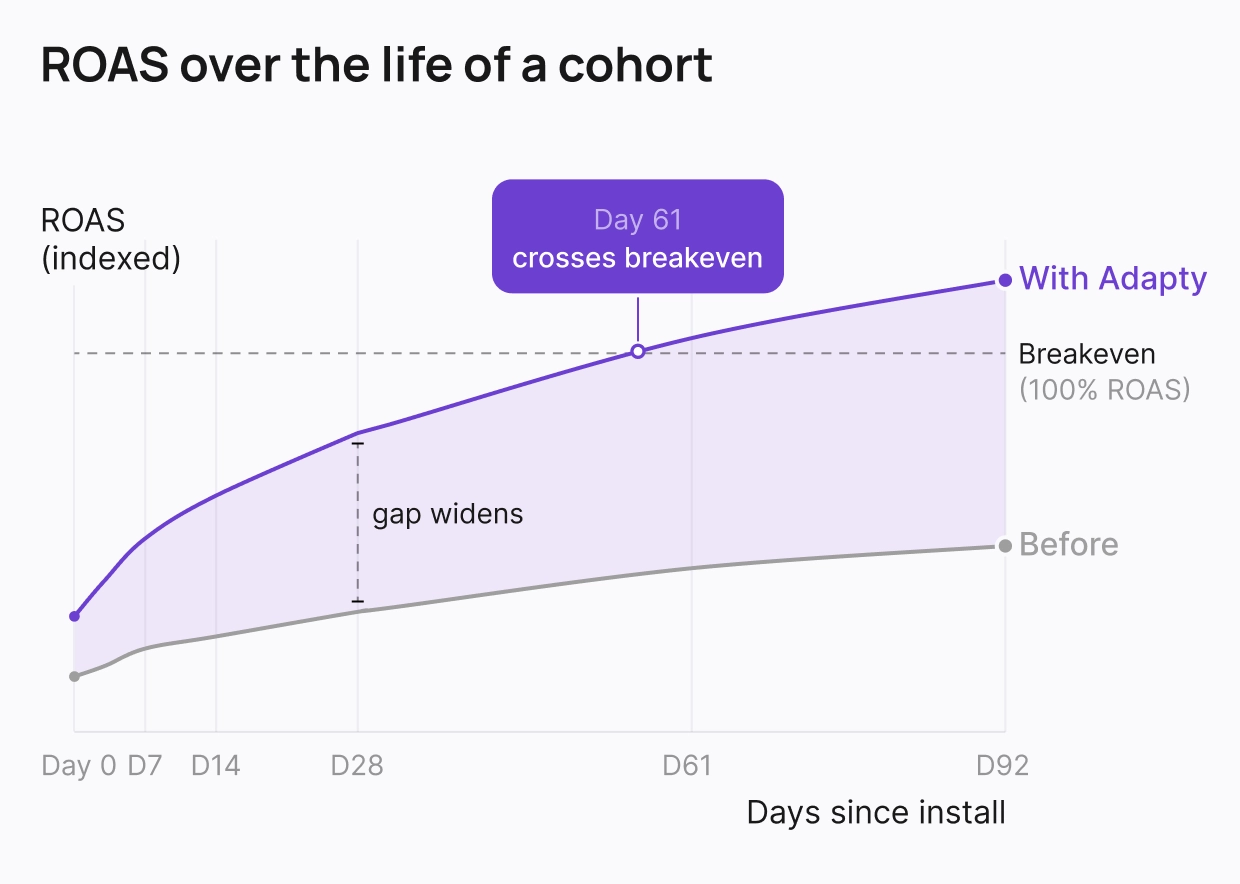
The same compounding shows up inside each cohort. In both periods, revenue per install kept growing from day 0 to day 92, but the Adapty cohorts grew faster. Higher starting point, steeper slope. The same users who convert better at install keep paying better three months in.
The period before never reached breakeven, even at day 366. The Adapty period crossed breakeven on day 61, and the curve was still climbing by day 92.
Why the channel could scale 63% without breaking
On Apple Ads, the allowable CPC is a function of how much revenue each tap produces downstream. When install-to-paid is low, the ceiling is low, and any bid increase pushes the channel further into the red. When install-to-paid lifts and the users retain better, the ceiling moves with it.
The bidding headroom came from the paywall work. Better paywalls produced better revenue per tap, and better revenue per tap raised the CPC ceiling. Once the funnel could absorb higher CPCs, the real constraint shifted from “does the math work” to “how much search volume exists in this market.” That’s why the team opened 57 country markets without breaking unit economics.
You don't fix Apple Ads in the ad account
Most Apple Ads playbooks live in the ad account. Better keywords. Tighter match types. Smarter bids. Those matters are worth doing. They also have a ceiling, and the ceiling is set by what happens 30 seconds after the install.
The keywords were already producing high-intent installs. AI Video’s turnaround came from connecting those keywords to the paywall the user actually needed, and from having the visibility to see that the connection worked.
The funnel is the strategy. The ad account is the input.
If you’re spending on Apple Ads and the installs are cheap but the conversions aren’t moving, the ad account isn’t where the fix lives.