Cheapest and most expensive countries for Apple Ads in 2026 (and why cheap isn't always better)

TL;DR:
The five most efficient markets: Paraguay, Costa Rica, Guatemala, Indonesia, and Brazil deliver 65 to 76 paying subscribers per $1,000. The US delivers 15.
A good market is cheap to enter and converts through trial and paid. Cheap-but-leaky markets fail the second test.
Speak to Apple Ads buyers and it’s Groundhog Day.
Most pour budgets into the US, the UK, and a handful of high-end (Tier-1) markets. Those are the markets with the most users and the most expensive auctions.
The instinct is that the expensive markets must be the valuable ones.
To test that instinct, we looked at our own data: 1M+ Apple Ads ad groups across 90 countries.
The data says that it’s complicated. We mapped the cheapest and most expensive Apple Ads countries, and the cost ranking alone won't tell you where to spend.
Where do Apple Ads cost the most, and the least?
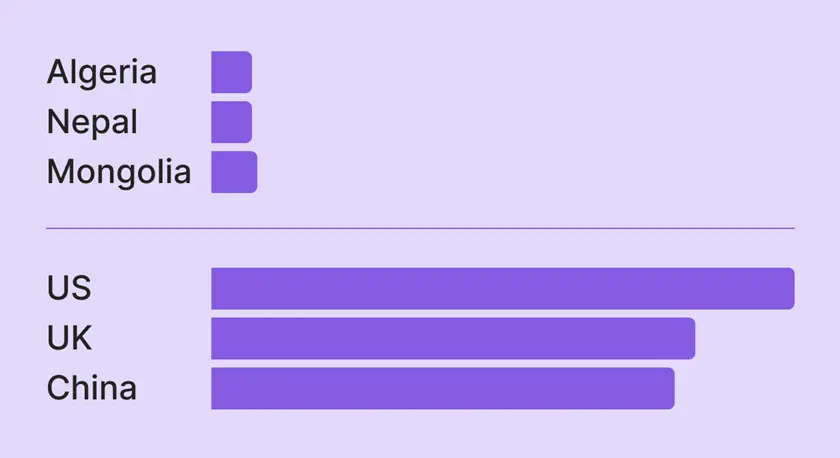
Cost per tap varies 14× across 90 markets.
A tap in the US costs $1.58. The same tap in Algeria costs $0.11. The same dollar buys fourteen times more taps in the cheapest market than the most expensive one.
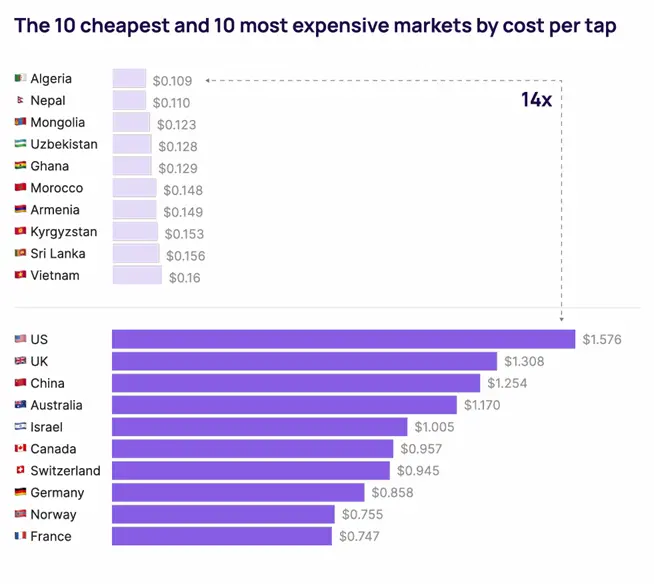
- The ten cheapest markets by CPT are Algeria, Nepal, Mongolia, Uzbekistan, Ghana, Morocco, Armenia, Kyrgyzstan, Sri Lanka, and Vietnam, all under $0.16 per tap.
- The ten most expensive are the US, UK, China, Australia, Israel, Canada, Switzerland, Germany, Norway, and France, ranging from $0.75 to $1.58.
That spread is the starting point for a market decision, but it’s not the end.
A cheap tap tells you what entry costs. But do those taps convert to downloads, trials, or paying subscribers? This data doesn’t say it.
That comes later in the funnel, and it's where cheap markets often fall apart.
💡The full 90-country table with CPA, TTR, and conversion rate is in our Apple Ads benchmarks 2026.'
Why do teams overspend in expensive markets?
Everyone wants to cast a wide net where there’s plenty of fish.
The US, UK, and other tier-1 markets have the most users, so they attract the most spend.
The expensive auction is partly a crowd effect: everyone bids on the same large markets, which bids the price up further.
The assumption underneath is that expensive means valuable. The data doesn't support it.
The US sits at $48 year-1 LTV, 15th on the list of 90 markets and barely above the global median. Acquisition budgets pour into a mid-pack LTV market because the audience is large, not because the per-user economics are best.
Several Tier 2-3 countries deliver per-user economics that rival or beat US spend over time. From our data, the likes of Guatemala, Costa Rica, and Croatia all clear $50 in year-1 LTV.
Emerging markets are not synonymous with low value, which is the first assumption a cost-only view gets wrong.
Why isn't the cheapest tap automatically the best market?
Because a cheap tap can leak at every stage after it.
CPT is the first number in a funnel, not the whole funnel. A market with a $0.15 tap and a broken conversion rate produces expensive subscribers despite cheap traffic.
What settles whether a cheap market is a good one? The cost per paying subscriber metric. A country CPA divided by install-to-paid rate.
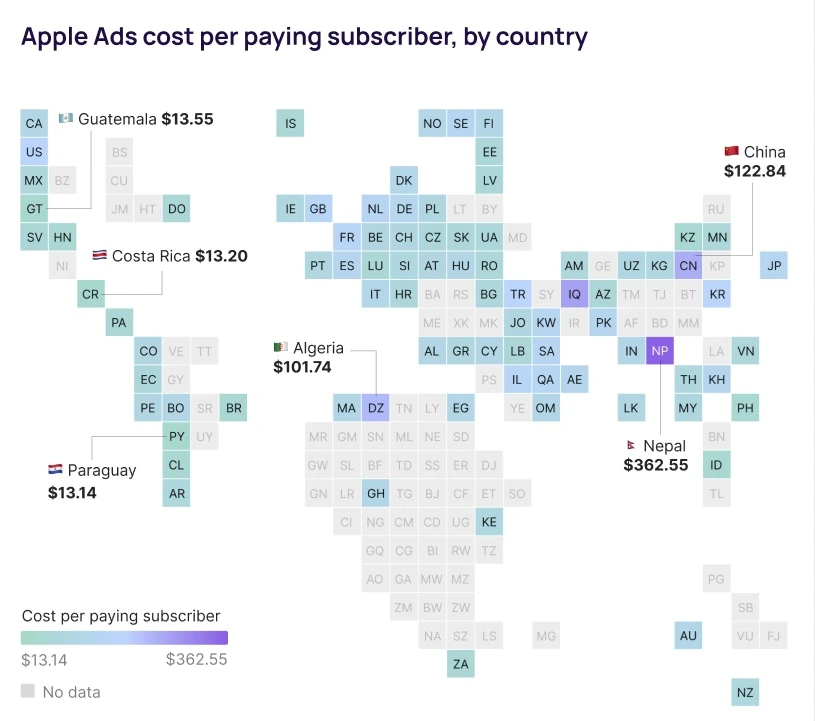
- Brazil delivers a paying subscriber for $15.36 and pays back for any app with $20 LTV.
- Nepal, despite some of the cheapest taps in the dataset, costs $362.55 per paying subscriber because the funnel collapses after the tap.
The 24 cheapest markets cost under $20 per paying subscriber, with Guatemala, Costa Rica, and Paraguay all under $14.
These are the markets where cheap taps and a working funnel line up, which cheap taps won’t deliver.
Which markets deliver paying subscribers efficiently?
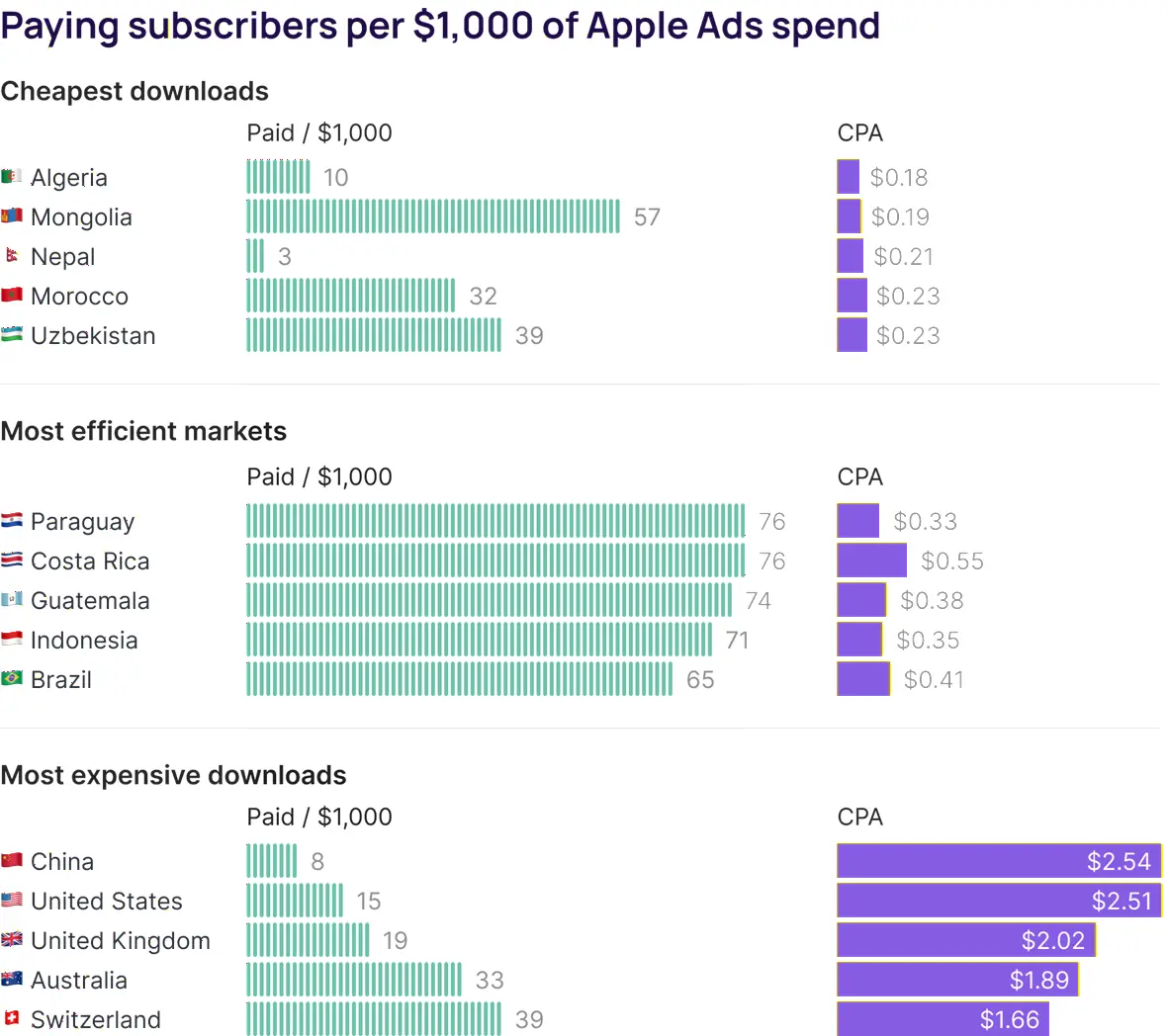
Five Tier 2-3 markets deliver 65 to 76 paying subscribers per $1,000 of spend**:** Paraguay (76), Costa Rica (76), Guatemala (74), Indonesia (71), and Brazil (65).
The US delivers 15. The UK delivers 19. Both fall well short of Brazil.
The markets with the cheapest taps don't top this list. Algeria's $0.18 download produces only 10 paying subscribers per $1,000; Nepal's cheap taps produce 3.
They're cheap to enter and leak almost everything after. The efficient markets cluster in Latin America and Eastern Europe, which most Apple Ads campaigns barely touch.
I now focus mostly on Tier 2-3 countries, from Eastern Europe to South America. The concern is that non-US geos may not deliver comparable LTV, but lower LTV is consistently offset by even lower acquisition costs. The only thing you need is ROAS above 100%.
How do you read cost and conversion at the same time?
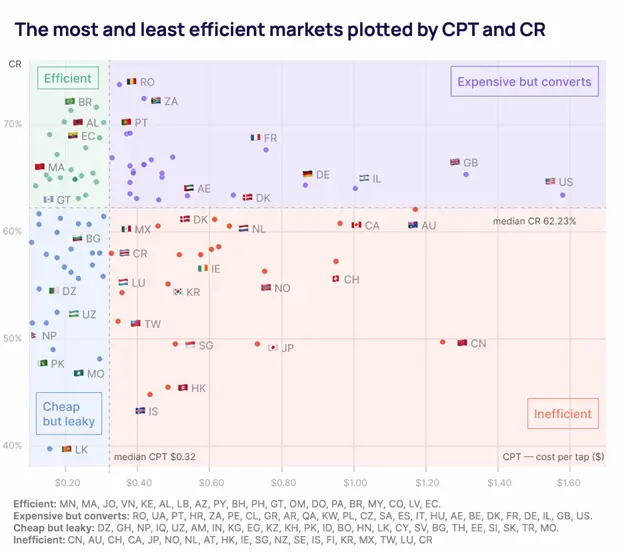
Plot every market on two axes: cost per tap and conversion rate, and four quadrants appear.
Each one calls for a different decision.
- Efficient (low cost, strong conversion). The expansion targets. Brazil, Colombia, Paraguay, and most of Latin America sit here. Cheap to enter and the funnel holds. This is where underused opportunity lives.
- Expensive but converts (high cost, strong conversion). Priced correctly. France, Germany, the UK, and the US sit here. The auction is expensive, but the funnel earns it back if your LTV supports the cost. Not a problem to fix, a price to weigh.
- Cheap but leaky (low cost, weak conversion). The trap. Algeria, Nepal, and Egypt have cheap taps and a funnel that drops most of them. The CPT looks great and the cost per paying subscriber is terrible.
- Inefficient (high cost, weak conversion). Avoid or fix. China, Japan, and Hong Kong pay premium prices without premium conversion. The worst of both axes.
A market has to clear both axes to be worth entering. Cheap alone lands you in cheap-but-leaky.
How to choose your next Apple Ads market
You can turn this framework into a market decision in 5 steps:
#1 - Start with cost per paying subscriber, not cost per tap.
CPT tells you what entry costs; cost per paying subscriber tells you what a customer costs.
Rank your candidate markets on the second number. If a market isn't in the report, estimate it as CPA divided by install-to-paid rate.
#2 - Check that the funnel holds before you scale.
A cheap market that converts taps to downloads but loses them at trial or paid is a cost trap.
Run a small test budget first and watch install-to-trial and trial-to-paid, not just CPT, before committing real spend.
#3 - Match the market to your LTV
A $20 cost per paying subscriber works if your LTV is above $20.
The efficient Latin American and Eastern European markets pay back for most apps; the expensive Tier-1 markets only pay back if your LTV is high enough to carry them.
#4 - Run a separate campaign per country
Bundling countries hides the per-market economics that decide everything here.
A dedicated campaign per market, even small ones, lets you read and optimize each funnel on its own.
For example, it lets you localize the Custom Product Page and paywall to each market rather than serving everyone the same English page.
ℹ️📈 [Our report shows](https://adapty.io/apple-ads-for-subscription-apps/] Custom Product Pages matched to intent lift downloads by 23%, and paywalls tailored to the traffic source lift paying users by 76%.
#5 Reallocate from inefficient to efficient quadrants gradually.
Don't cut Tier-1 spend overnight, since it may still pay back on volume.
Shift budget toward the efficient quadrant in increments and measure cost per paying subscriber as you go.
Each of these steps needs data from past the install, which is exactly where Apple's own dashboard stops and Adapty Apple Ads Manager picks up.
How Adapty helps you find underserved markets
You can’t complete this analysis unless you connect what you pay for a tap to what happens after the install.
Apple's dashboard stops at the install, so you miss the cost-per-subscriber and ROAS math that separates a real opportunity from a cheap trap.
Adapty Apple Ads Manager tracks ROAS by country, keyword, and ad group, so you can see whether Brazil's $0.41 download pays back as well as the US's $2.51.
Market Intelligence surfaces which keywords competitors bid on in countries you haven't entered yet, and you can set ROAS targets per country and let Adapty automate bids toward them.
Try Adapty Apple Ads today.
💡🗺️ Find underserved markets and prove they pay back. Adapty Apple Ads Manager ties Apple Ads spend to installs, trials, subscriptions, revenue, and ROAS by country, keyword, and ad group, so you can compare cheap markets against expensive ones on what pays back.
Cheap taps are the start of the question
The most expensive markets aren't the most valuable, and the cheapest aren't automatically worth entering.
The market worth your budget is the one that's cheap to reach and converts through to a paying subscriber.
Most teams overspend in Tier-1 markets and underspend in the efficient Tier 2-3 markets where the ROAS math works.
To find those markets and prove they pay back before you scale, try Adapty for free.