How to run profitable ads for subscription apps?

TL;DR:
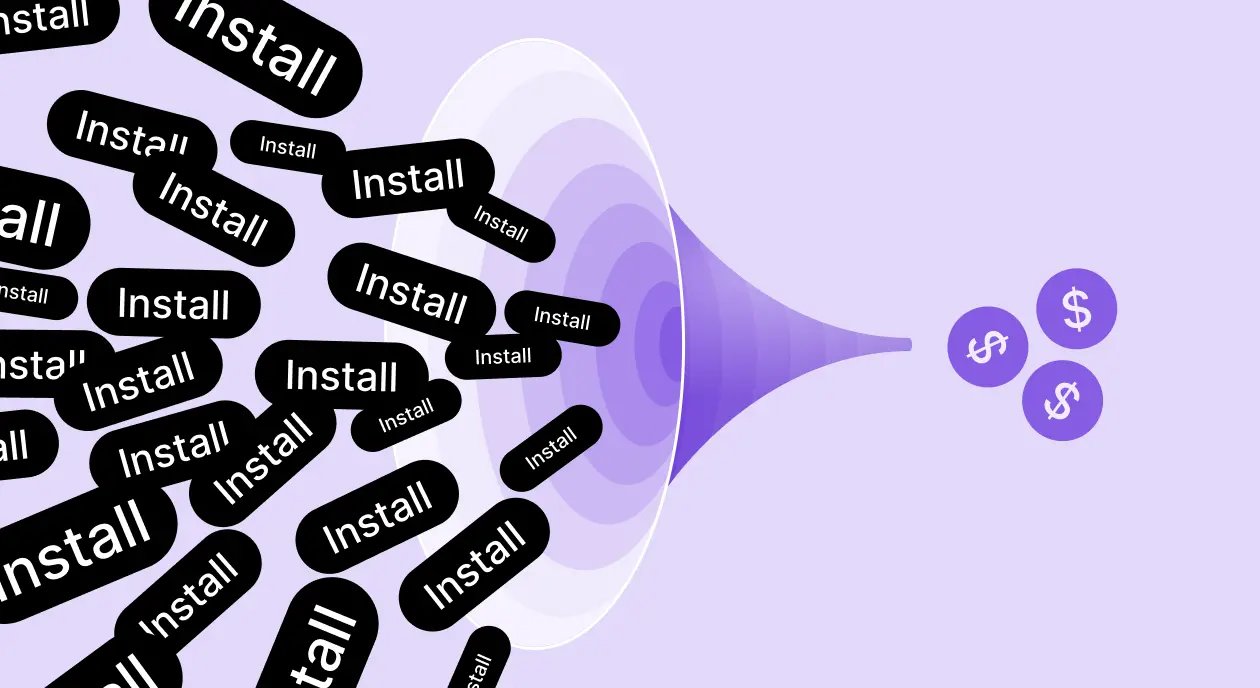
- At the median subscription app, only about 3 of every 100 installs become first-month paying subscribers.
- Ad networks can't see most of that journey, so they optimize on installs. Subscription revenue arrives weeks later, after the budget decision is already made.
- Most attribution tools pull subscription revenue from a separate system through an API sync that lags, breaks around trials and refunds, and quietly disconnects campaign-level numbers from what your billing platform shows.
- Adapty UA reads subscription events from the same SDK that runs your revenue, so you can see and predict which campaigns pay back and feed real revenue signals back to Meta and TikTok.
Are you scaling a subscription app on channels like Meta and TikTok?
Even with an MMP in place, you've probably noticed your attribution dashboard and billing dashboard tell different stories about the same campaigns.
Your revenue syncs are lagging, and numbers don't match. Trial events may arrive late or with wrong data. Sometimes, they don’t arrive at all.
You're making budget decisions on data that isn't telling you the full story.
Why doesn't your MMP's revenue data match your billing?
MMPs solved a part of the problem. They sit between your app and your ad networks and provide cross-network attribution.
It’s a robust infrastructure, but it’s built for the broad mobile app market. Subscription apps work differently.
Subscription revenue reaches them through a third-party API sync; your subscription platform pushes events out, the MMP joins them to attribution data, and you hope nothing breaks.
Often, something does. Especially around trials, renewals, and refunds as the system optimizes for two different things:
- Subscription apps run on renewals.
- Ad networks optimize for installs because installs are what they can see.
The fix isn't a better sync. It's no sync at all: attribution and subscription revenue in one system, recorded together, with nothing to drift between them.
At the start, the dashboard looks right since the install and trial starts to sync fine. The break happens later with the trial-to-paid conversion, the renewals, and the refunds. Those fire server-side, after the app is closed, and reach the MMP through an external sync that lags or drops them. Nobody gets an error. The numbers slowly drift from billing by 5 to 15 percent, and by the time anyone realizes, the team already made the budget call on that cohort weeks ago.
What is subscription-native attribution?
Adapty UA is an attribution solution built for subscription apps.
What it does: It captures clicks, matches installs to campaigns, ad sets, and creatives, with one difference: the subscription events are already in the same system.
They flow through the same Adapty SDK, so revenue, ROAS, and LTV are native.
Key thing: Adapty UA doesn't need to replace your MMP, your data warehouse, or any other infrastructure you've already invested in.
You can run it in parallel with whatever attribution stack you have, compare the numbers, and keep what wins.
Or, if you don't have an MMP yet, use it as the attribution built into the Adapty stack you already run: same SDK as your paywalls, A/B tests, and analytics.
ℹ️The install-to-revenue drop-off is backed by data, as reported in our State Of In-App Subscriptions 2026 report: 🟣 Only 11.2% of installs become a trial. Only 27.8% of trials convert to paid. 40.8% of those churn before month two. 🟣 Every 100 installs produces about three first-month paying subscribers — and fewer than two by month two. 🟣 The median install is worth ~$1 in first-year revenue. Median iOS cost per install: $4–$5. An install only pays back downstream. 🟣 90% of trials start on Day 0; only 44.5% of paid conversions do. You see the revenue truth only after you've already made the budget call.
The benefits of subscription native attribution
Here's what Adapty UA gives you that install-based reporting can't.
Go beyond installs and see which campaigns produce paying subscribers
At the median subscription app, only 27.8% of trials convert to paid. And the campaigns that win on cost per install are rarely the ones that win on paid conversions.
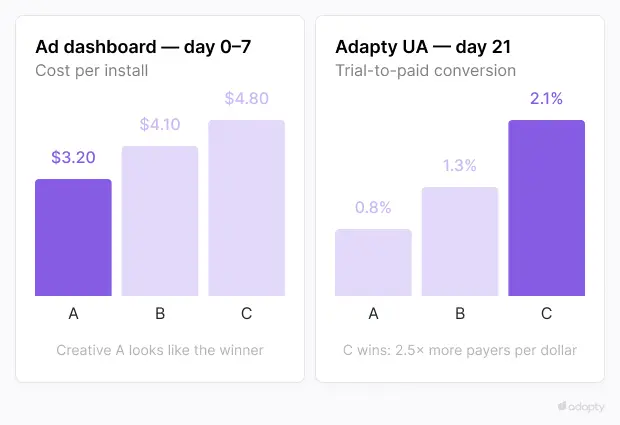
Say you run a Meta campaign with three creatives: Standard reporting shows Creative A winning on cost per install: $3.20 versus $4.10 and $4.80.
Creative A looks like the winner, so you move the budget toward it.
Three weeks later in Adapty UA, you look at the same cohort: Creative A converted to paid at 0.8%; Creative C at 2.1%.
The "expensive" creative produced 2.5x more paying subscribers per dollar, and you'd never have seen it. The cheap creative was bringing in users who installed and never paid.
You can only make that call when trial-to-paid conversion, cohort breakdowns, and ad spend live in the same view.
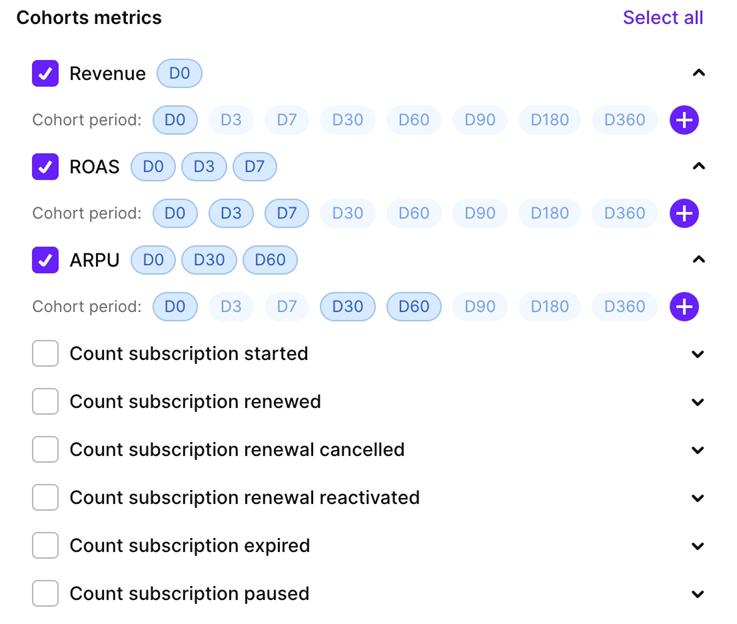
See real cohort ROAS and LTV, with nothing to reconcile
Subscription revenue keeps moving for months: through trials, conversions, renewals, and churn.
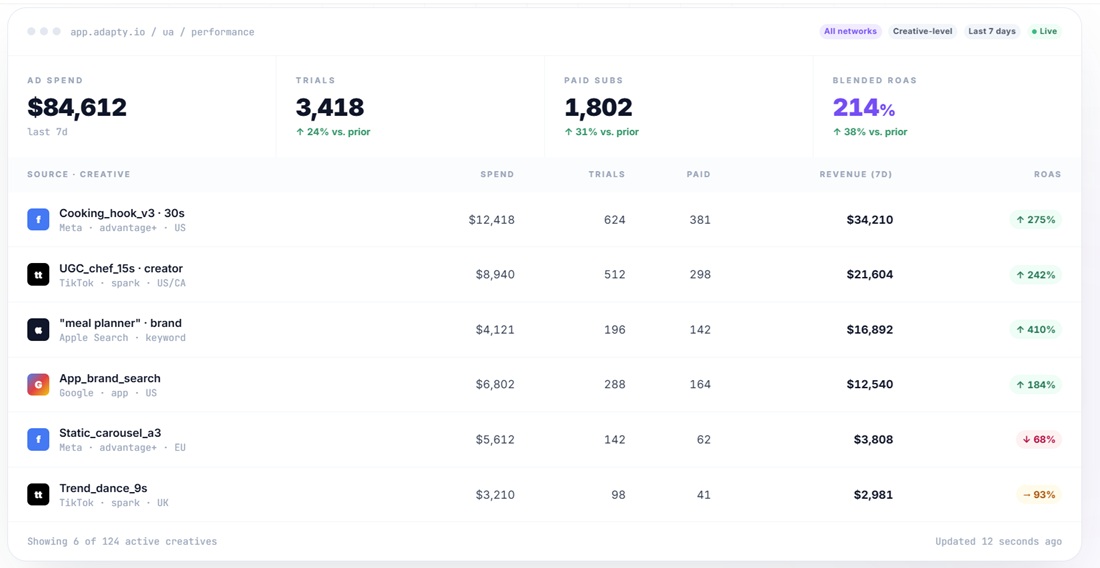
Adapty UA shows ROAS and LTV at the cohort level, sliced by campaign, ad set, and creative, so you can see which creative brings subscribers who renew.
You get real subscription revenue, unified with ad spend in one dashboard.
No manual reconciliation between attribution and revenue tools, because the revenue data is already in Adapty.
Predict the payback for your subscription app before cohorts mature
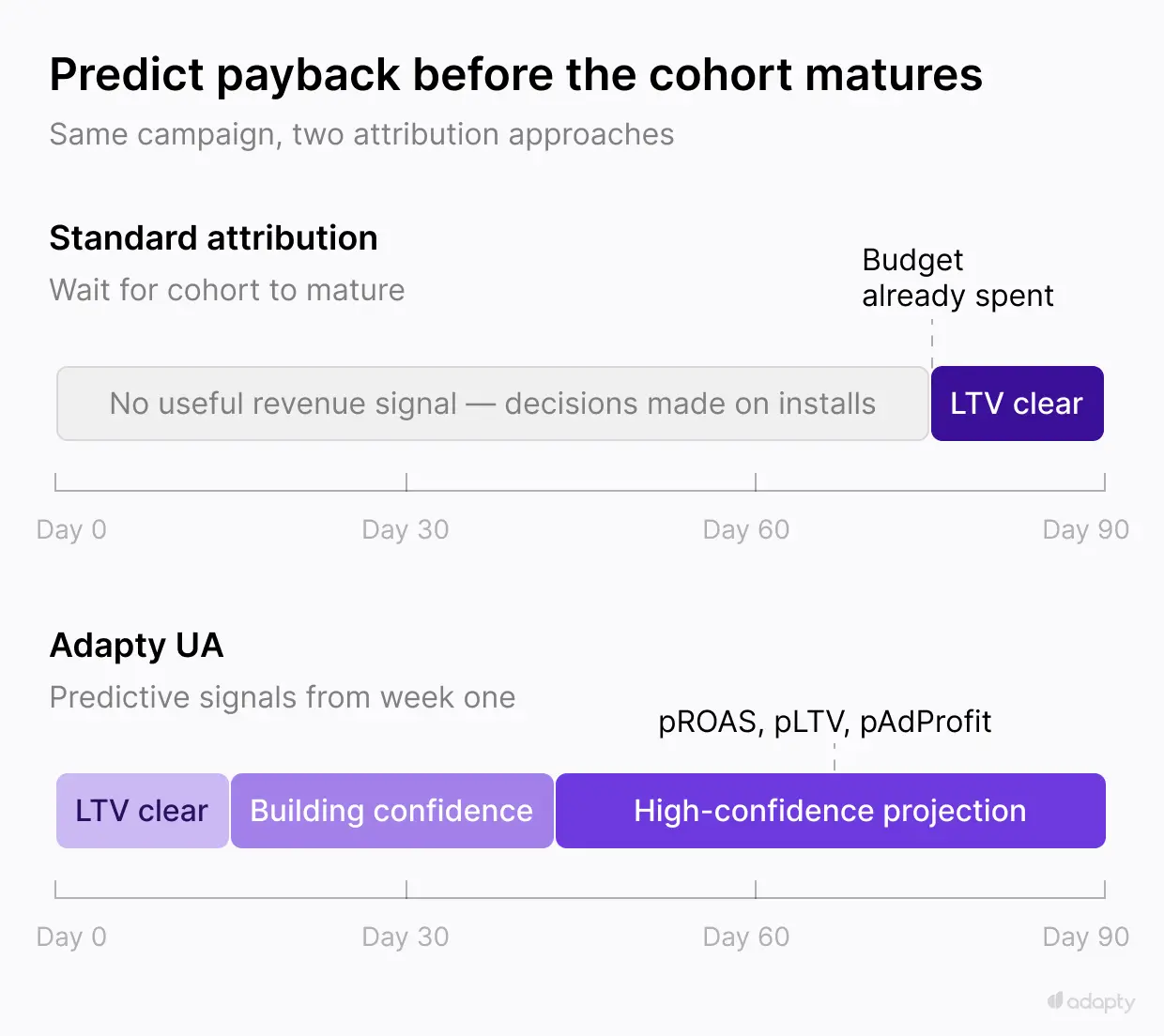
Subscription LTV takes 30, 60, or 90 days to fully play out.
By the time you know whether a campaign paid back, you've already made two or three more budget decisions on it.
Unless you use Adapty UA to map this out in time. It combines projected ROAS, projected LTV, and projected ad profit at the cohort level.
Each metric maps your campaign's early-cohort behavior against the same $3B+ subscription dataset that powers our State of In-App Subscriptions report.
The result: you can compare campaigns and make scaling decisions before the LTV curve resolves, instead of waiting two months for the data.
For Apple Ads specifically, we've mapped how the payback curve behaves out to day 92, and why day-7 reads kill good campaigns.
Train Meta and TikTok algorithms on real revenue
Ad channels like Meta or TikTok optimize on whatever signal you give them.
If the signal is "this user subscribed and is likely to renew," the algorithm goes looking for more people like them.
Adapty UA feeds enriched subscription events back to the ad networks: qualified trials, paid conversions, predicted value—so their models optimize toward users who pay.
This closes the loop. The same revenue data that tells you which campaigns work also tells Meta and TikTok who to find next.
And the payoff compounds. A better signal means a higher-quality audience, which means more paying subscribers at a lower cost per acquisition, and every cohort sharpens the next.
Show the right paywall to the cohort that arrived
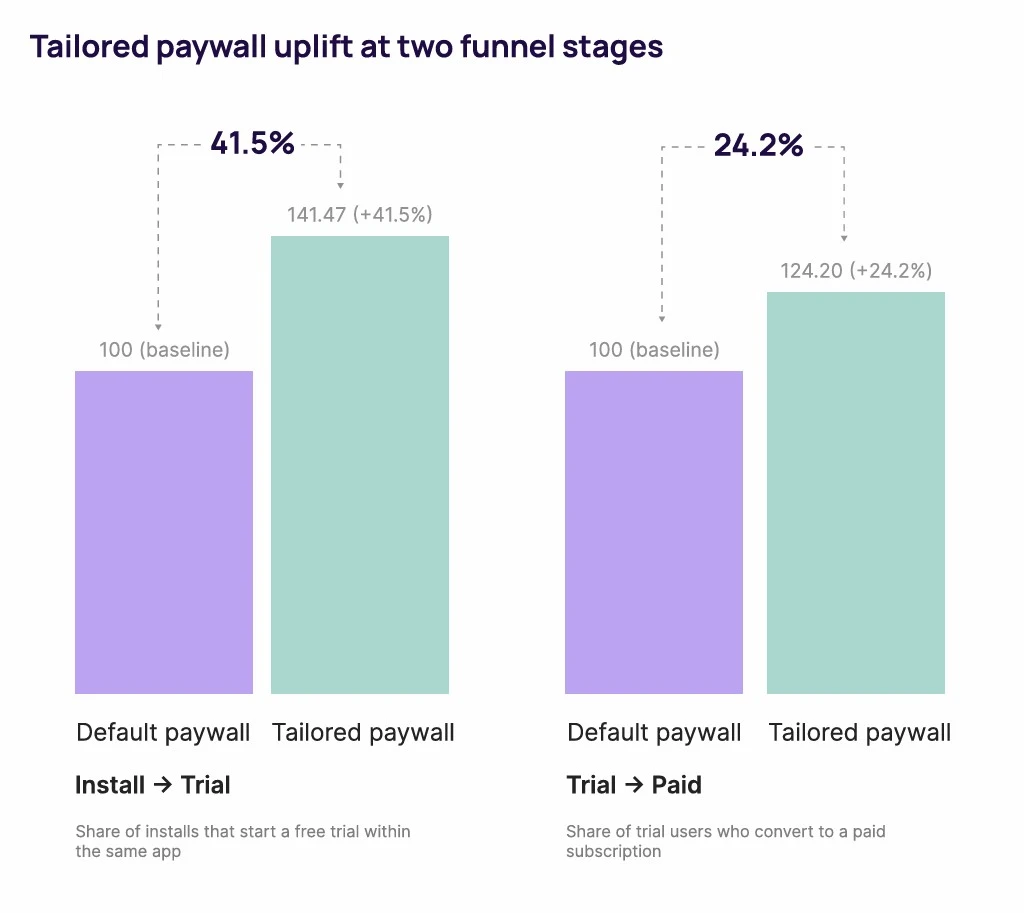
Our data found that a paywall matched to the user's intent lifted install-to-trial conversion by 41.5% and trial-to-paid by 24.2% against a default paywall.
This same principle can apply to whatever channel brought the user in.
Because attribution and paywalls run on the same Adapty SDK, you can show a different paywall based on the campaign, ad set, or creative that brought the user in.
For example
- A trial-only paywall for trial-optimized campaigns.
- Higher pricing for high-intent keyword traffic.
- Copy and design that match the ad someone clicked.
You don’t need a second vendor or integration between two systems because the targeting reads from the same attribution data that's already flowing.
What’s the mechanics behind Adapty UA?
- In the Adapty UA dashboard, you open Integrations and connect your Meta Ads or TikTok for Business account.
- Create a campaign, add your App Store or Google Play URL, and Adapty generates a Click link for it.
- Paste that link into your ad: in Meta, as the destination URL; in TikTok, in the Tracking URL field under Advanced Settings.
From there, every subscription event: trial start, paid conversion, renewal, and refund is attributed to the campaign, ad set, and creative behind it, because it flows through the same Adapty SDK that's already handling your revenue.
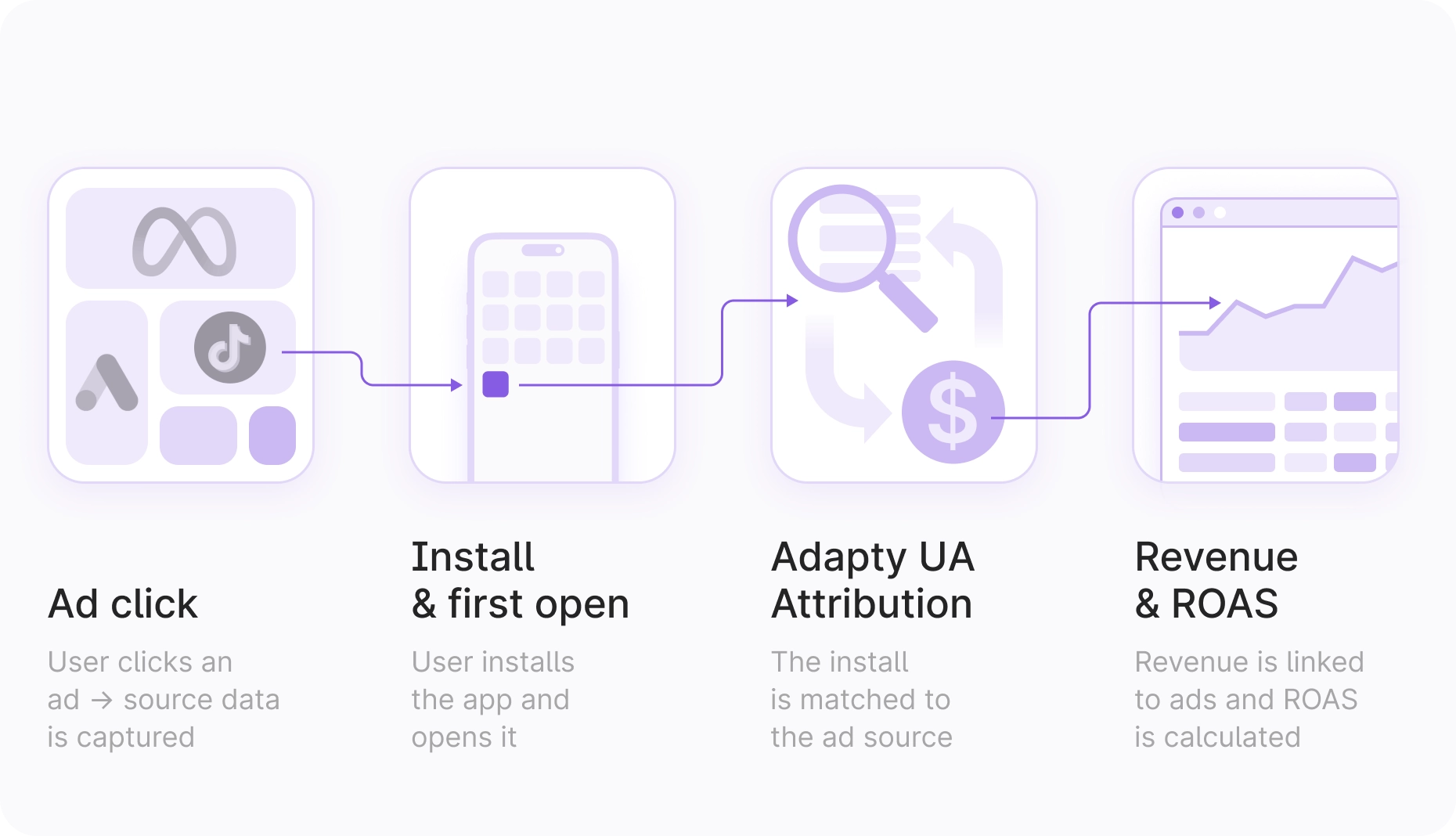
If you're already on Adapty, there's no second SDK to install and no new tracking infrastructure to maintain.
If you're not, install the SDK in observer mode—it reports events for attribution without touching your existing purchase setup.
Where Adapty UA fits in your stack
The easiest way to understand where Adapty UA sits is to look at what each tool in your stack is for.
| What it shows you | Ad network dashboards | Your MMP | Adapty UA |
| Clicks, impressions, installs | ☑️ | ☑️ | ☑️ |
| Cross-network attribution | ❌ | ☑️ | ☑️ |
| Subscription revenue truth | ❌ | partial (via API sync) | ☑️ |
| Cohort LTV by creative | ❌ | ❌ | ☑️ |
| Same SDK as your paywalls | ❌ | ❌ | ☑️ |
Each tool answers a different question: Ad networks tell you what they delivered. MMPs tell you which network gets credit. Adapty UA tells you which campaigns pay back in subscription revenue.
Most scaling subscription apps need all three. You don't have to give up your MMP to add the layer that's missing.
ℹ️If you run Web2App campaigns, the install-vs-revenue gap attribution gap is usually even wider. Web campaigns, app installs, and subscription revenue typically live in three different systems, and reconciling them across tools is its own ongoing project. Adapty UA pulls them into one place, whether you run in-app paywalls, Web2App through FunnelFox, or both.
How Welmi unified ad spend and subscription revenue with Adapty UA
Welmi, a Health & Fitness AI app, had the classic split early setup: Adapty handled subscription revenue, and Adjust handled attribution.
That meant no unified view of the acquisition-to-revenue funnel and no real-time ROAS. Plus, they had to spend extra time manually reconciling data between the two platforms.
When Adapty launched UA, Welmi was one of the first apps to sign up.
The team saw it not as a like-for-like swap, but as a chance to unify their platforms and data streams: attribution, revenue, paywalls, and A/B testing on one SDK, with campaign-level ROAS visible in real time.
The growth that followed: $60K MRR in August 2025, $150K in October, $200K+ in November.
Adapty, as a new market player, offered the same quality of attribution, but with more interesting terms. With Adjust, we were paying $0.04 per install, while in Adapty, we got $0.02 per install on the same volumes.
How to set up Adapty UA and connect your ad spend to subscription revenue
If you're already on Adapty, setup is mostly a dashboard toggle and an ad-platform connection without the need for API keys or a new SDK.
Enable User Acquisition in the dashboard, connect Meta or TikTok, and paste the Click link into your ad.
If your purchases run elsewhere, the SDK's observer mode reports events without touching your existing setup.
Full step-by-step instructions, with screenshots for each network, are in the **Adapty UA docs**.
How do your first 90 days with Adapty UA look
UA setup takes an afternoon, and revenue-connected data starts arriving within days.
The first weeks are about noticing where Adapty UA's numbers disagree with your ad dashboards. This is usually at least one creative that looked like a winner on CPI but isn't, and one that looked expensive but pays.
By the time first renewals land around day 35, you can see the real LTV shape of each campaign and start adding more budget on cohort truth.
The goal of the first 90 days isn't to overhaul your UA strategy. It's to get a clean read on which campaigns pay back.
Stop optimizing for installs alone
Installs are a useful, top-of-funnel signal.
The problem is that for a subscription app, they're the first of many signals, and the one least correlated with the metric that pays your bills.
For a subscription app, the ad worth scaling is the one that brings subscribers who pay back.
You can't see those ads in your ad-network dashboard, and an MMP only gets you partway. You see them when ad spend and subscription revenue live in the same place, which is what Adapty UA is for.
If you're already on Adapty, you can turn on UA today.
If you're not, you can connect Adapty UA alongside your current attribution stack and see how the data compares. No migration project.
Start connecting your ads to subscription revenue now with Adapty.