Apple ads vs other paid channels: when to use which in 2026

TL;DR:
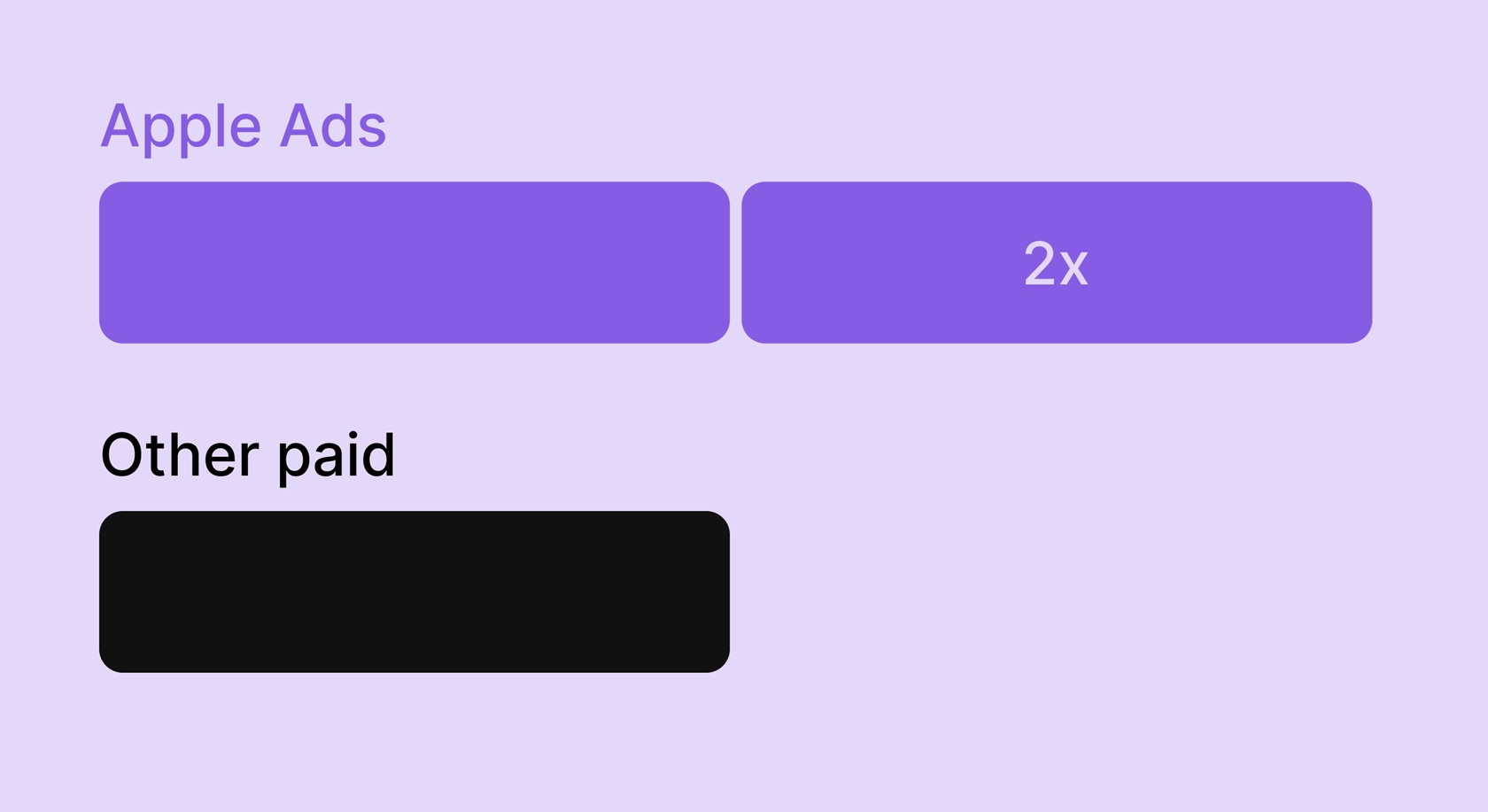
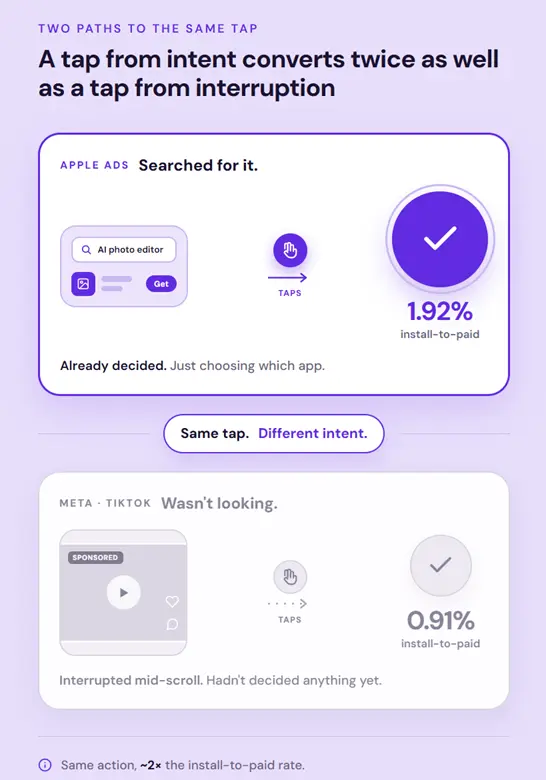
Apple Ads converts installs to paid at 1.92% versus 0.91% for other paid channels, a 2.1× advantage that comes from search intent.
But Apple Ads are capped by search volume. Meta and TikTok create demand and scale far beyond what people are already searching for.
The channels do different jobs. Apple Ads captures existing intent; Meta and TikTok generate new demand; Google App Campaigns reach across iOS and Android.
The real question is how to split the budget so each does the job it's best at.
Should you run Apple Ads, or another paid channel like Meta? That's a question a lot of teams face, especially on tighter budgets.
But is it the right question?
The two channels don't do the exact same job, so framing them as a choice misses how they work together. One captures demand, the other creates it.
We’ve looked at our internal database to see how Apple Ads convert compared to paid channels and how to decide which does which job for your app.
Which channels convert better: Apple Ads or other paid?
Across 1M+ ad groups in our latest report, Apple Ads converted installs to paid at 1.92%, more than double the 0.91% rate from other paid channels.
The gap is even wider earlier in the funnel: 3.66% of Apple Ads installs start a trial, versus 1.45% for other paid. A 2.5× difference.
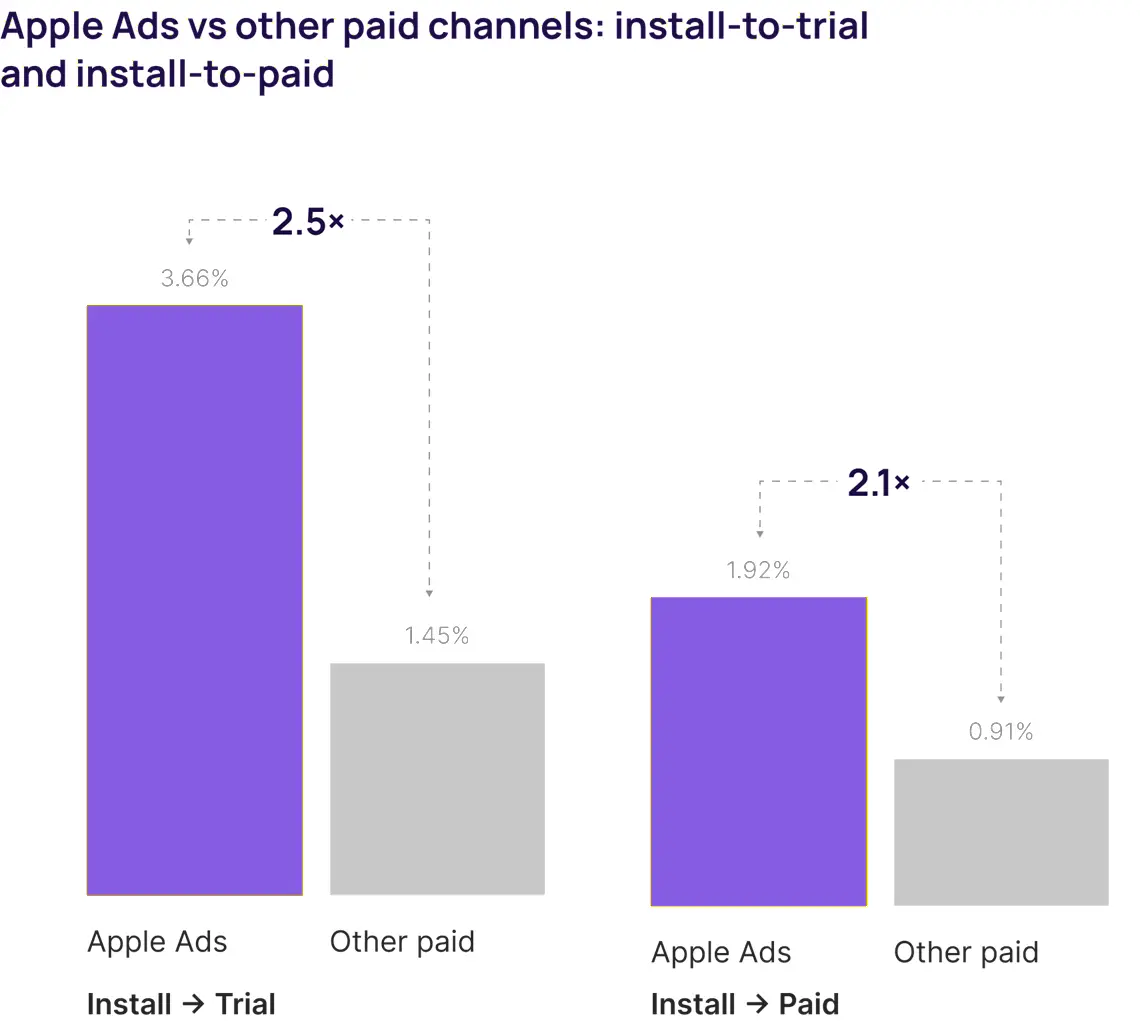
On conversion alone, Apple Ads wins, and it isn't close.
But the conversion rate is only half the picture. A channel that converts twice as well but reaches a tenth as many people is not automatically the channel you put your whole budget behind.
To use the conversion advantage well, you have to understand where it comes from.
Why is there a conversion split between Apple Ads and other paid channels?
Three structural differences explain this. But all three have their own limitations.
Apple Ads capture intent; social ads interrupt it
There’s a clear difference in intent between the two.
- People tap an Apple Ads result because they searched for something specific. Someone who typed "AI photo editor" into the App Store has already decided they want one.
- People tap a Meta or TikTok ad because it interrupted their scroll, before they ever decided they wanted the thing.
This is exactly why the Apple Ads user converts at twice the rate, which shows up at trial start where the decision happens.
The download data backs this up. Per Sensor Tower, the App Store accounted for just 14.5% of global gaming downloads and 28.3% of nongaming downloads in Q2 2025, yet captured 63.2% of gaming revenue and 73.0% of nongaming revenue.
And as eMarketer summarizes the figures, the App Store audience is smaller than Google Play's but far more valuable per user.
Apple's own data adds that nearly 65% of downloads happen right after a search, and top-position search ads convert at around 60%.
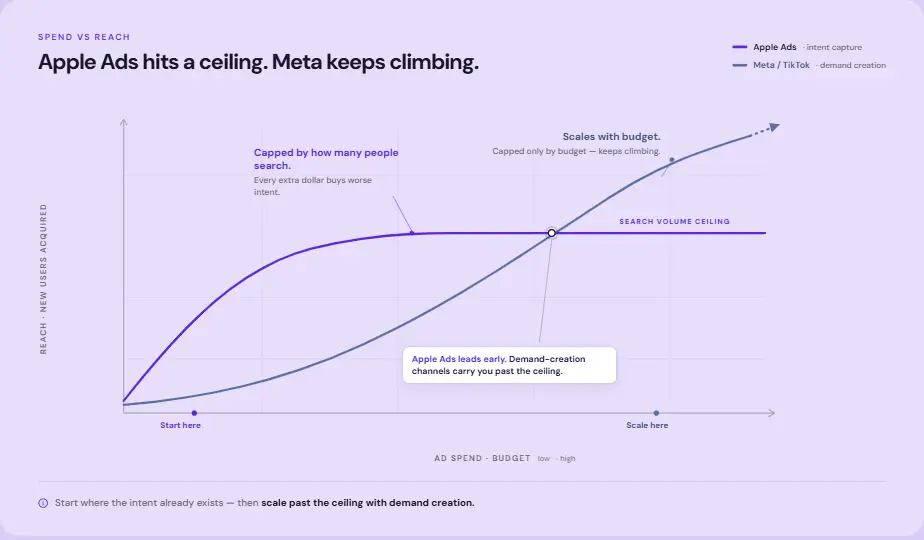
Apple Ads is capped by search volume; Meta is not
Apple Ads can only reach people who are already searching, and only so many people search for "meditation app" in a given country each day.
Once you've captured the core keywords in your category, every additional dollar buys worse intent, because the high-intent searches are finite.
You scale Apple Ads by adding countries and keywords, not by turning up a budget dial.
Meta and TikTok have no equivalent ceiling inside your addressable market. They create demand by showing your app to people who match a behavioral profile but never searched.
You scale by raising the budget and letting the algorithm find more of them.
That's why the biggest apps run enormous social budgets: it's the only way to grow past the size of the search pool.
Apple Ads has cleaner attribution after ATT
Since Apple introduced App Tracking Transparency in 2021, apps must ask permission before accessing the identifier that cross-app channels relied on to attribute installs. Most users decline.
Channels like Meta and TikTok lost much of their deterministic iOS signal as a result, while Apple Ads attributes installs with first-party data inside its own ecosystem.
Business of Apps notes that ATT and the decline of third-party identifiers have reduced the reliability of some attribution methods across the industry. On iOS, Apple Ads is the cleanest measurement you have.
When to use Apple Ads?
Apple Ads work best when you’re hitting intent and measurement together.
Use it as your launch channel: it gives the cleanest early data and the fastest read on whether your funnel converts.
Lean into it when
- You want to capture people already searching your category
- You need deterministic iOS attribution to make budget decisions
- You're entering markets where the auction is still cheap.
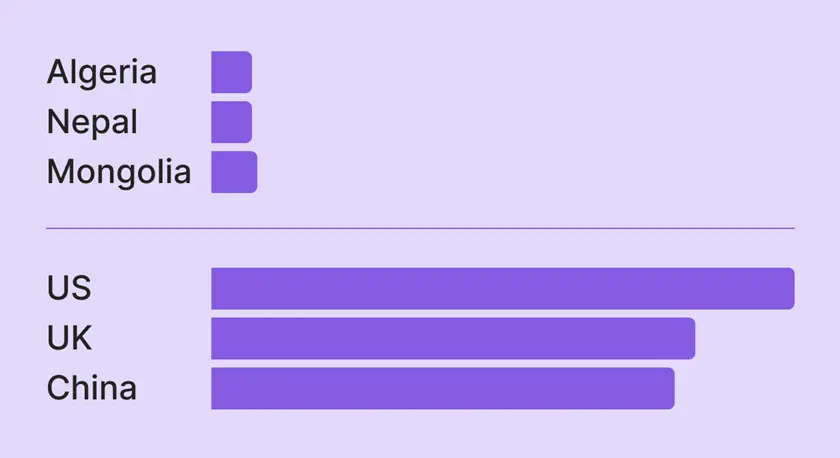
The conversion advantage is largest in emerging markets. In our data, the Apple Ads lift over other paid runs above +380% in markets like Indonesia and South Africa, and compresses to single digits in Tier-1 markets like the US, where the auction is already bid up.
Apple Ads earns the biggest share of your budget exactly where most teams underspend. We cover which markets pay back in our look at the cheapest and most expensive countries for Apple Ads.
What Apple Ads can't do is carry your whole growth target once you've saturated search. When core-keyword inventory runs out, you've hit the channel's ceiling, and that's the signal to lean on the others.
When to use Google App Campaigns instead of Apple Ads?
Google App Campaigns are the reach play when you need to grow beyond iOS or beyond pure search.
Google spans Search, YouTube, Play, and Display in one campaign type, and crucially it covers Android, which Apple Ads can't touch at all.
If your addressable market is cross-platform, Apple Ads only addresses half of it.
Use Google when you want demand capture that extends past the App Store: people searching on Google rather than in the App Store, plus discovery across YouTube and the Play Store.
It blends the intent capture of search with broader reach than Apple Ads alone, and it's the natural second channel for an app that has outgrown App Store search volume but still wants intent-led acquisition rather than pure interruption.
When to use Meta or TikTok
Meta and TikTok are the channels you reach for when you need scale and demand creation on top of demand capture.
They put your app in front of people who might not search for your category but fit the profile of someone who would pay. The only way to grow past the finite pool of people already searching.
Use them when your app has broad appeal, when you have strong video creative to work with, and when you've hit the search-volume ceiling on Apple Ads and Google.
They're also where creative does the heavy lifting: Apple Ads gives you screenshot and Custom Product Page variations, while Meta and TikTok reward video and let creative testing drive performance in a way search can't.
Mobile ad spend reached $419 billion in 2025, up 7.4% year over year, according to Business of Apps. The vast majority of that money flows through demand-creation channels, not search, because that's where the scale is.
The cost is conversion quality: an interrupted scroller converts at roughly half the rate of a searcher, which is the tradeoff you accept in exchange for reach.
How to split your budget across channels
First off, these channels aren't a competition so don’t treat them as such. They can compound.
You pause your Meta spend because Apple Ads look more efficient and it could backfire since social ads were generating the branded searches that Apple Ads was converting so cheaply.
Allocation is a portfolio decision that’s driven by two questions.
First, where are you on the scaling curve? Early on, Apple Ads gives you clean data and fast signal, so it should lead. As you scale past search volume, the mix shifts toward demand-creation channels because that's the only headroom left.
Second, what does your unit economics allow? Each channel has a different cost-to-quality profile, so the split should follow which channels clear your payback target in which markets, not a fixed percentage copied from someone else's playbook.
The practical answer for most subscription apps is to run Apple Ads and at least one demand-creation channel together, with Apple Ads anchoring iOS intent capture and Meta or TikTok supplying scale.
The right ratio depends on your category, your markets, and your payback math, which is the subject of its own guide.
How Adapty helps you compare channels on what matters
The hard part of running multiple channels is that each one's native dashboard tells a different story, measured a different way, and none of them sees the subscription revenue that arrives weeks later.
Apple's dashboard stops at the install. Meta's attribution is degraded on iOS. Comparing them on a level field is where most teams lose the thread.
Adapty ties every channel's spend to the same downstream events, the trial, the subscription, the renewal, and the lifetime value behind them, so you can compare Apple Ads, Meta, Google, and TikTok on true payback rather than on each platform's own version of the truth.
For the Apple Ads side specifically, Adapty Apple Ads Manager tracks ROAS by keyword, campaign, and country out past the install.
Adapty connects spend across Apple Ads, Meta, Google, and TikTok to the trials, subscriptions, and renewals each one actually produced, so you can split budget on true cross-channel payback instead of four dashboards that each measure differently.