How Subscription Apps Scale Meta Ads Beyond $100K


TL;DR:
- Before trying to scale Meta Ads, make sure your unit economics work. In the $100K+ accounts I’ve worked with, an LTV ratio around 2:1 to 3:1 is a common pattern.
- Keep the account simple and give Meta enough conversion volume. My operating rule at scale is roughly 10 optimization events per day per ad set.
- Build a creative system, not just individual winning ads. Test cheaply, validate on revenue, then move proven creatives into your scaling campaigns.
- Have at least one growth engine that works extremely well, whether that is creative production, product experimentation, organic acquisition, or influencer marketing.
- Do not ignore cash flow. Profitable acquisition can still stop scaling if you have to wait weeks for subscription revenue to reach your bank account.
- Your UA person should spend less time babysitting campaigns and more time on analysis, creative strategy, signal quality, and finding growth opportunities.
The three blockers I keep seeing between smaller Meta budgets and six-figure monthly spend, plus the unit economics you need before any scaling tactic matters.
I’ve worked with apps spending their first few hundred dollars on Meta Ads and apps spending six figures a month.
From the outside, the gap between those companies can look enormous. In practice, scaling Meta Ads for a subscription app usually comes down to a smaller set of problems.
The companies that reach $100K+ in monthly Meta spend tend to have solved three things: their account and creative system, the economics and cash flow behind scaling, and how their team spends its time.
Before any of those, though, there is one number I want to see.
Before you scale Meta Ads, check your unit economics
Among the apps I’ve worked with that sustain $100K+ in monthly Meta spend, the common pattern is an LTV ratio of roughly 2:1 to 3:1 or better.
That does not mean every app needs exactly the same ratio. What matters is understanding when the value of an acquired user becomes visible for your subscription model.
If you sell an annual subscription with a 7-day free trial, you get an important first read around day eight when the trial converts. If you sell annual subscriptions without a trial, you get a much stronger revenue signal on day one.
Weekly subscriptions are different. The first payment tells you very little about the user's eventual value, so retention becomes much more important. I’ve seen strong-retention products turn a roughly 50% day-zero return into 300% over the following months.
The point is simple: know how your own revenue curve behaves before deciding whether a campaign works.
And do not confuse ad spend with business success.
Spending $100K per month sounds impressive. But if you spend $100K, generate $105K after all costs, and take home almost nothing, the size of the ad account is irrelevant.
Scaling should magnify good economics. It will not repair bad economics.
Blocker 1: Your Meta Ads account and creative system
Optimize for user value, not just cheap conversions
At smaller budgets, purchase optimization and other lower-funnel events can be useful for building enough data.
At the scaling stage, though, I want Meta to understand which users are worth more, not simply which users complete the cheapest conversion.
That is why I generally move toward value or ROAS optimization once the account has enough revenue events to support it.
If your business has large seasonal or weekly swings, target ROAS can also help make spending more controlled.
The important part is volume.
My operating rule for larger accounts is around 10 optimization events per day, per ad set.
I use a daily target on purpose. Weekly totals can hide several dead days. An ad set might technically have enough events over seven days while still spending long periods with very little useful signal.
If your ad sets cannot generate enough events, simplify the account.
Keep your Meta Ads structure simple
Over-segmenting is one of the easiest ways to starve Meta of data.
I normally start by checking iOS and Android performance separately. Many subscription businesses monetize much more strongly on iOS, but that does not mean Android should automatically be ignored.
Jukebox, for example, is an app where I’ve seen Android perform strongly on its own rather than simply following the iOS business.
Check the economics before assuming one platform is better.
For geographies, one example structure I often use is:
- US
- Tier 1 English-speaking markets
- Other Tier 1 markets, separated by language where necessary
- Tier 2 markets, again separated where language or economics justify it
The reason is delivery.
Put a huge lower-cost market into the same campaign as a smaller expensive market and Meta may naturally push most of the budget toward the place where it can find cheaper results.
That is not necessarily the same place where you generate the most valuable subscribers.
Whatever structure you use, keep asking the same question: does every ad set have enough data to learn?
Send Meta better subscription signals
This matters especially on iOS.
Ad networks need early signals to understand which users they should find more of. But subscription apps often generate their most important revenue weeks or months after the original install.
So send Meta the useful subscription events you have.
If you have trials, purchases, renewals, or additional in-app purchases, make sure your acquisition setup reflects the events that actually matter to the business.
The harder question is whether every event deserves to be treated equally.
Imagine two users start a 7-day trial.
User A cancels after 20 minutes.
User B stays subscribed through the trial and eventually becomes a paying subscriber.
Technically, both generated a trial-start event. Economically, they are very different users.
If you optimize Meta toward every raw trial start, you may teach it to find more people like User A.
This is why signal quality matters as much as signal volume.
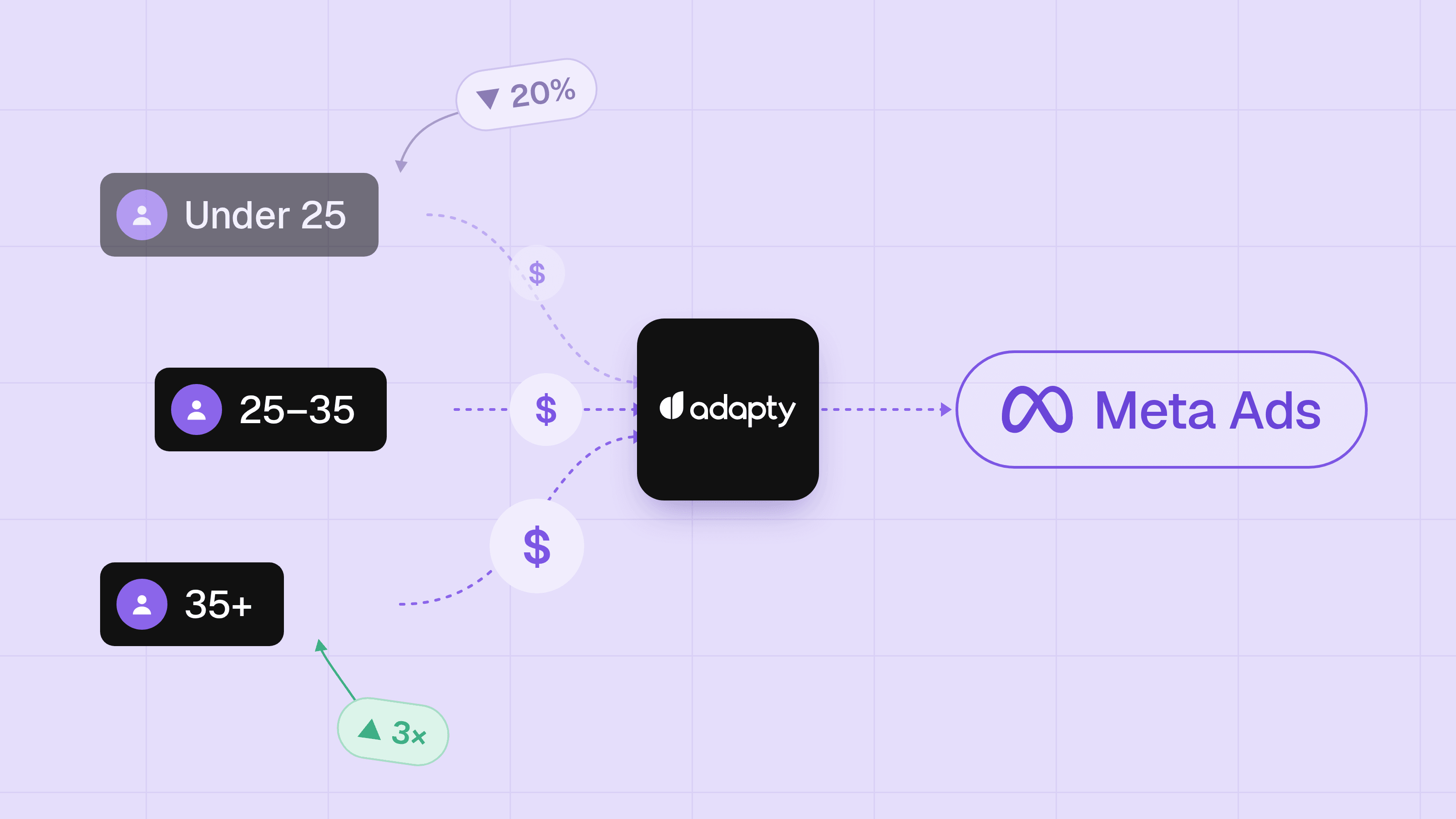
For example, Adapty Attribution's Qualified Trials can delay the signal sent to Meta or TikTok until a user has remained in the trial for a chosen period without cancelling. It can also send predicted LTV signals to Meta, giving the algorithm an earlier indication of which users are likely to become valuable. For web-to-app campaigns, Adapty connects acquisition data with subscription revenue so you can see which campaigns are actually driving paying users.
For subscription models where meaningful revenue arrives much later, predicted LTV can also help give the ad network an earlier estimate of which users are likely to become valuable.
The goal is not to send Meta more events for the sake of it.
The goal is to send Meta better information about which users you actually want.
Build a creative testing pipeline before you need one
When I open a new account, two things I want to understand quickly are:
How much of the account is being carried by the top creatives?
And:
How much does it cost the team to find the next winner?
The companies that scale are already looking for the next winning creative while the current winner is still performing.
They do not wait for performance to collapse.
Creative fatigue becomes more aggressive as your budget grows. If the target audience is narrow, it happens even faster.
I saw this with Videa, an AI video app I work with.
We found a creative that converted so well that spend eventually went beyond $1 million per month on that creative alone.
Then the trend behind the ad became popular everywhere.
Spend on the same creative fell back toward roughly $300K per month.
The ad itself had not suddenly become bad. The market had caught up with it.
At serious scale, fatigue does not always look like a slow decline. Sometimes a trend saturates and performance falls very quickly.
That is why I like a three-stage creative system:
- Install campaign: Use it as the cheapest first filter for creative concepts.
- Validation campaign: Move promising concepts into a campaign optimized around a revenue event. Give them enough time and data to prove the first result was not luck.
- Scaling campaign: Only move a creative into the main campaign once it earns the right to be there.
For validation, I am comfortable giving a new creative up to seven days when necessary.
A creative producing incredible ROAS on day one is exciting. It is not proof.
It could be the beginning of a winner, or it could simply be an unusually strong cohort.
More data removes luck from the decision.
Once you are producing hundreds of ads per month, you cannot put every new idea directly into your main scaling campaign and hope Meta figures it out.
You need a system.
Blocker 2: Scaling requires more than an ad account
Have one growth engine that works extremely well
Every company I’ve seen scale has at least one growth engine running extremely well.
For some, it is in-house creative production.
For others, it is aggressive product experimentation and A/B testing.
Some companies have built a large organic acquisition engine through SEO.
Others understand influencer marketing better than everyone around them.
Very few companies are exceptional at all of these simultaneously.
They find one engine that works and keep compounding it.
If you are trying to scale and everything in your company is just "okay," that is often the problem.
Find the thing you can become unusually good at.
Do not let your home market define the ceiling
I notice a funny difference between companies depending on where they come from.
Turkish app companies often want to test the US immediately because they know the revenue opportunity is there.
Some European companies do the opposite. They prove the product in their local country and keep spending there for too long, even when the product could work globally.
Both approaches can create problems.
EatBetter, an AI calorie tracker I work with, first became a strong name in its category in Turkey. The team had evidence the product worked before pushing harder into other markets.
That is a good sequence.
Prove the product can work somewhere. Then test whether it can work everywhere it reasonably should.
If your app is not culturally specific, do not automatically treat your home country as your maximum market size.
Understand which type of web-to-app setup you need
"Web-to-app" gets used to describe several different acquisition setups, and mixing them together causes confusion.
The first version is relatively simple.
A user clicks a Meta ad, goes through a tracked web touchpoint or link, continues to the App Store, installs the app, and the acquisition source is connected back to the user.
This can give you more actionable attribution data and stronger signals for campaign optimization, without requiring you to move the actual subscription checkout to the web.
The second version is a full web funnel.
The user sees an ad, completes onboarding on the web, pays on the web, and then continues into the mobile app.
That model can work extremely well, but it is a much bigger project. Payments, account linking, analytics, tax requirements, regional rules, web product work, and mobile product work all have to work together.
If you are still trying to get your first Meta campaigns to scale, I would not treat a full web funnel as a shortcut.
Get the fundamentals right first.
Then decide whether the additional complexity creates enough upside for your business.
Solve the cash-flow problem before it becomes urgent
This is one of the least exciting parts of scaling, which is probably why founders wait too long to think about it.
Your acquisition can be profitable and still run out of money.
Imagine you spend today to acquire a subscriber whose economics are excellent over 90 or 180 days.
Meta wants its money now.
Your subscription revenue arrives over time.
Then the app stores still have their own payout schedules.
That gap can become a hard ceiling on growth.
Once your category starts working, speed matters even more because competitors notice. New apps enter the market, creative formats get copied, and acquisition gets more expensive.
If your campaigns are profitable but you cannot recycle revenue into acquisition quickly enough, you can lose momentum even with good unit economics.
Think about funding before you desperately need it.
Revenue-based financing is one option. Equity is another. Some companies fund growth entirely from cash flow.
Adapty Finance is also built around this problem, allowing eligible app businesses to access earned App Store and Google Play revenue earlier rather than waiting for the normal payout cycle.
Whatever you choose, model the cash requirement while things are going well.
It is much easier than trying to solve it after your campaigns hit a ceiling.
Blocker 3: Your team may be optimizing the wrong things
If your UA person only does media buying, rethink the role
I do not mean this as an insult to media buyers.
I mean that the job has changed.
If someone spends most of the day changing bids, moving budgets, duplicating campaigns, and trying to outsmart Meta's algorithm manually, I do not think that is the highest-value use of a full-time UA person anymore.
Meta automates a huge amount of the mechanical media-buying work.
The human advantage is somewhere else.
I would rather have that person spending time on:
- understanding raw acquisition and subscription data
- finding unusual cohort behavior
- identifying which creatives bring valuable users
- improving the creative testing system
- working with the product team on conversion
- investigating attribution and event-quality problems
- using AI to analyze large amounts of campaign and creative data faster
That is where I think a strong UA person earns their salary today.
And if one person is responsible for hundreds of thousands of dollars of your ad budget every month, hiring purely based on who costs the least is strange economics.
The upside from a very good growth person can be much larger than the difference between an average salary and an expensive one.
Audit opportunity cost, not just visible costs
This is the cost almost nobody puts into a spreadsheet.
Companies are very good at auditing things they can see.
You know what your agency costs.
You know what your UA manager costs.
You know what your creative tools cost.
You can question every one of those invoices.
But almost nobody asks what underperformance inside Meta costs them.
Imagine you spend $100K per month and generate 200% ROAS.
That looks good.
But what if, with better creative decisions, cleaner subscription signals, or a stronger account structure, the same budget could generate 250% or 300%?
That difference is not displayed anywhere as an expense.
There is no invoice saying:
Opportunity cost this month: $50,000.
So companies often spend hours negotiating a few hundred dollars from a software contract while much larger amounts disappear through inefficient acquisition.
Savings are visible.
Opportunity cost is not.
I would audit both.
Questions I get about scaling Meta Ads
What is the minimum Meta Ads budget per ad set?
Work backwards from the event you are optimizing for.
Take your expected cost per optimization event, whether that is a purchase, qualified trial, or another meaningful conversion, and multiply it by roughly 10.
That gives you a useful starting point for the daily budget I would want available per ad set.
If your target event costs $20, for example, a $30 daily ad set probably will not generate enough signal.
This is also why I usually recommend learning Meta before trying to master every paid channel at once.
Meta is comparatively predictable and gives you a good environment for understanding creative, conversion, and acquisition economics.
Is spending $100K a month on Meta alone realistic?
Yes.
I have seen apps spend much more than that.
The question is not whether Meta can spend $100K.
Meta will happily take your budget.
The question is whether your economics continue to work at $100K.
If your campaigns do not generate acceptable returns at a smaller scale after you have enough conversion data to trust the result, increasing the budget usually will not solve the underlying problem.
What separates a $100K/month app from a $1M/month app?
Creative production speed is usually one of the biggest differences.
At that level, teams can be producing hundreds of ads per month.
They also keep extracting incremental gains from the rest of the funnel: onboarding, paywalls, pricing, A/B tests, App Store creative, custom product pages, localization, and retention.
There is rarely one magical change that takes an app from $100K to $1M in monthly spend.
It is usually a large number of smaller improvements executed faster than competitors can copy them.
We have a 7-day free trial and cannot optimize Meta for ROAS yet. What should we optimize for?
Do not assume every trial is equally valuable.
If a user starts a free trial and cancels almost immediately, I do not want to teach Meta that this is the behavior we are looking for.
One option is to optimize toward qualified trials.
Instead of sending the trial event immediately, wait for a defined period and only send the event if the user remains in the trial.
You get fewer events, but potentially much stronger ones.
The right delay depends on your trial length, cancellation behavior, and event volume.
If your subscription value takes even longer to become clear, predicted LTV can also help you work with an earlier estimate of future user value rather than waiting months for the complete revenue curve.
Should I test creatives outside the US?
Yes.
Especially if the creative concept itself is what you are trying to validate.
But remember that a creative winning in a cheaper market does not automatically mean its economics will carry over to the US.
Use lower-cost markets to learn faster where it makes sense, then validate the business result in the markets you actually want to scale.
The real difference at $100K per month
The biggest Meta accounts are not necessarily managed by people who know a secret campaign setting.
They usually have better systems.
They know their unit economics.
They give Meta enough high-quality data.
They replace winning creatives before they die.
They have at least one growth engine that compounds.
They understand how long it takes acquisition spend to come back as cash.
And their growth team spends more time finding leverage than moving bids around.
That is the real gap between an app testing Meta and an app that can sustainably spend six figures per month.