Why should your test plan live as hypotheses in Adapty?

TL;DR:
- A hypothesis in AI Growth Advisor is a saved record of one change: why your app needs it, what to expect, the metric that judges it, and what came out of its A/B test.
- Saved hypotheses turn the test plan into one list your whole team reads in the Adapty Dashboard, from idea to result, instead of a spreadsheet only its owner updates.
- Not ready to test? Add the hypothesis to your backlog, and your agent picks it up later from where it stopped.
- Every result and every skip with a reason feeds the next round, so the agent stops suggesting what you tried or rejected and suggests the next step instead. On each new audit, it rechecks your saved hypotheses against this month's numbers.
AI Growth Advisor used to suggest hypotheses one way. Autopilot read your numbers and proposed changes, but it couldn't see what your team had already tried or why you turned an idea down. So some suggestions were tests you had already run.
Now it works both ways. Your AI agent suggests hypotheses with the growth-advisor skill, and you answer which to keep and why you skip the rest. Each answer and each test result shapes the next round, so the plan gets more specific to your app. The hypotheses you keep are saved in AI Growth Advisor with the reason your numbers say you need them, the expected result, and their status from idea to A/B test result. Each one is a single prompt away from its A/B test: the agent builds what the test needs and sets it up for your confirmation.
What is an A/B testing hypothesis in AI Growth Advisor?
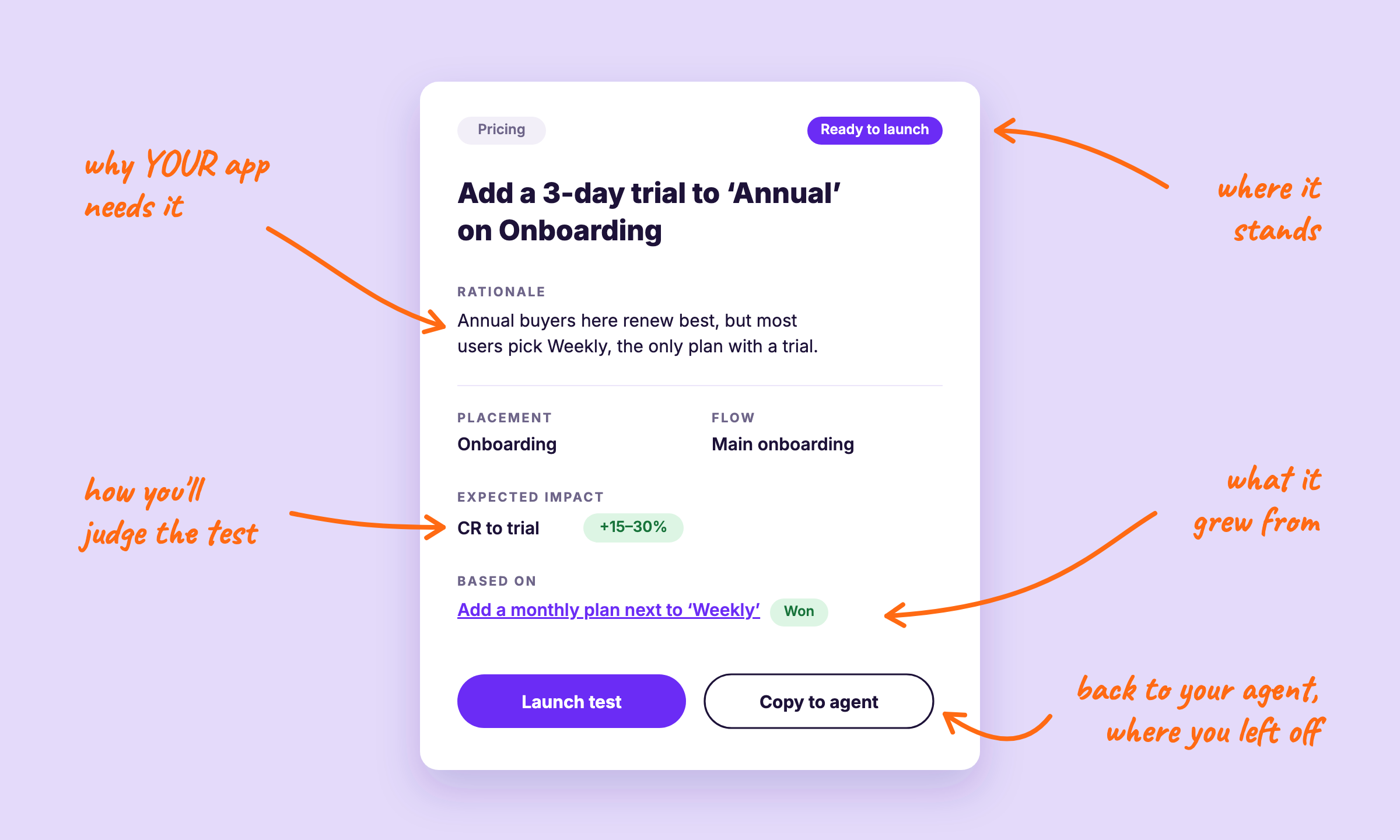
A hypothesis is one change with everything needed to test it and judge it. The agent fills these fields from your Adapty data:
| Field | What it says |
| Title | The verb, the product or paywall by its name in your data, what it is now and what it becomes, the placement, and the audience when the change targets part of it |
| Rationale | Why your app needs it: the unusual number, its period, and how the change acts on it |
| Expected impact | The metric that judges the A/B test, such as ARPU or CR to trial, and a range from real subscription A/B tests, or "untested" |
| Where it runs | The placement, and the flow or segment it changes |
| Based on | The hypothesis this one grew from, such as the next step after a finished test |
Here is one, for a sample app:
Replace 'Weekly Pro' at $6.99 with 'Weekly Pro EU' at $8.49 on 'Onboarding Main' on Onboarding, for new users in Germany, France, the UK, Italy, and Spain
Why: these five countries bring 32% of this paywall's purchases, all at the US price of $6.99 a week. They convert 2.1% of paywall views to paid, above the 1.38% median for Europe in State of Paywalls 2026, where the typical weekly price is $8.06. Users here pay less than their market and still buy more often than it.
Expected: judged by revenue per new user in these countries. If conversion holds, the new price brings about $1,300 a month more in first payments, and $1.50 more on every weekly renewal after.
Time: about 3 weeks, at about 200 purchases a week from these countries.
A developer can set up that test from the title alone, and anyone on the team can tell from the rationale why it is in the plan.
Why save hypotheses instead of keeping a test list?
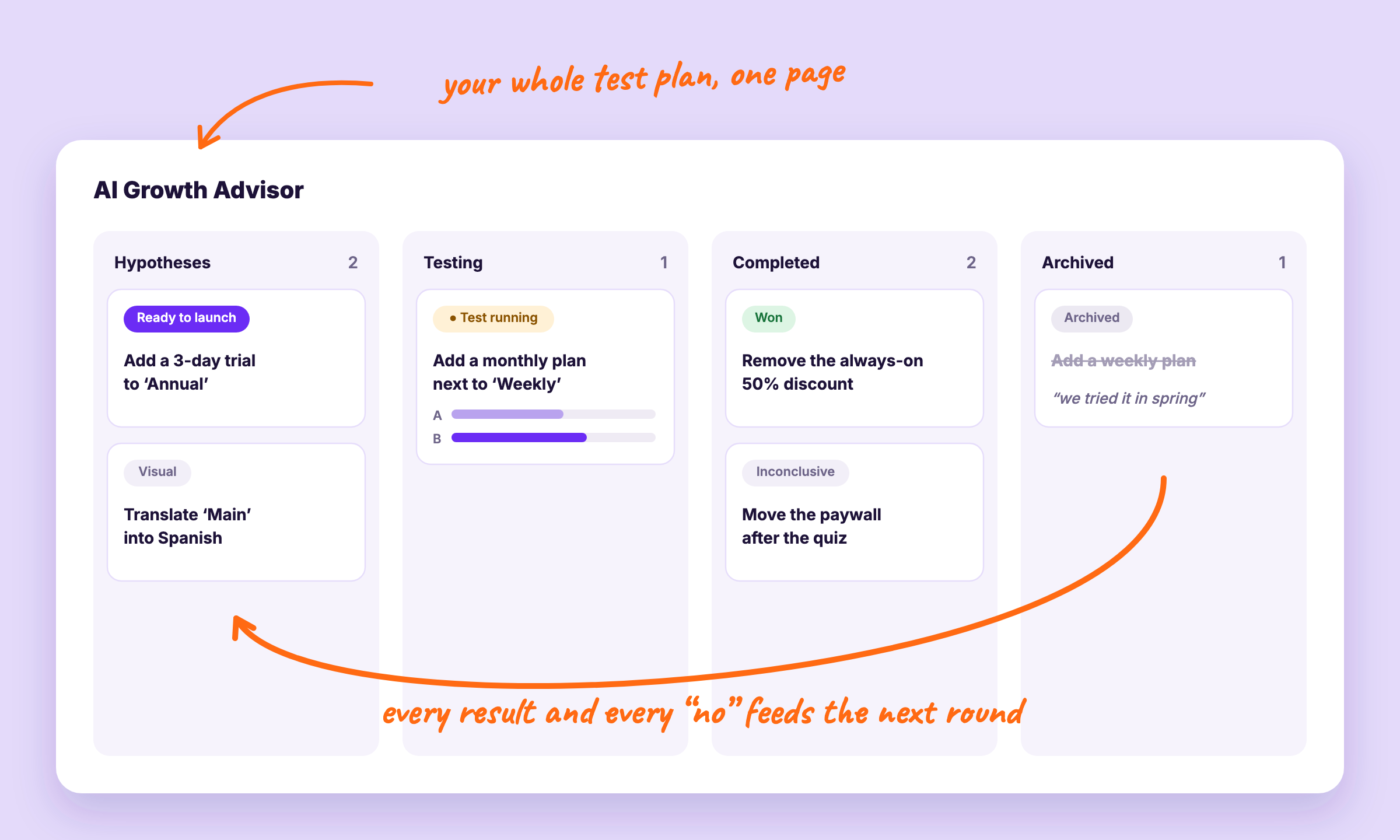
A list of A/B tests records what ran. A saved hypothesis also keeps what to try next and why, so one list works as your backlog and your archive.
As a backlog, it holds the hypotheses waiting for a test slot, since a placement runs one A/B test per audience at a time. Save the rest there, including the ones you mark "not now". When you're ready for one, copy a prompt from its card, and the agent continues from where the hypothesis stands.
As an archive, it keeps each finished test's result and each skip's reason. A new teammate reads what the app tested and why, and the agent reads the same list, so it doesn't suggest what you already tried or rejected.
How do saved hypotheses make the next suggestions better?
Before suggesting anything new, the agent reads what you already decided.
- Tested, testing, or live: never suggested again.
- Skipped with "we tried it": the agent moves to the next step of that change. An annual plan as a second option leads to a 12-month commitment plan outside the US.
- A lost test: rules the change out on its target only. A trial that lost on annual says nothing about a trial on monthly.
- A test that ended too early: rules nothing out, and you can run it again.
The agent also reads your app's history in Adapty: past A/B tests, dropped products, and names that give a test away, such as a paywall called "No Free Trial". What's left is ranked by the purchases at stake, with changes to the offer ahead of changes to the look.
What happens to your backlog when you run a new audit?
The agent checks what is due first, then checks whether each saved hypothesis still holds.
What is due opens the reply, before anything new: a running test that is ready to stop, a test that ended without a result, a change put live without a test whose waiting time has passed, or a hypothesis whose flow or placement is gone.
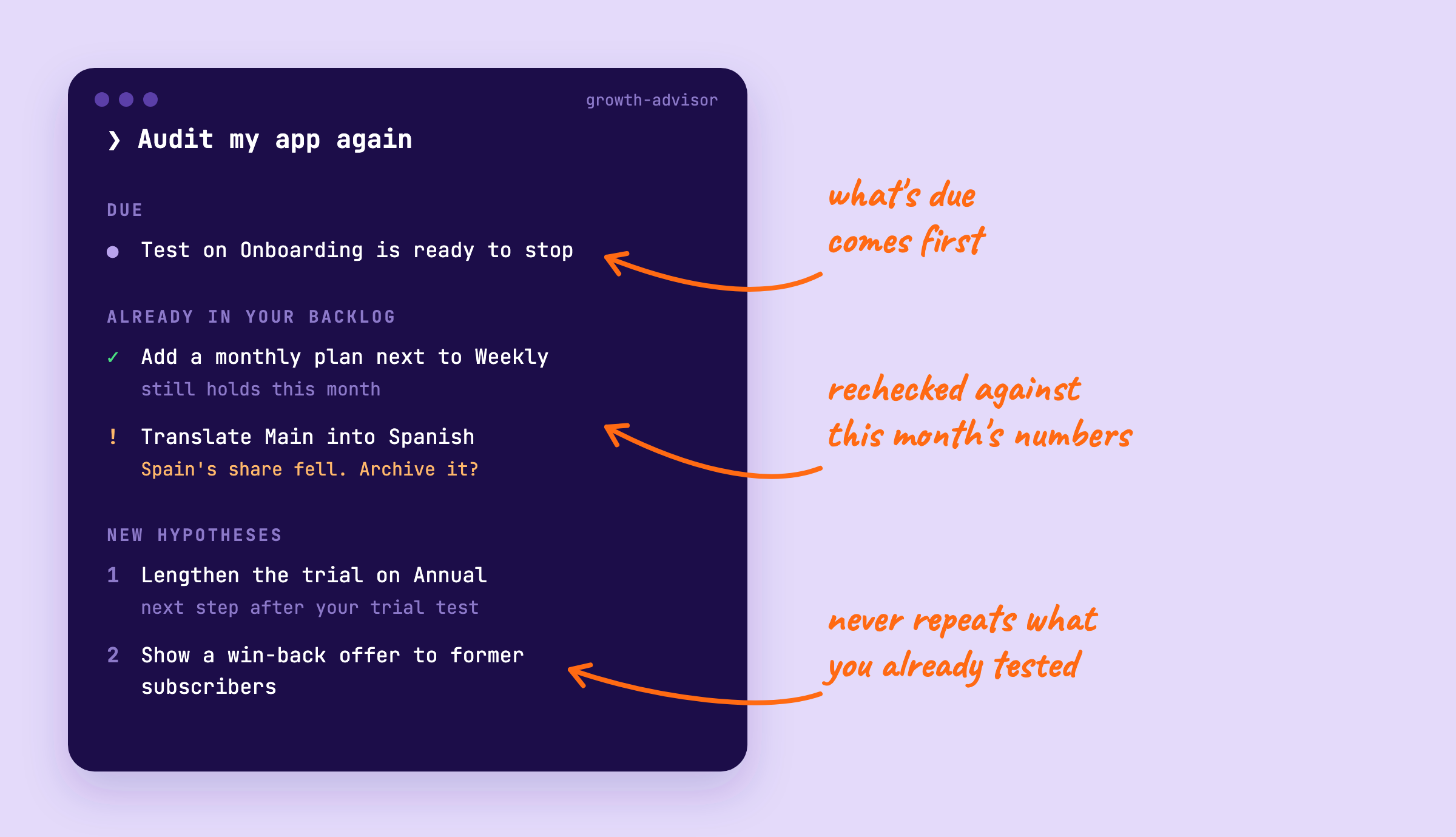
Then the agent rereads each saved hypothesis against this month's numbers. A hypothesis whose rationale still holds is listed under "Already in your backlog" as a reminder, so a good idea doesn't sink to the bottom of the page. One whose numbers have moved gets one line on what changed and an offer to archive it. A hypothesis you skipped as "not now" can come back, and so can one whose numbers changed since you skipped it.
The agent never archives a hypothesis on its own, even one that looks old. Archiving changes only the list: the products, tests, flows, and placements behind it keep working.
How does a hypothesis become an A/B test, and who calls the result?
Pick a hypothesis, and the agent builds what its test needs: a flow copy with one change, a new product once you approve its store product ID, or a segment. Trials and offers are yours to create in the store. Then the agent creates the paywall A/B test as a draft and shows you who will see what before it starts.
The agent calls the result too. Ask it to schedule a check on your test, and twice a week it reads the numbers for you and posts to your chat, Slack, email, Notion, or Linear. Once each variant has about 200 purchases, it tells you which variant leads and offers to stop the test and keep it. The stop waits for your confirmation, since it changes what your users see. After it, the hypothesis moves to Completed as won.
How do you start a hypothesis backlog?
You need your AI agent with the Adapty plugin, which brings the growth-advisor skill, and an Adapty account with data.
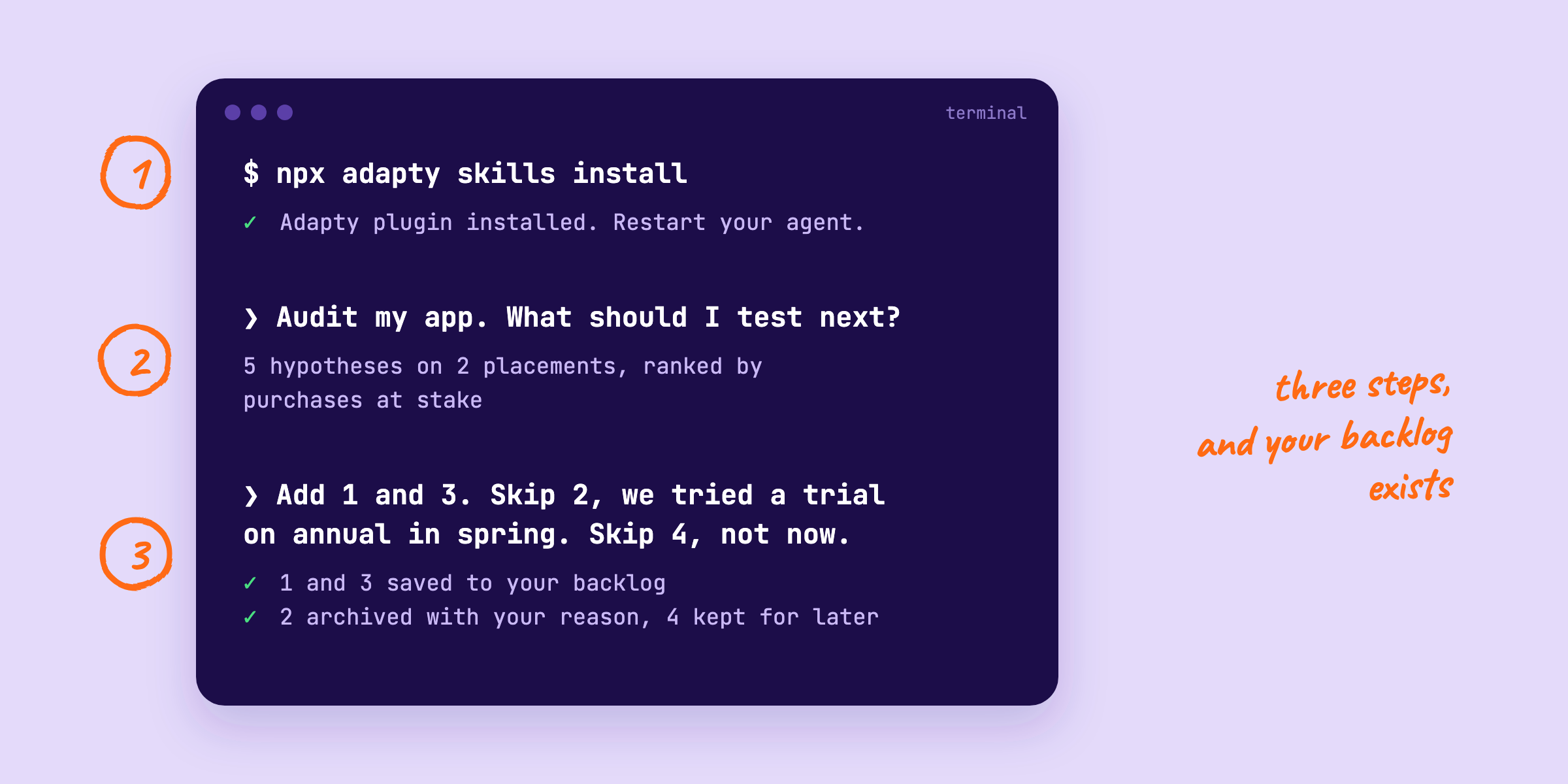
- Install the plugin. In your terminal, run
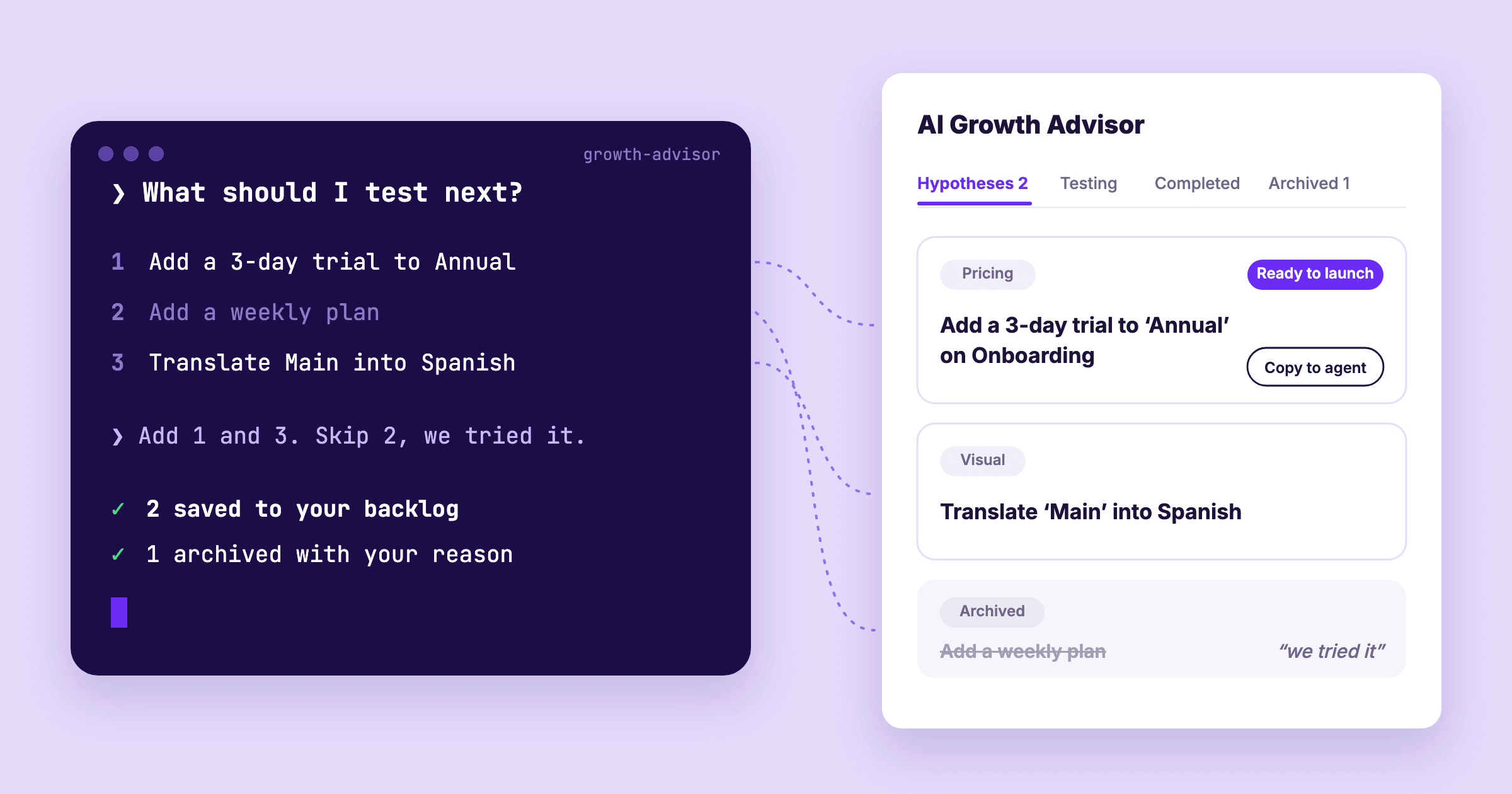
npx adapty skills install, then start a new session in your coding agent, such as Claude Code, Codex, or Cursor. For claude.ai and Claude desktop, follow Install the plugin. - Ask for hypotheses. Tell the agent "Audit my app. What should I test next?" The agent replies with up to five hypotheses, grouped by placement in the order to test them.
- Keep the ones you like, skip the rest with a reason. Answer in plain words: "Add 1 and 3. Skip 2, we tried a trial on annual in spring. Skip 4, not now." The added ones appear on the AI Growth Advisor page. Number 2 goes to Archived with your reason, and the next round suggests the next step for trials instead, such as a different trial length. Skip 4 stays in the backlog.
- Pick one to start. Say "start with 1", or come back later and click Copy to agent on its card. If you're not sure which to start with, the agent names its pick and why.
A reply with no answer saves nothing, so the list only holds what you chose.
Start your backlog
Your backlog starts with the first answer you give the agent: add what's worth testing, and skip the rest with a reason.