How to pass the bar raiser interview at Adapty

TL;DR:
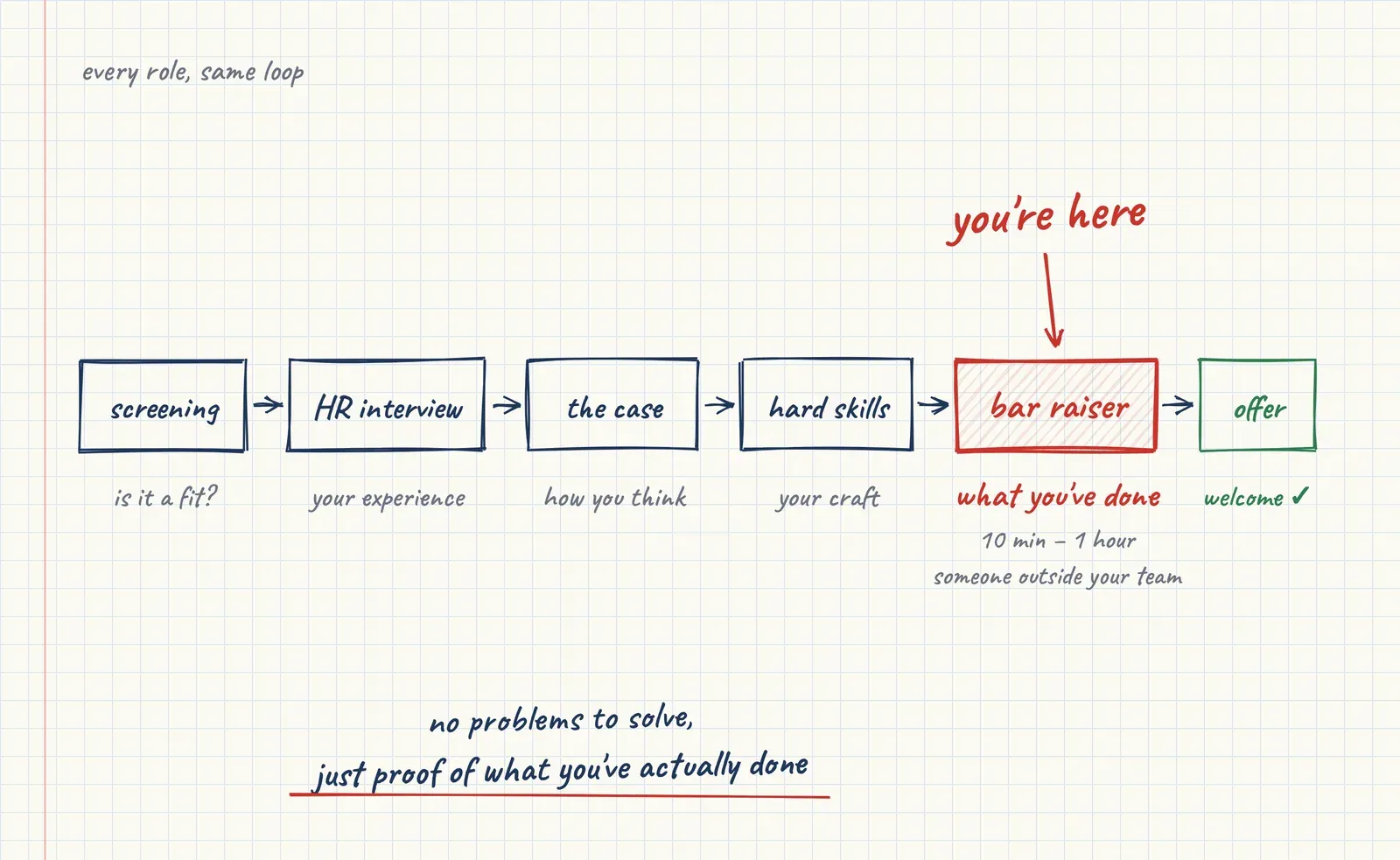
The bar raiser is the last interview at Adapty for every role, and it's run by someone from outside the team you're joining. There's nothing to solve: we go deep into what you've actually done, what you personally owned, the numbers behind it and your biggest failure. Bring two or three real stories with numbers, keep your answers short and direct, and say "I don't know" when you don't.
Every role at Adapty ends with the same interview, the bar raiser (in your calendar invite it may just say "final interview"). By the time you get there you've already worked through a live case and shown your craft to the hiring team, so this last conversation isn't about skills at all. It's about evidence: what you've actually achieved, and whether you'd make the team around you stronger.
I'm convinced that the best predictor of what someone will do is what they've already done. If a person has spent ten years at work and there's nothing interesting to tell about it, the odds that something interesting starts happening once they join us are close to zero. The bar raiser is where we check that, as directly as we can.
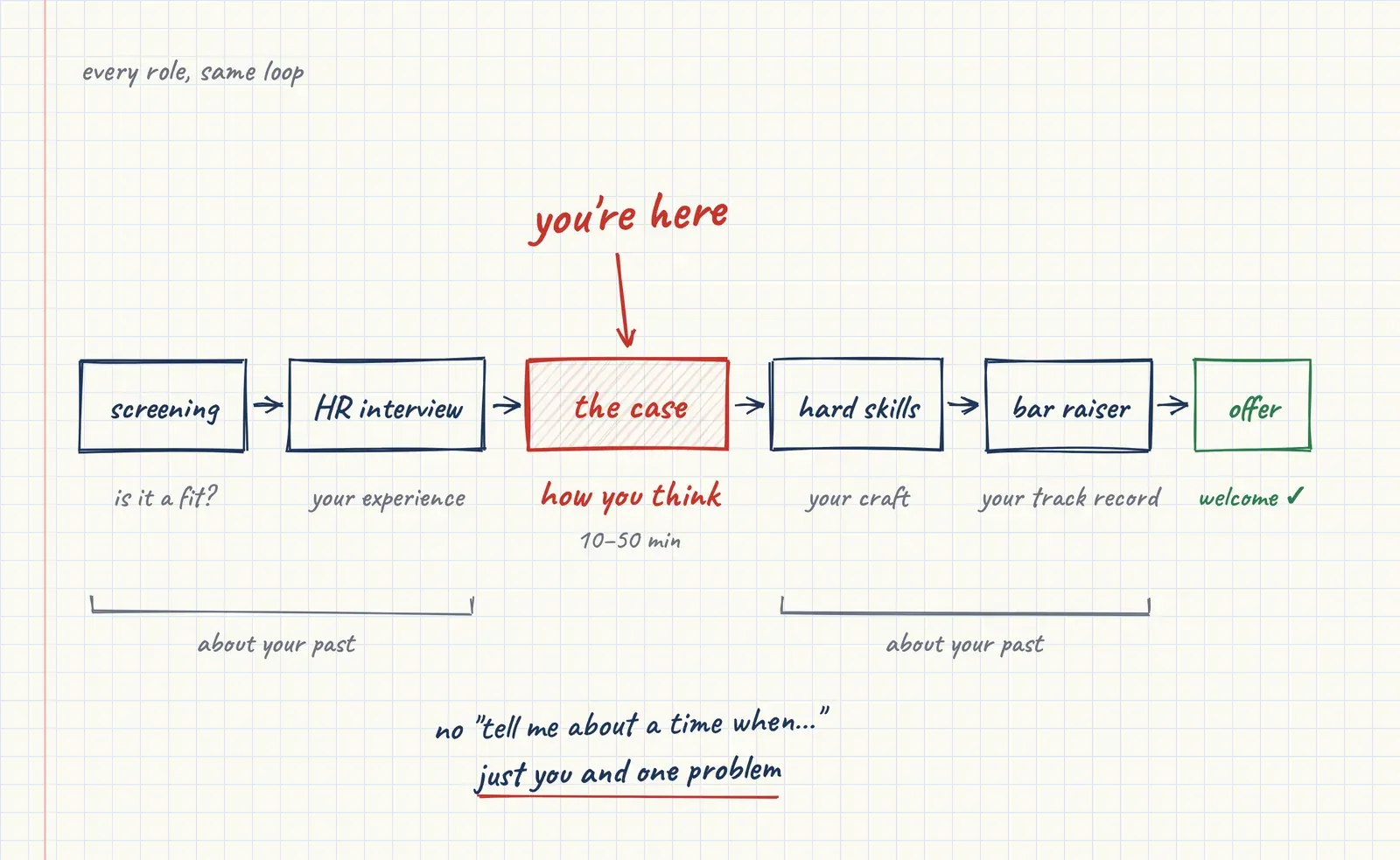
This post covers why the stage exists, how the session runs and what we dig for. It's the second post in a series about how we hire, and the first one covers the case interview.
Why we have a bar raiser at all
We borrowed the idea from Revolut, where the bar raiser is a separate stage of the hiring process, and adapted it to a company our size. The principle behind it is simple: every new hire should raise the average level of the team they're joining. We think it's the best one-line definition of a good hire.
The reason it works is pretty human. By the final stage the hiring manager has usually spent weeks on the search, they needed someone yesterday, and they're often a little in love with the candidate. That's normal, and it's exactly why the last word shouldn't be theirs alone. A red flag spotted by someone with no stake in filling the role carries more weight than one the hiring team has learned to explain away.
There's a longer-term reason too. Every "good enough" hire feels reasonable in the moment, but they add up, and at some point a team of good-enough people starts setting the culture just by its size. That's very hard to undo, so the bar raiser exists to stop the hire that seems reasonable today.
That's why the bar raiser is always someone from outside the team you're joining, trained for the job. The hiring manager still owns the decision, but if the bar raiser says you're below the bar, that's final. For a long time I ran almost all of these myself, which made me the bottleneck of our hiring, so now a small group of people I've trained run them too. We think of it less as delegating a task and more as clearance: you get to run bar raisers once you've shown you raise the bar yourself.
What "raising the bar" means
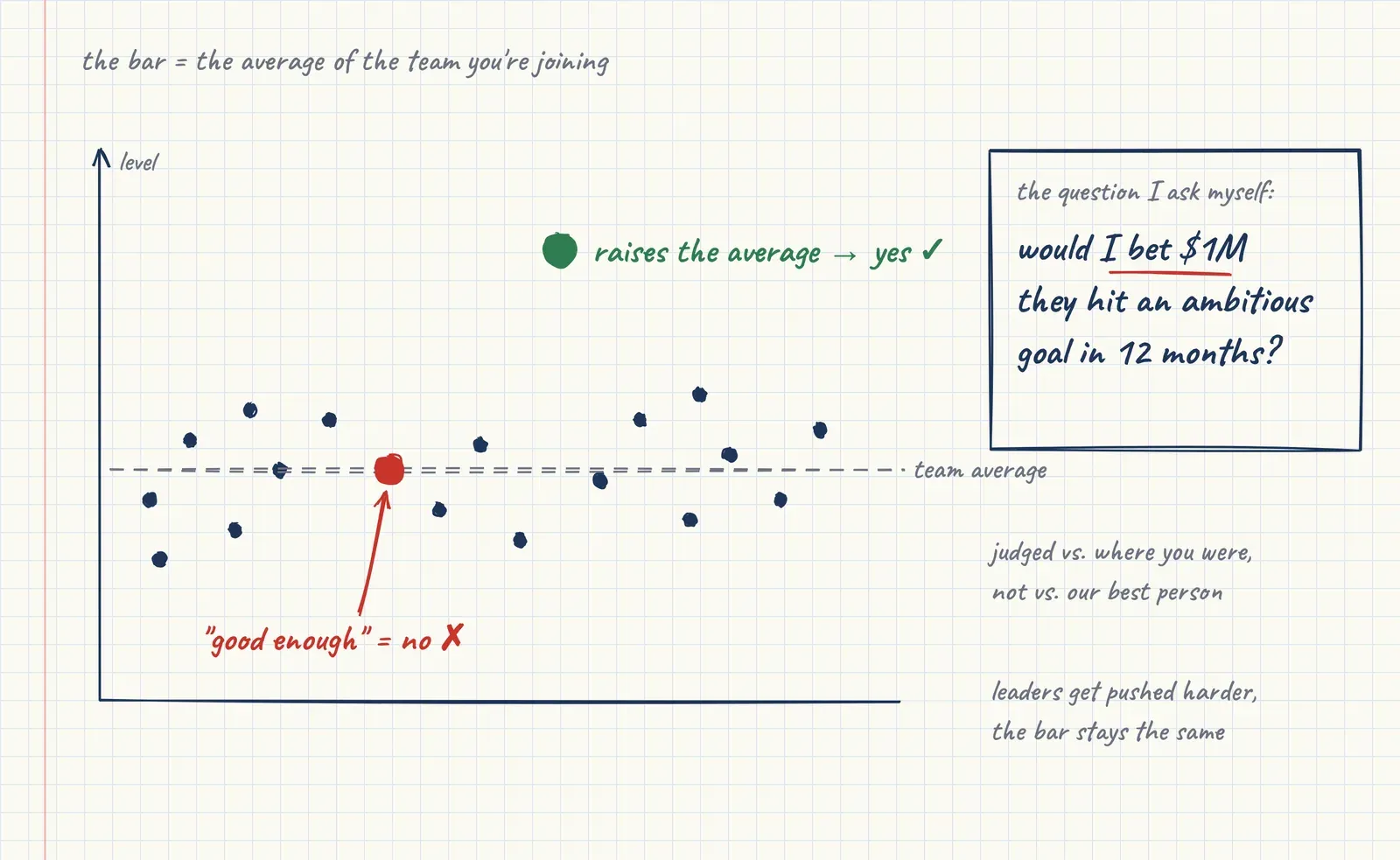
If you've made it to the bar raiser, you're already good enough, because that's exactly what the earlier stages check. The question underneath this conversation is different: will you raise the average level of the team you're joining? If you'd land at the average or below it, that's "good enough", and good enough is a no.
We don't compare you to our best person, we look at how you stood out in your own context. A recent graduate who won olympiads or built something real on the side can clear the bar, while fifteen years of experience with nothing specific to show for it won't. Seniority changes how hard we push (leaders get dug into much harder than individual contributors), but not where the bar is.
When I'm making the call, I ask myself whether I'd bet a million dollars that this person hits an ambitious goal within twelve months. The people who make that easy connect their work to business results, dig until they understand the real problem and tend to pull other strong people along with them. The ones who make it hard do the work by the script, need to be managed all the time and, when you give them an ambitious goal, try to negotiate it down instead of looking for a way to hit it.
How the session works
The bar raiser takes anywhere from 10 minutes to an hour, and we'll tell you that at the start. I used to wrap up some conversations early without warning once I'd seen enough, and people (fairly) felt dropped, so now we say it upfront. A short interview doesn't mean it went badly, and a long one doesn't mean it went well.
Your interviewer will have read the notes from your earlier stages, so they may open with whatever left a question mark. After a short intro they'll explain the format, which is a deep dive into your past experience and achievements, with direct answers expected. Then they'll ask what they should know about you in the context of this role, and you get two or three minutes to answer. Prepare this one, because it sets the direction for everything that follows.
Most of the time goes into your achievements, how your work is measured and your biggest failure. There may be a short question to think through out loud (keep a pen nearby), and if things are going well you'll get a direct question about whether you're ready for the pace, because the first months here are intense. The end is yours: you get at least five minutes for your own questions, and you'll hear exactly when to expect an answer.
What we won't do is test your hard skills again, run a second case or talk about money. All of that happens at other stages.
Here, we drive
In the case interview you run the conversation. In the bar raiser it's the other way around: the interviewer leads, picks up the first concrete fact in your answer and keeps digging until it's clear.
That means we'll interrupt you, sometimes a lot. It's not rudeness, it's how we get to the point, since a ten-minute monologue tells us much less than two minutes of back-and-forth. We'll also point out when something doesn't add up. Our job is to assess you, not to catch you out, so we don't accuse anyone of anything. We just keep asking until the picture holds together (or clearly doesn't).
One thing that surprises people: strong candidates often undersell themselves, while weak ones are usually great at selling. We try hard to judge evidence rather than confidence, so a nervous answer full of facts beats a polished one without them every time.
What we dig for
Proof that it was you
Wins can be "we", but decisions and mistakes should be "I". When you say "we launched" or "a process was introduced", expect "who exactly?": who designed it, who built it, who made the call. We'll also often ask the counterfactual, which is whether it would have happened without you. The best answers separate what you did from what the team did and from plain luck, including the parts you can't take credit for.
Numbers you actually know
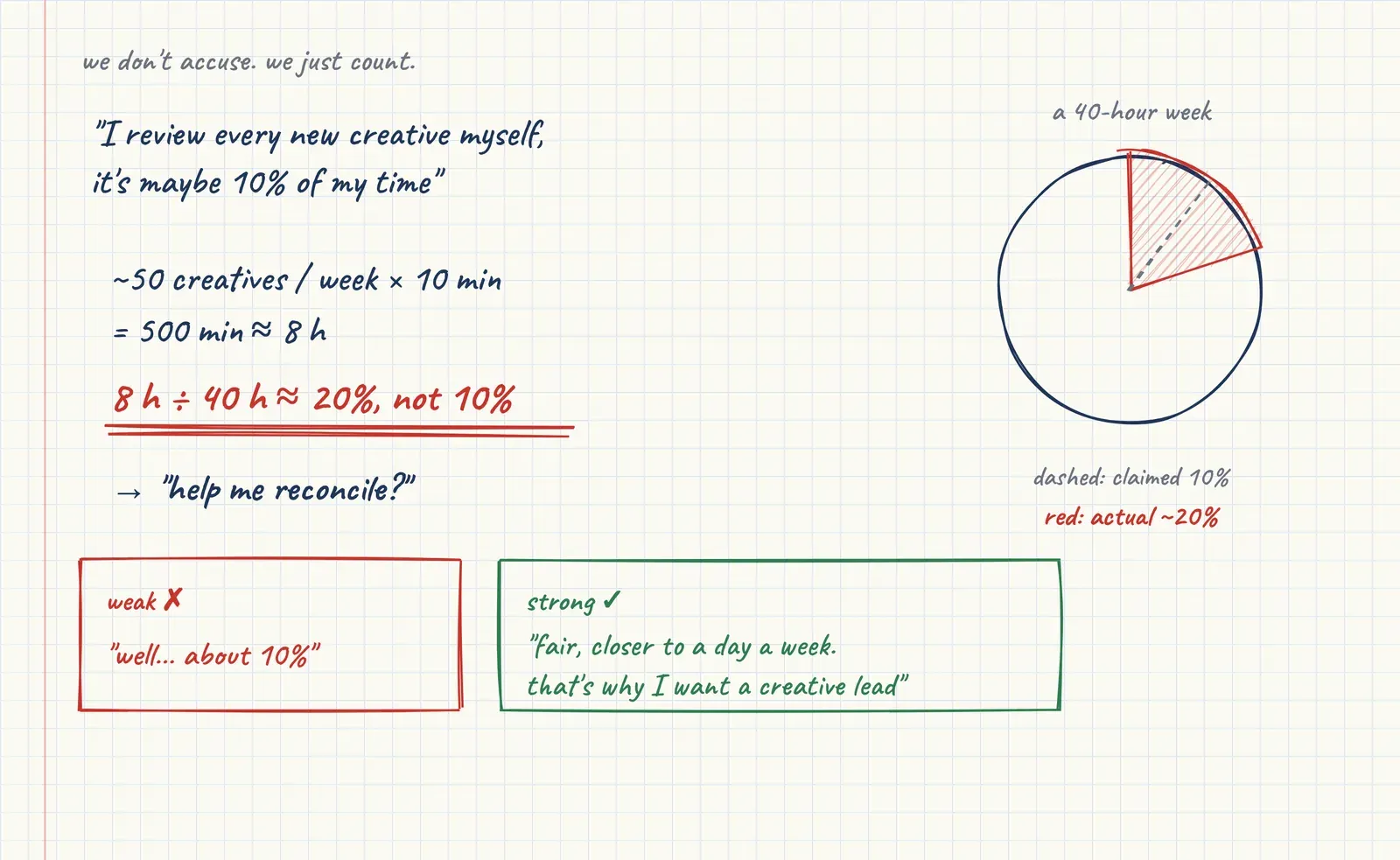
I've never met a real professional who doesn't know their numbers. We'll ask how your work is measured, where you are against the goal and what you looked at recently. You don't need a spreadsheet in your head, but you should know the numbers you're accountable for. And if a claim can be turned into hours, money or people, we might do the math out loud with you. It's not a trap, and "fair, I rounded that down" is a perfectly good answer.
A failure that was your decision
"Tell me about your biggest failure" is one of my favorite questions, because it shows the scale of the decisions someone makes right away. A strong answer is a call you made that turned out wrong: what it cost, how you got out of it and what you changed afterwards. "It just happened", "leadership decided" or "I can't think of a big failure" almost always mean there wasn't much ownership to begin with.
Straight answers
Be Direct is one of our values, and this is where it shows most. We expect short, straight answers, especially under pressure. "I don't know" or "I don't remember" is completely fine (an honest no is actually a good sign), so we press on evasion, not on not knowing. And if you think our premise is wrong, tell us. Some of the best moments in these interviews are candidates pushing back on the interviewer.
Fire in the eyes
The most common trap at this stage is someone who's pleasant, humble and great to talk to, but has no drive. Our value is Stay Humble, Play to Win, and we need both halves. So we look for signs that you want to win: results you pushed for when nobody asked you to, people who'd follow you to a new company, and anything you've stuck with for years outside work (a sport, competitions, a side project). We'll also ask you directly whether you're ready to work hard, and how you react matters as much as what you say.
What this looks like in practice
Let's say you're interviewing for a growth lead role, and right now you run growth at a photo-editing app. Everything below is made up, but the pattern is very real.
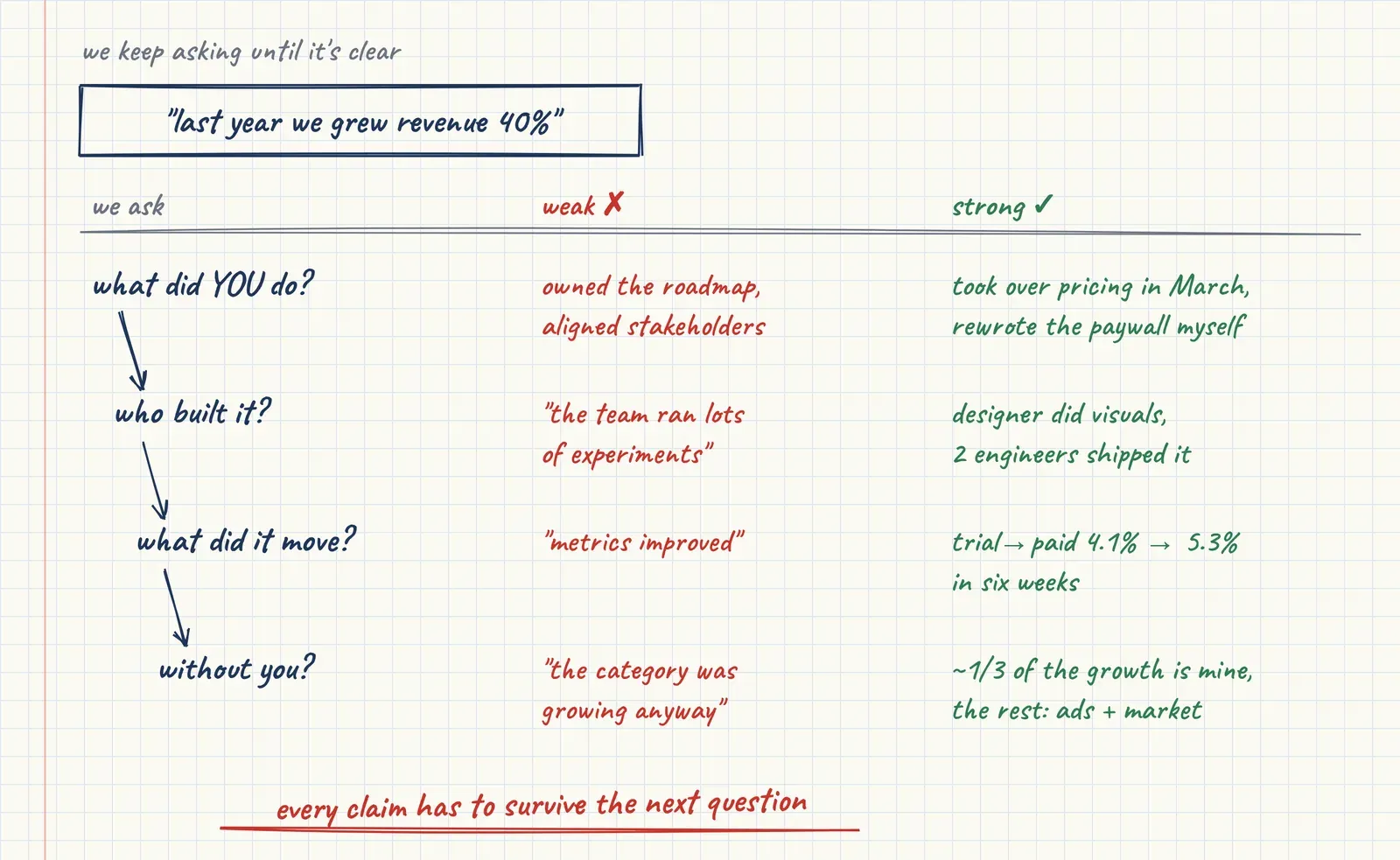
You open with: "Last year we grew revenue 40%." Here's a weak version of the next ten minutes. Asked what they personally did, the candidate says they owned the roadmap and aligned stakeholders. Asked to pick one thing that changed because of them, they say the team ran lots of experiments and the metrics improved. Asked whether it would have happened without them, they say the whole category was growing anyway. It's a pleasant conversation, and at the end of it there isn't a single achievement we can put their name on.
A strong version sounds like this: "Most of it came from pricing, which I took over in March. I rewrote the paywall and the plan structure myself, our designer did the visuals and two engineers shipped it. Trial-to-paid went from 4.1% to 5.3% in six weeks, and I'd estimate that's about a third of the growth. The rest was a bigger ad budget and the category itself, and I can't take credit for that."
Numbers. Asked what they looked at this week, a weak candidate says it's been a hectic week. A strong one says day-7 retention on the new onboarding dipped from 31% to 28%, they think the shorter trial is the reason, and they'll know by Friday.
The math. The candidate mentions they review every new ad creative themselves, "maybe 10% of my time". About fifty creatives a week at ten minutes each is roughly eight hours, closer to 20% of a working week, so the interviewer asks them to reconcile. "Well, about 10%" is a weak answer. "Fair, it's closer to a day a week, and that's exactly why I want to hire a creative lead" is a strong one.
Failure. Weak: "The launch slipped because another team didn't deliver." Strong: "I pushed a price increase in two markets without a holdout group. Churn went up and we couldn't tell how much was the price and how much was seasonality, which cost us about a month. Since then nothing on pricing ships without a holdout."
None of the strong answers are impressive because of the numbers themselves. They're strong because every claim survives the next question.
Almost nobody fails on skills here
In our experience, almost nobody fails the bar raiser on skills, since those were checked earlier. People tend to fail on the same handful of things:
- They can't separate "I" from "we", even after a few follow-ups.
- They describe activity instead of results: meetings, processes, stakeholders.
- Their numbers stop after the first level, or don't add up when we do the math.
- The failure story is passive, or there isn't one.
- They dodge questions and keep dodging after we bring them back.
- They give polished, rehearsed answers with nothing behind them (those rarely survive the second follow-up).
- They're pleasant and humble, but show no drive.
- They can't say why they want to work at Adapty.
The strongest candidates know their numbers instantly, separate their own contribution from the team's and from luck, say "I don't know" without hesitating, correct themselves out loud when they realize they're wrong, and push back when something we say doesn't make sense.
How to prepare
There's nothing to cram for, but a little preparation goes a long way:
- Pick two to four stories you're proud of, and for each one know the goal, what you did personally, why, and the result in numbers. Recent stories beat ones from five years ago.
- Refresh the numbers you're accountable for today and how your work is measured.
- Think through your biggest failure and be honest about it.
- If you manage people, be ready to talk about who you hired, who you let go and who would follow you.
- Read our values and know why you want to join.
And if you're not in the process yet, take a look at our open roles.
– Vitaly