How to buy a mobile app: what to pay attention to

To develop an app from scratch, you’d need a lot of time and human resource. Alternatively, you can buy a ready-made app and build up on it. There’s a lot of nuance and risks to consider with this option, though.
In this article, we’ll discuss how to approach purchasing an app, which metrics to look at, how the deal will be done, and what you must never neglect.
Why buy a mobile app
An app is a business: you invest in its development to earn even more. With the global mobile app market projected to exceed $630 billion in 2026 and consumer spending on app stores climbing toward $233 billion, acquiring an existing app remains one of the fastest paths to entering this lucrative space. Building an app from scratch takes 6–12 months of development, significant capital, and carries no guarantee of product-market fit. Buying an existing app lets you skip the riskiest phase and start with a validated product, a real user base, and — ideally — proven revenue streams. Here are the most common reasons for buying an app.
1. You can acquire users at a lower cost than the current owner. App monetization requires a constant flow of new subscribers. This means you need a systematic approach to configuring and optimizing ads, as well as improving your paywall conversion rate. An experienced team with strong performance marketing skills can make a profitable business out of a money-losing app.
2. You have access to relevant marketing channels or traffic sources. Examples include app review websites, influencer networks, or even other apps where you can place ads. It is quite notable that companies involved in buying and selling apps often include those who own traffic networks, CPA agencies, and media buying firms.
3. You can improve the app from the product standpoint. Sometimes an app just needs UI polish, better onboarding, or smarter monetization to become a quality product loved by users. In 2026, adding AI-powered personalization features can boost multiples by 20–40%, according to recent marketplace data. If you have an experienced product team, you can certainly try finding an underrated app and improving it drastically.
4. You want to strengthen your own product or acquire a competitor. You already have a solid app asset. Why not expand your audience by acquiring smaller apps sharing the same category? Mobile games make the easiest example here: if you buy a game similar to yours and help users move over to your project, this will solidify your position and protect it from potential competitors. The New York Times' acquisition of Wordle illustrates how even simple apps can become strategic acquisitions that drive broader digital subscription growth.
5. You want to enter a high-growth niche quickly. Certain categories — such as AI tools, health and fitness, and productivity — are seeing rapid revenue growth. Building from scratch means competing against established players. Acquiring an app already ranked in these categories gives you an immediate foothold, existing App Store Optimization (ASO) equity, and real user feedback to build on. If you are an app developer or product owner focused on acquiring applications with a vision to enhance their conversion rates and in-app subscriptions, Adapty is your strategic partner. By scheduling a free demo call with us, you will explore how our solutions can help you significantly elevate conversion rates and revenue for the app you intend to buy, ensuring a profitable app purchase.
Why apps are sold
Depending on the reasons behind the owner looking to sell, you can get very different deals. Understanding these motivations will help you negotiate a better price and spot potential issues early.
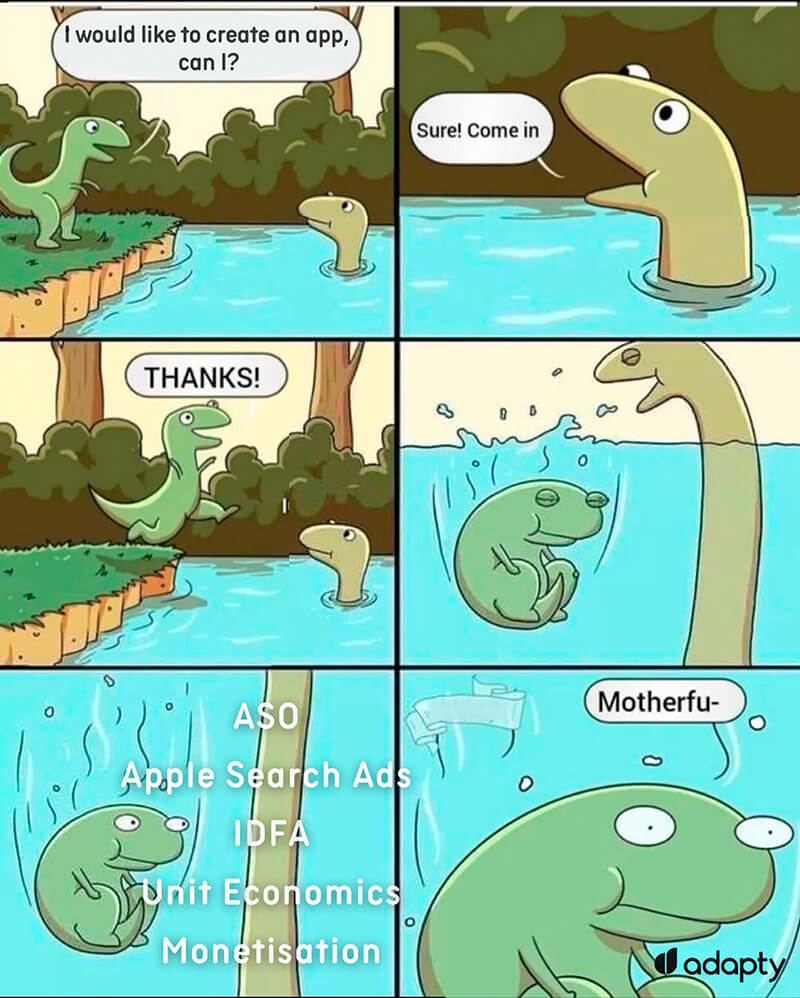
1. Unrealistic expectations. Those new to the mobile app business often come in expecting to build an app, set up monetization tools, and watch their bank account grow. They are then surprised to learn that subscriptions will be refunded, the app requires updates and maintenance, reviews demand attention, and the traffic must be constantly acquired and monetized. The developer then decides to get rid of the app.
2. Lack of resources. There comes a point where the developer realizes that for the app to continue growing, they need money to acquire new users and hire people to maintain the app and create content. Further growth requires investments, but no one wants to deal with a no-name developer. It is often easier to sell the app than to look for a team and investors.
3. Burnout. The developer has simply gotten weary of their app. They want to switch fields, find a job, or proceed to working on their next idea. They do not want to neglect the app, which is why they decide to sell it.
4. Irrelevant asset. This happens if the app was initially developed to supplement some other business that ended up closing. For example, gym owners developed a health app with workout plans and a step counter. The gym closed, and the owners had no choice but to sell the app.
5. Team conflict. A trivial yet quite common reason. The founders could not find common ground and decided to part ways. They had to sell the app and share the money.
6. The app is in the red. If the app is not monetized and the developer is running out of money, it is sometimes easier to sell it than seek extra funding.
7. Speculation. Some specialize in buying apps, making them profitable, and then reselling them. Be cautious if you suspect that is your seller's occupation — they may be deceitful with the data they provide. In the current acquisition market, roll-ups and portfolio publishers are actively seeking app deals, which means increased competition but also more market transparency.
8. Money emergency and personal reasons. Sometimes the seller may have deeply personal reasons. For example, they may need to buy a new home, afford costly medical treatment, or pay debts.
What to consider when buying an app?
The founders' and the brand's reputation
This step is obvious yet often overlooked for this very reason. Despite being a mass product, mobile apps face heavy limitations imposed by their chosen niche. If the developer or team behind the app has done dubious things in the past — even with other apps — this will haunt the app and have a negative impact even after the app is transferred to another developer account. Google the names, look for reviews, and ask around in the community.
The developer's reputation in the app marketplace
Stores rank developers by how much they trust them. If the developer has launched similar web view apps infested with suspicious ads, their reputation is likely lacking. Once the app is transferred from their account to yours, you can face problems with update reviews or even get your app blocked. That is why it is crucial to check the developer account's history before buying one of their apps.
The app's conformity to store guidelines
Sometimes the app is no longer passing reviews following a policy or guideline change introduced by the app store. While it does not get removed, the developer cannot publish any updates. If the app has not received any updates for a long time, it should be considered a red flag. Ask the seller about it and make sure no update issues are present. Otherwise, you will end up with a frozen asset. In 2026, pay special attention to privacy compliance. Both Apple and Google have significantly tightened rules around data collection, third-party SDKs, and user consent. An app that relies on outdated tracking methods or non-compliant SDKs could face removal or forced updates immediately after purchase.
The company's and its shareholders' legal stand
Make sure the asset that is listed for sale actually belongs to the seller. No matter whether you are using a marketplace, broker services, or negotiating directly with the developer, there is always a chance the seller has illegally obtained the app. To make sure, it is best to consult your lawyer. Also try searching the seller's or their company's name, check who the domain belongs to, and look at the developers' social media accounts.
IP rights
The app can be patented as a utility or design, its name may be a registered trademark, or the trademark may be in the process of being registered. By buying an app, you also buy the rights to all the names and patents related to it. Right and patent transfers are a tedious procedure, but it is always better to get it done right away to prevent problems in the future.
Technical debt and code quality
This is something many first-time buyers overlook. Have a developer you trust review the codebase before finalizing the deal. Key things to check include the programming language and framework (is it modern and maintainable?), third-party dependencies and licensing, test coverage, architecture documentation, and whether the app supports the latest OS versions. According to experienced acquirers, if a CTO on the buyer's side sees that the code will not hold up under heavy user traffic, that is often a deal-breaker.
Business economy
The most common and obvious risk is that the owner can — and is likely to — hide at least some parts of the whole picture from you. When you are buying an app that is earning money, the seller will almost always attempt to sweep problems under the carpet. They will try to make the numbers look better or even manipulate the data. When buying a mobile app, the key risk is to unwittingly end up buying a business that is in the red. If you do not see any catches in the app's business economy, it means you must be looking the wrong way.
How to audit the app's financials
Revenue audit
Mobile apps are most often sold as templates you are supposed to build your own project with. However, we are considering buying an app as a ready-made business with its own economy. If the app is not being monetized, it likely has no monetization potential. In that case, why buy it? The subscription model is often considered the most reliable monetization technique, even though apps with AdMob-based monetization are more often seen on sale. Content apps will earn much less with in-app advertising than with the subscription model. A smart strategy is to buy a content app that relies on ads and introduce subscriptions instead.
Valuation methods and multiples in 2026
App valuations in 2026 are typically anchored to EBITDA or MRR multiples, adjusted based on strategic fit, growth momentum, and execution risk. Here are the primary methods used today:
| Valuation method | Formula | Best for |
| Revenue multiple | Annual revenue × industry multiple (2.0x–7.0x) | Apps with consistent income streams |
| EBITDA multiple | EBITDA × multiple (3x–5x typical, up to 40x for high-growth) | Profitable, mature apps over $5M value |
| DCF (discounted cash flow) | Sum of future cash flows / (1 + discount rate)^t | Apps with predictable recurring revenue |
| User-based valuation | Monthly active users × value per user ($5–$25) | Pre-revenue apps with strong engagement |
| LTV-based valuation | Total users × (CLV − CAC) | Subscription apps with reliable cohort data |
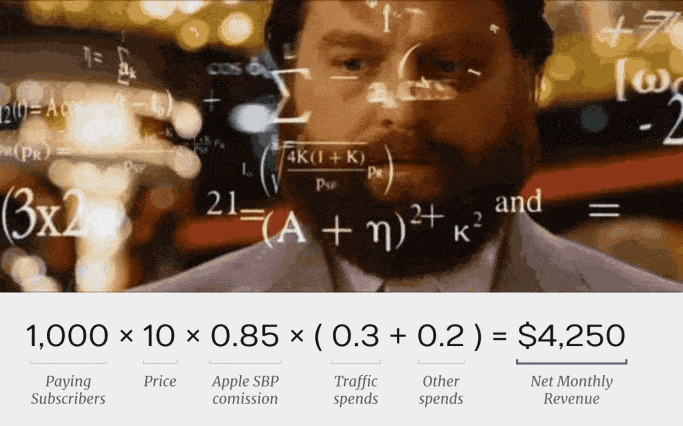
Valuation example: You have 1,000 subscribers paying $10 per month, and you are a member of the Apple Small Business Program (15% commission). You are earning 0.85 × 1,000 × 10 = $8,500 per month. If you spend 30% on traffic and 20% on everything else, you end up with a net revenue of 0.5 × $8,500 = $4,250. Using a 12x–36x monthly net revenue multiple, the app could be valued at $51,000 to $153,000.
Revenue multiples by app category
Not all app categories are valued equally. The table below shows typical revenue multiples in 2026 based on recent marketplace and M&A data:
| App category | Typical revenue multiple | Key valuation drivers |
| SaaS / productivity | 5.0x–7.0x | Recurring revenue, high retention, low churn |
| Health and fitness | 3.5x–5.5x | Subscription stickiness, content depth |
| Education | 3.0x–5.0x | User engagement, completion rates |
| AI-powered apps | 4.0x–6.0x | Proprietary models, defensible technology |
| Utilities | 2.5x–4.0x | Stable organic traffic, low maintenance |
| Gaming | 2.0x–3.0x | High UA costs, lower retention predictability |
| Lifestyle / media | 2.0x–3.5x | Audience loyalty, content production cost |
Apps with AI features, hybrid monetization models, and multiple revenue streams can command premiums of 15–40% above these baseline ranges.
Monetization timeline
Another important thing to consider is the monetization timeline. It is important to forecast the app's potential revenue dynamics for at least a year ahead. An app that has been around for one or more years may have impressive user behavior stats. But what if it has only been monetizing for a month? Introducing monetization to a free product always changes customer behavior for the worse. The longer the app has been monetized, the better. Avoid considering buying apps whose monetization history spans less than three months — or be extremely careful. You will need to forecast revenue and spending. There are two kinds of expenses: marketing and operating. Operating expenses are relatively straightforward — you need money to maintain the app's functionality. Variable expenses are defined by the app's niche and content. For example, a fitness app with professional trainer videos costs significantly more to maintain than one with scanned workout plans. Once you buy the app, you will have to produce content yourself and invest in crafting it. It is always better to evaluate these costs in advance. You could also arrange an assistance period with the developer, which should be included in the agreement. However, if you feel you might need long-term assistance with managing the app, reconsider whether you should buy it at all.
Marketing expenses
App monetization requires continuous user acquisition, which involves marketing expenses. Before buying, ask the seller about the average subscriber acquisition cost. If the seller says they rely mainly on Meta ads for user acquisition, ask to see the ads manager stats or even request guest access, as screenshots are easy to manipulate. Keep in mind that the developer can have traffic channels you do not. For example, they could be promoting the app via other projects. Once those traffic sources are cut, the stats will take a visible hit. App revenue is composed of three parts: new subscriptions, rebills, and organic subscriptions. Doing the math for revenue is not that hard. It is harder to forecast what will happen in half a year, a year, or multiple years. And it is much harder to devise a course of action that keeps the subscriptions profitable.
Key metrics to evaluate before buying
Before closing any deal, request and verify these critical metrics:
| Metric | What it tells you | Healthy benchmark |
| MRR / ARR | Current recurring revenue run rate | Stable or growing month-over-month |
| DAU / MAU ratio | User engagement and stickiness | Above 20%; premium apps achieve 30%+ |
| LTV (lifetime value) | Total revenue a user generates over time | LTV:CAC ratio of 3:1 or better |
| CAC (customer acquisition cost) | Cost to acquire one paying user | Recoverable within 3–6 months |
| Churn rate | Percentage of subscribers canceling | Below 8–10% monthly for subscriptions |
| Retention (Day 1, Day 7, Day 30) | How well the app keeps users over time | Day 1: ~24%; Day 30: ~5.8% (averages) |
| Refund rate | Whether users regret purchasing | Below 5% of total transactions |
| Organic vs. paid traffic split | Revenue sustainability after acquisition | A balanced mix of both (ideally 50/50) |
How to evaluate the app's economy with Adapty
The best-case scenario is that the developer is a client here at Adapty. This makes forecasting future revenue and predicting monetization growth points a straightforward task. Revenue dynamics matters much more than the raw number itself.
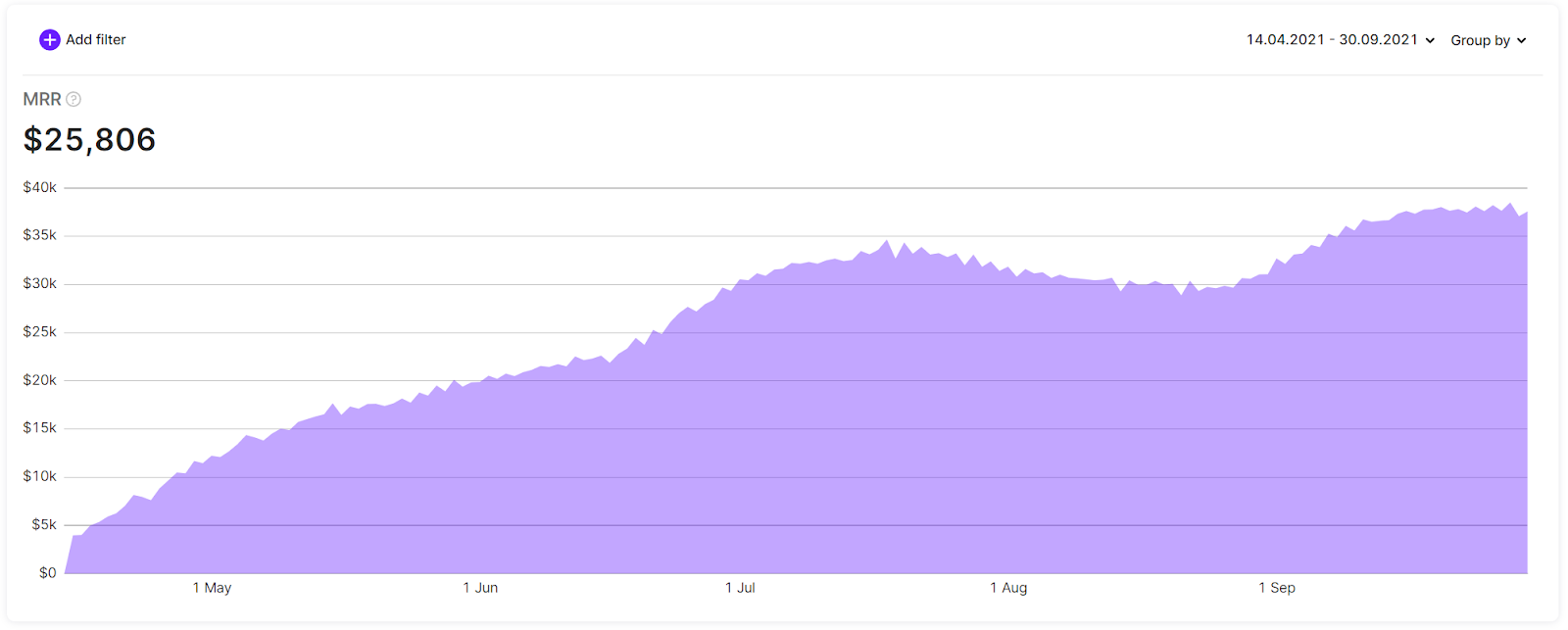
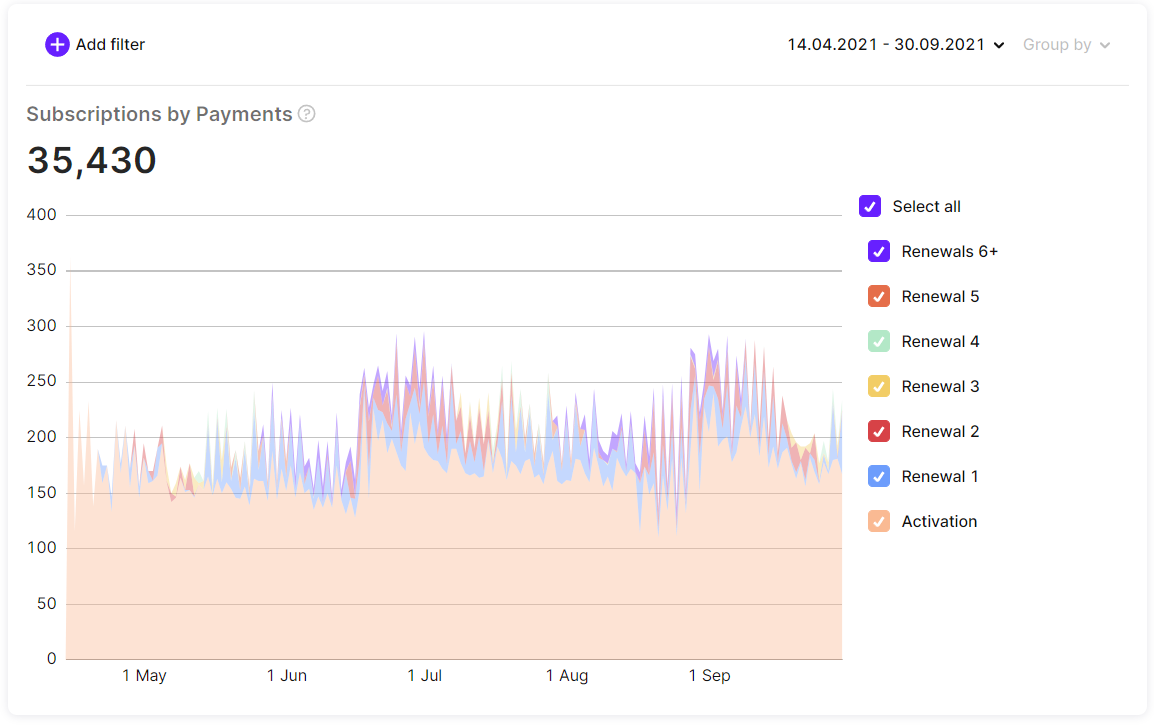
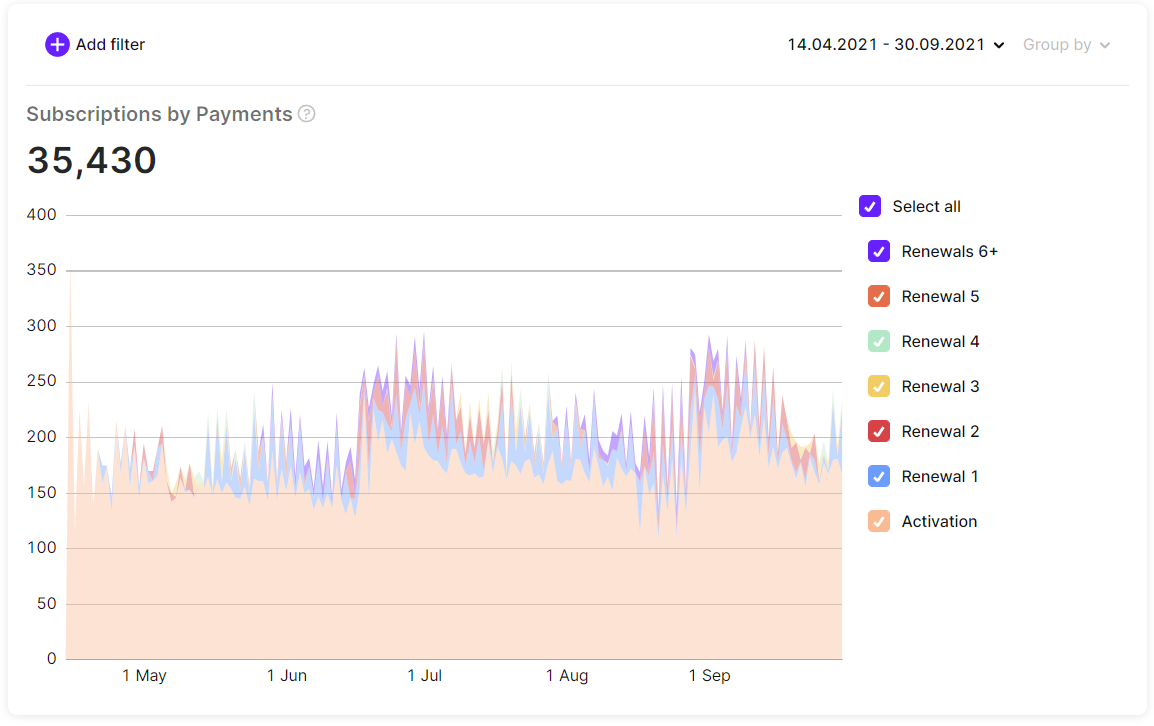
Here is why: The MRR chart illustrates monthly revenue growth. It might seem like a good sign. However, the revenue growth may be caused solely by the number of new subscribers growing. If the subscriptions will not automatically renew or the refund rate grows alongside them, then MRR growth alone cannot be considered a positive metric. Look at the payment events chart. If out of 35,000 events only 6 are rebills and most revenue comes from fresh subscriptions, that is not a good sign: once the developer stops spending on acquiring traffic, revenue will plummet. If the payment base is composed of long-term loyal subscribers, though, that is another thing entirely.
Cohort dynamics shows how much the customers care about the app and for how long they are ready to pay for using it. The developer can try pulling off various tricks, but the monetization data cannot lie. Therefore, you should prefer apps that give you the whole picture on their monetization. If you have the data, you can build a model forecasting how long the current subscriptions will remain active, calculate the LTV and CAC metrics, and compare them to the traffic data provided by the developer.
Red flags to watch for
A subscription-based app's revenue is usually composed of three parts: rebills, organic subscribers, and paid traffic subscribers. Everything is clear with rebills: the longer the subscription is renewed, the better. Be more careful with organic traffic. With mobile apps, organic subscriptions are most often manipulated or manufactured by incentivized traffic. Usually, both incentivized users and bots are involved. This traffic will inevitably plummet over time.
Tip: Be careful with apps that rank #1 for high and medium-value search terms. Even the #2 and #3 spots are more reliable with possible risks considered. As a rule of thumb, an app that continuously holds the #2 or #3 spot over a year is better than an app ranked #1 since a week ago. Here is a summary of common red flags and what to do about them:
| Red flag | What it might mean | What to do |
| Revenue spike right before listing | Seller inflated numbers with heavy ad spend | Request 12+ months of revenue and ad spend data |
| Very low rebill rate | Users do not find ongoing value | Analyze cohort retention curves in detail |
| No updates in 6+ months | Possible store compliance issues | Check store status and test a minor update |
| Sudden #1 ranking | Incentivized installs or bot traffic | Cross-reference installs with engagement metrics |
| Single traffic channel dependency | High risk if that channel changes | Assess diversification potential |
| Seller unwilling to share ad accounts | Possible data manipulation | Insist on guest access or walk away |
| iOS-only with single UA channel | Business relies on platforms you cannot control | Evaluate cross-platform expansion potential |
Paid traffic is another area requiring caution. From experience, it is quite rare to have a developer properly report on paid traffic present in their app. Analytics tools still are not perfect, and most people do not expect in advance they will need to sell the app. Accounts sometimes get lost or blocked. Request all the info the developer can reliably give and try to see if the numbers check out.
App purchase and transfer
The sale must be accompanied by signing an agreement. The best approach is to hire a lawyer who will help design a bilateral contract and make sure the buyer gets all the patents, IP rights, and associated assets. If the app is being sold on a marketplace or via escrow, the intermediary will usually handle the paperwork. Marketplaces typically charge success fees of up to 10% of the selling amount (sometimes higher). You can try negotiating with the developer outside the marketplace, but this poses certain risks. Once you reach an agreement, both parties sign a contract.
Then, the seller can either transfer the app from their developer account into yours, or transfer their entire developer account. In the former case, the app must be eligible for transfer — both the App Store and Google Play have strict guidelines outlining which apps are eligible and which are not. It is crucial that both the seller's app and the buyer's account meet these conditions. Paid subscriptions, ratings, and reviews will be transferred with the app.
You should also acquire the domain, the app's website, and the administrator's email address with all accounts relevant to the app. If the developer's account is transferred instead, it is the seller's duty to make sure the account only keeps those assets that are part of the deal. Do not forget to change the billing info in the profile. With the app, the developer also transfers the repository with its source code. Make sure the repository actually contains the code the app is using. If unsure, ask a developer you trust. Once you pay the seller and receive the app and accounts, the deal is considered closed.
Post-acquisition checklist
Here is what to do immediately after acquiring an app:
| Priority | Action | Timeline |
| 1 | Change all passwords, API keys, and admin credentials | Day 1 |
| 2 | Update billing info in developer accounts | Day 1 |
| 3 | Verify the codebase builds and deploys correctly | Week 1 |
| 4 | Set up your own analytics and subscription management (e.g., Adapty) | Week 1–2 |
| 5 | Audit and update privacy policy and terms of service | Week 1–2 |
| 6 | Review and optimize existing paywalls with A/B testing | Month 1 |
| 7 | Establish your own UA campaigns and track performance | Month 1–2 |
| 8 | Push a minor update to confirm store review process works | Month 1 |
Where to buy a mobile app?
You can buy apps on marketplaces, through brokers, or directly from developers. There are teams that specialize in buying undervalued apps, improving them, and reselling. There are funds that do the same on a larger scale.
| Platform | Type | Best for |
| Flippa | Marketplace | Broad selection, from small apps to $4M+ deals |
| AppWill | Marketplace | Mobile apps and games, verified listings |
| AppBusinessBrokers | Broker | Curated profitable app listings |
| FE International | M&A advisor | Mid-market to enterprise-level app deals |
| SellMyApp | Marketplace | App templates and source code |
| CodeCanyon | Marketplace | App templates and unfinished apps |
| AppCapital | Advisory / evaluation | App valuation and risk assessment |
Mobile apps are often sold as businesses, so you will find sellers on any marketplace where you can search for "online business" or "ready-made business." In 2026, the app acquisition market continues to heat up, with dedicated acquisition funds and roll-up studios actively seeking deals across health and fitness, productivity, utilities, and lifestyle categories.
How to increase the value of an acquired app
Once you have completed the purchase, the real work begins. Here are proven strategies for increasing the app's value post-acquisition:
Optimize the paywall. The fastest win for most acquired apps is improving the paywall. Use A/B testing to experiment with different layouts, pricing, and subscription plans. Tools like Adapty's Paywall Builder let you make changes without app store resubmission.
Diversify monetization. If the app relies on a single revenue stream (ads only, or a single subscription tier), introduce hybrid monetization. Apps with multiple income streams — subscriptions, in-app purchases, and ads — command a 15–30% premium in valuations.
Expand to other platforms. If the app is iOS-only, an Android version opens up the largest global user base. Web-to-app and app-to-web funnels can further increase subscriber retention and reduce platform fees.
Add AI features. In 2026, AI integration is a significant valuation multiplier. Even basic personalization — smarter content recommendations, AI-driven onboarding, or personalized pricing — can differentiate the app from competitors. AI-powered apps have seen revenue grow 136% year over year in recent reports.
Improve retention. Retention is the single most important signal for future buyers. Focus on onboarding optimization, push notification strategy, and regular content updates. According to industry benchmarks, even small retention improvements compound into significant revenue increases over time.
Final calculations
Buying an app is a complex affair that requires a thorough and delicate approach. However, the benefits of this kind of purchase may be tremendous. With the mobile app market exceeding $630 billion in 2026 and M&A activity recovering after a period of caution, there are significant opportunities for buyers who do their homework. The key is to approach any acquisition with discipline: verify all financial data independently, understand the technical and legal risks, evaluate the app's monetization potential, and have a clear plan for post-acquisition growth.
Unlock the full revenue potential of your acquired apps with Adapty. Schedule a free demo call and explore how we can assist in optimizing conversion rates and in-app subscriptions, ensuring that every app you buy is a profitable venture. You can also use our subscription calculator to get a rough estimate of the app's revenue based on your data.