Daily Active Users (DAU) measures the number of unique users who engage with your app within a 24-hour window. This metric is essential for understanding your app’s daily engagement levels and is particularly important for apps where daily interaction drives success, such as social media, gaming, and messaging platforms. DAU helps product teams assess user engagement, track campaign effectiveness, and identify patterns in user behavior.
What is Daily Active Users (DAU)?
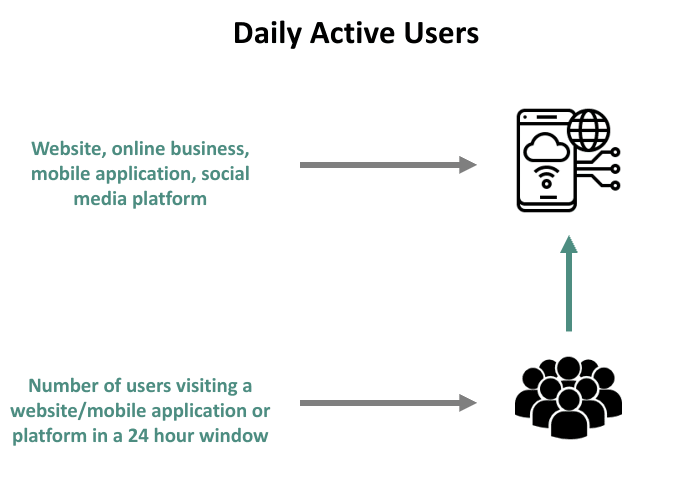
Daily Active Users (DAU) is a key performance metric that counts the number of unique users who interact with your mobile app or platform within a single day. Unlike simple download counts or total registered users, DAU focuses exclusively on users who actively engage with your product during a specific 24-hour period.
The term “unique” is crucial here—if one user opens your app ten times in a single day, they are still counted as just one daily active user. This distinction separates DAU from session-based metrics and provides a clearer picture of how many individual people find value in your product on any given day.
DAU serves as a real-time pulse check for your app’s health. A growing DAU indicates that your app is becoming more embedded in users’ daily routines, while a declining DAU may signal engagement issues that require immediate attention. For apps that rely on advertising revenue or in-app purchases, maintaining a strong DAU is directly tied to monetization potential.

What are active users?
An active user is someone who has downloaded your app and performed a meaningful interaction within a specified timeframe. However, the definition of “active” varies significantly depending on your app’s purpose and business model.
The most common definition considers a user “active” when they log into their account. However, this baseline definition may not capture true engagement for all app categories. More sophisticated approaches define activity based on actions that demonstrate genuine value exchange.
Examples of how different app types define “active” users:
- Gaming apps: Completing a level, participating in a daily challenge, or making an in-game action
- E-commerce apps: Adding an item to cart, browsing products, or completing a purchase
- Financial apps: Making a transaction, checking account balance, or transferring funds
- Social media apps: Posting content, liking, commenting, or sharing
- Messaging apps: Sending or receiving a message
- News apps: Reading at least one full article
- Fitness apps: Logging a workout or tracking health data
The key is to define “active” in a way that aligns with your app’s core value proposition. A user who briefly opens your app but takes no meaningful action may not represent true engagement, even though they technically “used” the product.
Users are typically identified through unique identifiers such as user IDs, device identifiers (IDFA for iOS, GAID for Android), email addresses, or a combination of these when one method fails.
How do you calculate DAU?
Calculating DAU requires a clear methodology and consistent tracking. Here’s a step-by-step approach:
Step 1: Define your “active” criteria
Before measuring anything, establish what constitutes an active interaction for your specific app. This definition should reflect meaningful engagement with your core features, not just passive app opens.
Step 2: Set your measurement window
DAU is measured over a strict 24-hour period. Most companies use Coordinated Universal Time (UTC) to ensure consistency across global user bases. Whatever timezone you choose, apply it consistently to maintain data integrity.
Step 3: Count unique users
Using your analytics platform, count the number of distinct user IDs that performed your defined active action within the 24-hour window. Remember: each user counts only once, regardless of how many times they engaged.
DAU calculation example
Consider a meditation app where “active” is defined as completing a meditation session:
- Day X activity:
- User A completes a 10-minute session, then closes the app
- User B opens the app but doesn’t start a session
- User C completes two sessions throughout the day
- User A returns and completes another session
- DAU for Day X: 2 (Users A and C)
- User A counts once (despite two sessions)
- User B is not counted (no completed session)
- User C counts once (despite multiple sessions)
Important considerations
- Track DAU over time rather than focusing on single-day numbers
- Use rolling averages (7-day or 30-day) to smooth out natural fluctuations
- Segment DAU by user cohorts, acquisition channels, or geographic regions for deeper insights
Why should you use DAU metric?
DAU provides unique insights that other metrics cannot deliver. Here’s why it matters for your app strategy:
Measure true engagement
A growing DAU indicates that users find ongoing value in your product. Unlike downloads or registrations, DAU reflects actual, repeated usage—the clearest sign that your app solves a real problem for users.
Get immediate feedback
DAU provides near-real-time feedback on product changes. Launch a new feature today, and you can see its impact on engagement tomorrow. This rapid feedback loop enables agile decision-making and quick course corrections.
Identify usage patterns
Tracking DAU over weeks and months reveals patterns in user behavior. You might discover higher engagement on weekdays versus weekends, or seasonal trends that affect usage. These insights inform marketing timing and content scheduling.
Detect technical issues early
A sudden, unexpected drop in DAU often signals technical problems—server outages, login bugs, or issues with a new app release. DAU serves as an early warning system for problems that require immediate attention.
Support other key metrics
DAU is foundational for calculating other critical metrics. Lifetime Value (LTV) depends on retention rates, which rely on active user data. Without accurate DAU tracking, your entire analytics framework loses reliability.
Track campaign effectiveness
Marketing campaigns should drive not just downloads but sustained engagement. By monitoring DAU before, during, and after campaigns, you can measure whether your marketing efforts translate into lasting user activity.
DAU/MAU ratio
The DAU/MAU ratio—also called the “stickiness ratio”—is one of the most powerful metrics derived from DAU. It measures what percentage of your monthly users engage with your app on a daily basis.
How to calculate DAU/MAU ratio
DAU/MAU Ratio = (Daily Active Users / Monthly Active Users) × 100

Practical example
If your app has 2,000 DAU and 8,000 MAU in a given month:
DAU/MAU = (2,000 / 8,000) × 100 = 25%
This means the average user engages with your app approximately 7-8 days per month (25% of 30 days).
- 10-20%: Average for most apps; indicates room for improvement
- 20-25%: Good engagement; users are forming habits around your product
- 25%+: Excellent; your app is becoming part of users’ daily routines
- 50%+: World-class; typical of highly addictive products like messaging apps
Industry benchmarks
The “ideal” ratio varies by app category:
- Social media and messaging apps: Often exceed 50% (daily use is expected)
- Gaming apps: Typically target 20-30%
- News and content apps: Usually range from 15-25%
- Utility and productivity apps: May have lower ratios but still be successful
When DAU/MAU doesn’t apply
This ratio isn’t meaningful for all products. Apps designed for infrequent use—travel booking, real estate, or ride-sharing—shouldn’t be evaluated by daily engagement. For these categories, weekly or monthly active users provide more relevant insights.
What is a good DAU count?
There’s no universal “good” DAU number—what matters is context and trajectory. A successful B2B productivity tool might thrive with 5,000 DAU, while a consumer social app might need millions to be viable.
Rather than fixating on a specific DAU target, monitor:
- Growth rate: Is DAU increasing over time?
- Stability: Are there concerning drops or unusual volatility?
- Correlation with business goals: Does DAU growth translate to revenue?
According to industry data, apps with a DAU/MAU ratio above 20% are performing well, while those exceeding 50% demonstrate exceptional engagement. However, these benchmarks apply primarily to apps where daily usage is realistic.
When evaluating your DAU, consider:
- App category: Gaming and social apps naturally have higher DAU expectations than finance or travel apps
- User base size: A 10% DAU increase means different things for 1,000 users versus 1 million
- Seasonality: Some apps have predictable fluctuations (fitness apps in January, shopping apps during holidays)
- Competitive landscape: How does your DAU compare to similar apps in your category?
Be cautious if:
- DAU declines steadily over multiple weeks
- DAU/MAU ratio drops below 10% for an app designed for frequent use
- DAU growth doesn’t correlate with user acquisition (indicating retention problems)
How can you increase DAU?
Boosting DAU requires a multi-channel approach focused on creating value that brings users back daily.
1. Push notifications
Push notifications are powerful re-engagement tools when used thoughtfully. The key is delivering genuine value, not interruptions.
Best practices:
- Personalize notifications based on user behavior and preferences
- Time notifications when users are most likely to engage
- Focus on value-driven messages (new content, time-sensitive offers, relevant updates)
- Avoid over-notification, which drives uninstalls
- A/B test notification content and timing to optimize performance
2. In-app messages
Personalized in-app messaging significantly impacts retention. Research shows that apps using tailored in-app messages see retention rates of 61-74% within 28 days, compared to 49% for generic messaging.
Effective strategies:
- Welcome messages for new users
- Feature discovery prompts
- Progress updates and achievements
- Personalized content recommendations
- Contextual help and tips
3. Email and SMS re-engagement
For users who haven’t opened your app recently, external channels can reignite interest:
- Share new features or content updates
- Offer exclusive promotions or rewards
- Provide personalized recommendations based on past behavior
- Create urgency with time-limited offers
4. Deep linking
Deep links direct users to specific in-app content rather than generic home screens. When a user clicks a notification about a new feature, deep linking takes them directly to that feature—reducing friction and increasing engagement likelihood.
Applications:
- Marketing campaign links that open relevant app sections
- Email links that continue in-app journeys
- Social sharing that brings users to specific content
- QR codes that trigger targeted experiences
5. Gamification and daily rewards
Creating daily incentives encourages habitual usage:
- Daily login bonuses or streaks
- Limited-time challenges and events
- Progress tracking and achievements
- Leaderboards and social competition
6. Continuous product improvement
Ultimately, the best way to increase DAU is to build a product users genuinely want to use daily:
- Gather and act on user feedback
- Regularly release meaningful updates
- Fix bugs and performance issues quickly
- Add features that enhance core value propositions
Key takeaways
- DAU measures unique daily users: It counts individual users who engage meaningfully with your app within a 24-hour period, with each person counted only once regardless of session frequency.
- Define “active” strategically: Your definition of an active user should align with your app’s core value proposition—a login may not be enough for apps where deeper engagement matters.
- Use DAU/MAU for stickiness: The ratio between daily and monthly active users reveals how habitual your product has become, with 20%+ considered good and 50%+ indicating world-class engagement.
- Context determines “good” DAU: Focus on growth trends and business correlation rather than absolute numbers, as appropriate benchmarks vary dramatically by app category.
- Combine DAU with other metrics: DAU alone can be misleading—pair it with retention rates, LTV, revenue metrics, and user feedback for a complete picture of app health.
- Increase DAU through multiple channels: Leverage push notifications, in-app messages, email, deep linking, and gamification to create daily engagement habits, but always prioritize genuine user value over manipulation.
- Monitor for immediate feedback: DAU’s daily granularity makes it ideal for measuring the impact of feature launches, marketing campaigns, and identifying technical issues quickly.