User acquisition refers to the strategies and activities used to attract new users to a mobile app or platform. It encompasses paid advertising, organic discovery, and referral programs working together to drive installs and grow an engaged user base. Understanding UA fundamentals is essential for app developers and marketers looking to scale their products profitably.
What is user acquisition?
User acquisition, commonly abbreviated as UA, is the process of attracting new users to a mobile app, website, service, or platform through marketing activities. While other industries might refer to this as customer acquisition, the mobile app ecosystem prefers the term “user” since not everyone who downloads an app becomes a paying customer.
The primary goal of user acquisition is to increase the number of app installs while ensuring those users are high-quality and likely to engage with the app over time. This involves identifying target audiences, selecting appropriate marketing channels, creating compelling messaging, and optimizing campaigns based on performance data.
For mobile apps specifically, user acquisition is critical because scale directly impacts monetization potential. Whether an app generates revenue through in-app purchases, subscriptions, or advertising, having a large and active user base is essential for financial sustainability.
How does user acquisition work?
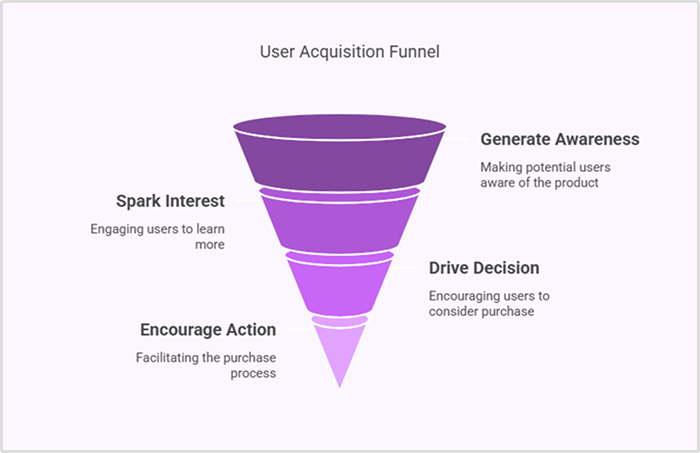
User acquisition operates through a combination of paid and organic channels designed to reach potential users and convince them to download an app. The process typically follows these stages:
Audience identification involves defining the ideal user profile based on demographics, behaviors, interests, and device preferences. This targeting ensures marketing spend reaches people most likely to find value in the app.
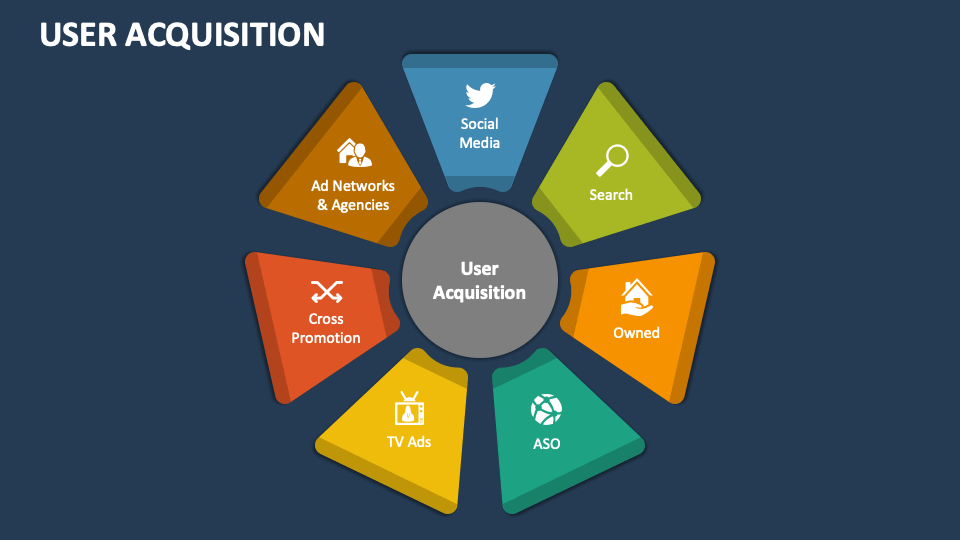
Channel selection determines where to reach the target audience. This might include social media platforms, search engines, ad networks, content partnerships, or the app stores themselves. Different channels serve different purposes within the overall acquisition strategy.
Creative development focuses on producing ads, landing pages, and app store assets that communicate the app’s value proposition. Effective creatives demonstrate what makes the app unique and why users should download it.
Campaign execution puts the strategy into action across selected channels. This includes setting budgets, configuring targeting parameters, launching ads, and monitoring initial performance.
Optimization involves analyzing campaign data to identify what works and what doesn’t. Marketers adjust targeting, creatives, bidding strategies, and channel allocation to improve efficiency and results over time.
The entire process is cyclical, with insights from each campaign informing future strategies. Successful user acquisition requires continuous testing, learning, and refinement based on performance metrics.
Why is user acquisition important?
With millions of apps available across iOS and Android stores, organic discovery alone rarely drives sufficient growth. User acquisition provides the structured approach needed to stand out in a crowded marketplace.
Scale enables monetization. Whether through in-app purchases, subscriptions, or advertising revenue, apps need active users to generate income. UA provides the mechanism to build and maintain the user base required for sustainable revenue.
App store visibility improves with downloads. Store algorithms factor download velocity and volume into ranking calculations. Strong user acquisition can create a virtuous cycle where paid installs boost organic visibility, which drives additional free installs.
Quality users deliver better outcomes. Effective UA doesn’t just drive volume—it attracts users who match the app’s target profile. These users are more likely to engage, convert to paying customers, and remain active over time.
Competitive positioning requires proactive growth. In most app categories, competitors are actively acquiring users. Apps that don’t invest in acquisition risk losing market share to those that do.
Data-driven improvement becomes possible. UA campaigns generate valuable data about what messages resonate, which audiences respond, and where the best users come from. This intelligence improves not just marketing but product development as well.
Key components of user acquisition
Paid acquisition
Paid acquisition involves spending money to promote an app through advertising channels. This provides immediate visibility and can be precisely targeted to specific audiences. Common paid channels include social media advertising on platforms like Meta, TikTok, and Snapchat; search advertising through Google and Apple; mobile ad networks that display ads within other apps; and programmatic advertising purchased through demand-side platforms.
Paid acquisition offers control over targeting, budget, and timing. Marketers can reach specific demographics, interests, or behaviors and adjust campaigns in real-time based on performance. However, it requires ongoing investment and careful management to remain cost-effective.
Organic acquisition
Organic acquisition refers to users who discover and download an app without direct paid promotion. This includes users who find the app through app store browsing, word-of-mouth recommendations, press coverage, or social media mentions.
While organic users are technically “free,” building organic acquisition channels requires investment in brand awareness, public relations, community building, and product quality. Apps with strong organic acquisition benefit from lower overall customer acquisition costs and often see higher user quality since these users actively sought out the app.
App Store Optimization (ASO)
App Store Optimization is the practice of improving an app’s visibility and conversion rate within the iOS App Store and Google Play Store. ASO focuses on optimizing elements that influence how apps rank in search results and how well store listings convert browsers into installers.
Key ASO components include title and subtitle optimization with relevant keywords, compelling app descriptions that communicate value, high-quality screenshots and preview videos, encouraging and managing user reviews and ratings, and strategic category and keyword selection.
Effective ASO improves both paid and organic acquisition by ensuring the app store listing converts the traffic that marketing efforts generate. Even the best advertising campaign fails if users land on an unappealing store page.
Content and social media
Content marketing and social media presence support user acquisition by building awareness, demonstrating expertise, and engaging potential users before they reach the app store.
Content strategies might include blog posts addressing problems the app solves, video content showcasing app features, user-generated content from satisfied customers, influencer partnerships that provide authentic endorsements, and community engagement on relevant platforms.
These approaches build long-term brand equity and create multiple touchpoints with potential users. While content and social rarely drive immediate conversions at scale, they contribute to overall acquisition efficiency by warming audiences before they encounter paid advertising.
Referral programs
Referral programs incentivize existing users to recommend the app to friends, family, or colleagues. These programs leverage the trust inherent in personal recommendations to acquire new users at lower costs than traditional advertising.
Effective referral programs offer meaningful incentives to both the referring user and the new user, make sharing simple and frictionless, track referrals accurately to ensure rewards delivery, and integrate naturally into the user experience rather than feeling forced.
Users acquired through referrals often show higher engagement and retention because they come with a personal endorsement and may already understand the app’s value proposition.
Key metrics for user acquisition measurement
Understanding UA performance requires tracking multiple metrics that together provide a complete picture of efficiency, quality, and profitability.
| Metric | Formula | What it measures |
|---|---|---|
| Cost Per Install (CPI) | Total campaign spend ÷ Number of installs | The average cost to acquire each new app install |
| Cost Per Acquisition (CPA) | Total campaign spend ÷ Number of desired actions | Cost to drive specific actions like purchases or registrations |
| Customer Acquisition Cost (CAC) | Total sales and marketing cost ÷ Number of new customers | Comprehensive cost including all acquisition-related expenses |
| Conversion Rate (CVR) | (Number of conversions ÷ Number of interactions) × 100 | Percentage of users who complete desired actions |
| Lifetime Value (LTV) | Average purchase value × Number of purchases × Retention period | Total revenue expected from a user over their entire engagement |
| Average Revenue Per User (ARPU) | Total revenue in period ÷ Number of users in period | Revenue generated per user within a specific timeframe |
| Return on Ad Spend (ROAS) | (Revenue from campaign ÷ Campaign spend) × 100 | Revenue generated for each dollar spent on advertising |
| Churn Rate | (Users lost ÷ Total users) × 100 | Percentage of users who stop using the app |
The relationship between these metrics matters as much as individual values. For example, comparing LTV to CAC reveals whether acquired users generate more revenue than they cost to acquire. A healthy ratio indicates sustainable growth, while a ratio below 1:1 suggests the acquisition strategy is losing money.
For hybrid apps and cross-platform products, these metrics should be tracked separately by platform to identify performance differences and optimize accordingly.
How to create a strategic user acquisition plan?
Building an effective UA strategy requires systematic planning that aligns marketing activities with business objectives.
Define clear goals by establishing specific, measurable targets for user acquisition. These might include install volumes, CAC thresholds, ROAS targets, or user quality benchmarks. Goals should connect to broader business objectives like revenue targets or market share ambitions.
Understand your audience through research into who your ideal users are, what problems they face, where they spend time online, and what motivates them to try new apps. This understanding informs targeting decisions and creative messaging across all channels.
Select appropriate channels based on where your target audience can be reached and what your budget allows. Different channels serve different purposes—some drive volume efficiently while others deliver higher-quality users at premium prices. A balanced portfolio typically outperforms over-reliance on any single channel.
Develop compelling creatives that communicate your app’s unique value proposition clearly and quickly. Mobile users make snap decisions, so creative assets must grab attention and convey benefits immediately. Plan for testing multiple creative variations to identify top performers.
Establish measurement infrastructure by implementing tracking tools that capture accurate data about campaign performance, user behavior, and downstream outcomes. Without reliable measurement, optimization becomes guesswork.
Plan for iteration by building testing into your strategy from the start. Budget time and resources for A/B testing creatives, experimenting with new channels, and refining targeting based on performance data.
For a comprehensive guide to building and executing mobile user acquisition strategies, see Adapty’s Mobile User Acquisition Guide.
Top 7 mistakes in user acquisition
Even experienced marketers make errors that undermine UA effectiveness. Common pitfalls include:
- Focusing solely on install volume without considering user quality leads to high acquisition costs and poor retention. Apps that optimize only for installs often acquire users who never engage meaningfully.
- Neglecting attribution and measurement makes it impossible to understand what’s working and why. Without proper tracking, budget allocation becomes arbitrary rather than data-driven.
- Ignoring lifetime value in favor of front-end metrics like CPI causes marketers to optimize for the wrong outcomes. A higher CPI may be worthwhile if those users deliver substantially higher lifetime value.
- Underinvesting in creative testing leaves performance on the table. Creative fatigue is real, and even top-performing ads eventually decline. Continuous creative development keeps campaigns fresh and effective.
- Treating all channels identically ignores the unique characteristics and best practices for each platform. What works on TikTok differs from what succeeds on Google Ads, and strategies should reflect these differences.
- Setting and forgetting campaigns wastes budget as market conditions, competition, and user behavior change constantly. Active campaign management identifies problems early and capitalizes on opportunities quickly.
- Overlooking app store optimization undermines conversion of the traffic that campaigns generate. Even excellent advertising can’t overcome a poor store listing.
For detailed analysis of these and other common mistakes, read Adapty’s guide to the Top 10 User Acquisition Mistakes.