

Subscription fatigue is the overwhelm and frustration consumers feel when they manage too many recurring services at once — when the cognitive and financial cost of tracking, evaluating, and paying for subscriptions starts to exceed the perceived value of any one of them. Originally tied to streaming, the term now applies across SaaS, mobile apps, news, fitness, and direct-to-consumer boxes. For subscription businesses, fatigue shows up as higher churn rate, harder acquisition, and growing price sensitivity at every renewal point.
Why subscription fatigue happens
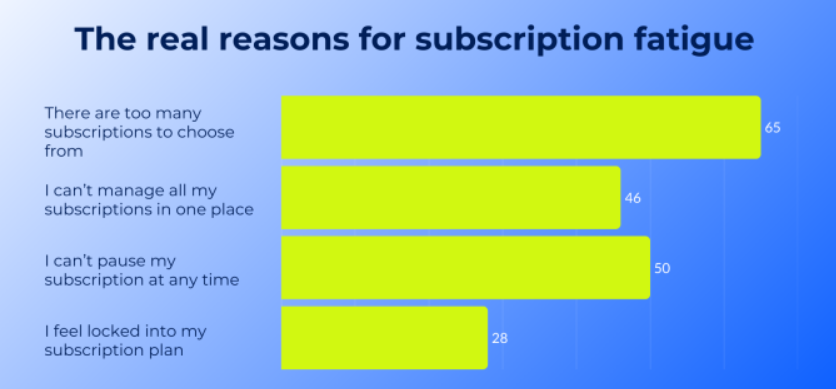
Subscription fatigue is not a single behavior but a cluster of overlapping pressures that build up across a consumer’s entire bill stack. Most fatigue researchers point to five primary drivers — and each one has a direct counterpart in how subscription businesses are designed.
Choice overload and decision fatigue
In nearly every category, consumers now face dozens of viable subscription options. Psychologist Barry Schwartz called this the “paradox of choice”: when people are bombarded with too many options, they make worse decisions, feel less satisfied with the ones they make, and often delay deciding at all. Applied to subscriptions, this means a sign-up that should feel like a small commitment becomes another draining decision in a long line of them.
Cumulative financial burden
Individual subscriptions feel small. Collectively they don’t. A 2024 CNET study found U.S. adults spend an average of $91 per month on subscriptions, while a separate study showed consumers thought they were spending $86 monthly when they were actually spending $219 — a $133 gap per month. A Waterstone Management Group study reported that 84% of surveyed Americans underestimated their subscription spending. Once consumers do an audit, the number is almost always higher than they expected, which triggers cancellations.
Eroding perceived value
Fatigue accelerates whenever a subscription stops feeling worth it. Causes include repetitive content, missing or stripped-back features, free-shipping or loyalty perks being removed, and unannounced price increases. Deloitte’s 2025 Digital Media Trends report found 47% of consumers believe they pay too much for the streaming services they use, and 41% say the available content isn’t worth the price.
Administrative overhead
Each subscription brings its own login, billing date, payment method, and renewal cycle. C+R Research found that 74% of consumers say recurring charges are easy to forget, and roughly two-thirds admit to forgetting to cancel a free trial before being billed. The mental cost of managing 8 to 12 active subscriptions becomes its own reason to cancel.
Dark patterns and forced commitments
When sign-up is one click but cancellation requires phone calls, retention scripts, or hidden menus, fatigue becomes resentment. Regulators are responding: the U.S. Federal Trade Commission’s Click-to-Cancel rule was vacated by the Eighth Circuit in July 2025, but the agency restarted negative-option rulemaking in March 2026 and continues to bring enforcement actions against companies whose cancellation flows are deliberately hard to navigate.
Subscription fatigue by the numbers
The data has shifted from anecdotal to clearly measurable. The figures below summarize the most recent research across consumer surveys and category studies.
| Metric | Figure | Source / context |
|---|---|---|
| Consumers reporting subscription fatigue | 41% | Marketing LTB, 2025 |
| Streaming subscribers who canceled at least one service due to fatigue | 41% | CivicScience, 2025 |
| Subscribers who feel they have too many streaming subscriptions | 42% | Simon-Kucher Global Streaming Study |
| Average U.S. household streaming subscriptions | 4.1 | Deloitte Digital Media Trends, 2025 |
| U.S. households that canceled a streaming service in the past 6 months | 39% | Deloitte Digital Media Trends, 2025 |
| Average monthly U.S. subscription spend (perceived vs. actual) | $86 vs. $219 | Consumer spending study, 2022 |
| Consumers who underestimate their subscription spending | 84% | Waterstone Management Group |
| Recurring charges consumers say are easy to forget | 74% | C+R Research |
| Cancellation reduction when a pause option is offered | Up to 25% | Recurly retention data |
How subscription fatigue shows up across industries
Fatigue does not hit every category at the same intensity. Services that are deeply embedded in daily routines hold up far better than commoditized or content-driven ones. The table below summarizes how fatigue typically presents in each major sector.
| Industry | Primary fatigue trigger | Typical user reaction |
|---|---|---|
| Video streaming | Library fragmentation, price hikes | Cycle: subscribe, binge, cancel |
| Music streaming | Overlap with bundled or family plans | Consolidation to one provider |
| News and publishing | Paywall density across many outlets | Cancellation, ad-supported tiers |
| SaaS and B2B tools | Tool sprawl, seat-based escalation | Vendor consolidation, contract renegotiation |
| Mobile apps | Weekly billing, repeat trial pop-ups | Quick churn, refund requests |
| DTC product boxes | Inventory pile-up, lifestyle drift | Skips, pauses, full cancellation |
| Health and fitness | Drop in usage frequency | Pause first, cancel within 2 cycles |
Subscription fatigue vs. churn — how they differ
Subscription fatigue and churn are closely linked but not the same thing. Fatigue is the underlying consumer state; churn is the business outcome it produces. Distinguishing the two helps teams diagnose which lever to pull.
| Dimension | Subscription fatigue | Churn |
|---|---|---|
| What it describes | A consumer state across the whole subscription stack | A measurable cancellation event for a single service |
| Where it lives | In the user’s head and household budget | In your billing system |
| How it’s measured | Surveys, exit interviews, market data | Cancellation rate, retention curves, MRR impact |
| Lever to address it | Value, transparency, flexibility, personalization | Onboarding, save offers, dunning, win-back |
| When it shows up | Anytime — including before sign-up | At renewal or trial-end events |
What subscription fatigue means for mobile apps
Mobile apps sit at the front line of subscription fatigue because the install-to-pay funnel is short, the choice set is enormous, and users can cancel through their device settings in seconds. Adapty’s State of in-app subscriptions 2026, based on $3 billion in subscription revenue across 16,000+ apps, reveals three patterns where fatigue most directly shapes outcomes.
Weekly plans are now the default
Weekly subscriptions accounted for roughly 56% of all app subscription revenue in 2025, up from 43% just two years earlier. Users want low-commitment entry points — partly because they have been burned by long contracts elsewhere. The flip side is that 65% of weekly subscribers cancel within the first 30 days, so the model only works when value is delivered fast.
Day 0 is the entire conversion window
Around 90% of trial starts happen in the first session after install. Users who don’t convert during onboarding rarely come back to the paywall. This is fatigue compressed into a single moment: people have already decided they will not maintain another subscription unless this one earns it immediately. Paywall optimization and onboarding design therefore matter far more than re-engagement campaigns.
Trial fatigue and refund risk
Free trials still lift retention — trial subscribers renew 8 to 60% better at first renewal depending on plan type — but they don’t universally lift LTV. In Productivity and Lifestyle apps, direct buyers are worth more at 12 months than trial users, while in Utilities and Health & Fitness the trial premium reaches +85% and +64% respectively. Refund rates also rise sharply when fatigued users sign up for a trial they never intended to keep. See the Adapty research on free trial vs. direct purchase for the category-level breakdown.
How to reduce subscription fatigue
No single tactic eliminates fatigue, but the strongest retention strategies all attack it on multiple fronts at once. The table below summarizes the most evidence-backed levers.
| Strategy | What it addresses | Typical impact |
|---|---|---|
| Faster time-to-value in onboarding | Day 0 decision pressure, refund risk | Higher trial-to-paid, lower refunds |
| Transparent, simple pricing | Hidden cost anxiety | Higher trust, fewer cancellations |
| Pause, skip, swap options | Loss of usage relevance | Up to 25% fewer cancellations |
| Personalized paywalls and offers | Choice overload | Higher conversion, higher LTV |
| Effortless cancellation flows | Dark-pattern resentment | Improved brand trust, reduced refund disputes |
| Bundling and family plans | Multiple separate bills | Higher household retention |
Lead with demonstrable value
The most reliable defense against fatigue is making sure users experience a clear win before the paywall arrives. In utility-style and habit-forming categories, that means routing users to a small but tangible outcome — a finished journal entry, a measured workout, a usable export — within the first session.
Make pricing transparent and simple
Complicated tier matrices and surprise renewals fuel fatigue more than the price itself. Use clear plan names, single headline prices, and unambiguous renewal terms. Offering a freemium tier alongside paid plans gives uncertain users a low-stakes way to get in.
Build flexibility into the lifecycle
Pause, skip, swap, and frequency adjustments protect retention by giving users an option short of cancellation. Recurly’s data shows that around 25% of subscribers who would have cancelled choose to pause when given the option. The same logic applies in mobile: a pause flow inside a self-service portal often saves the relationship.
Personalize the offer and the renewal
Generic paywalls and one-size-fits-all renewals are a fatigue accelerant. Segmenting by user behavior, region, and stage of the funnel — and adjusting price points, plan length, and trial structure accordingly — consistently beats static pricing. The broader pattern is documented in Adapty’s analysis of subscription economy trends shaping the market.
Make cancellation effortless
This sounds counterintuitive, but easy cancellation reduces fatigue and improves long-term LTV. Customers who can leave without friction are more likely to return when their needs change. With regulators on both sides of the Atlantic actively scrutinizing dark patterns, making cancellation as easy as sign-up has shifted from competitive advantage to baseline expectation.