

Return on ad spend (ROAS) is a marketing metric that measures how much revenue an advertising campaign generates for every dollar spent on it. It is calculated by dividing the revenue attributed to ads by the ad cost, and is typically expressed as a ratio (e.g., 4:1), a multiplier (4x), or a percentage (400%). ROAS tells marketers whether paid campaigns are pulling their weight, where to allocate more budget, and where to cut. Unlike ROI, it focuses only on advertising performance, which makes it the primary KPI for user acquisition teams running mobile and digital campaigns.
How to calculate ROAS
The ROAS formula is intentionally simple, which is part of its appeal. You take the revenue produced by an advertising campaign and divide it by the cost of running that campaign over the same period.
ROAS formula
ROAS = Revenue from ads ÷ Cost of ads
The result can be expressed in several ways depending on how your team prefers to read the numbers. A campaign that returned $5,000 on $1,000 of ad spend can be reported as 5:1, 5x, 500%, or simply 5. They all describe the same thing: every dollar of ad spend produced five dollars of attributed revenue.
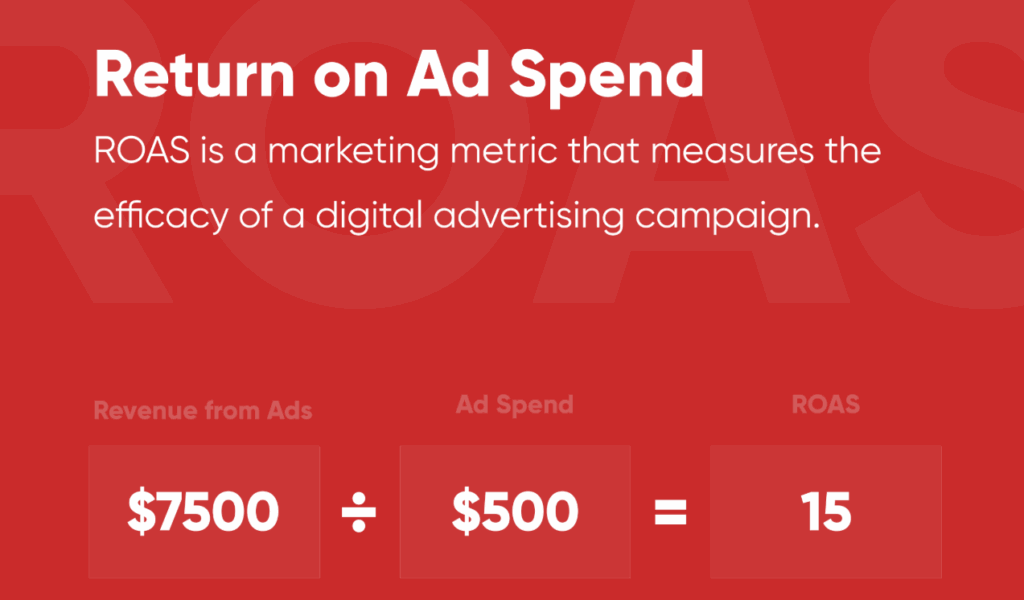
ROAS calculation example
Suppose you run a paid social campaign for a fitness subscription app. You spend $2,000 on ads over a month and attribute $7,000 in subscription revenue to that campaign. Your ROAS is $7,000 ÷ $2,000 = 3.5, or 3.5:1. For every dollar invested in ads, the campaign returned $3.50 in revenue.
The table below shows how the same formula plays out across different spend and revenue scenarios:
| Ad spend | Attributed revenue | ROAS (ratio) | ROAS (%) | Interpretation |
|---|---|---|---|---|
| $1,000 | $500 | 0.5:1 | 50% | Losing money on ads |
| $1,000 | $1,000 | 1:1 | 100% | Break-even on ad spend only |
| $1,000 | $3,000 | 3:1 | 300% | Healthy for many app categories |
| $1,000 | $4,000 | 4:1 | 400% | Common cross-industry benchmark |
| $1,000 | $10,000 | 10:1 | 1,000% | Strong return; review attribution |
What counts as ad spend
The denominator looks simple but quietly hides decisions that change the answer. A “narrow” ROAS counts only the media buy: dollars handed to Meta, Google, TikTok, Apple Search Ads, and so on. A “true” or fully loaded ROAS adds creative production, agency or contractor fees, attribution and analytics tools, and the salaries of the people running the campaigns. Both views are useful, but they are not interchangeable. Most teams report campaign-level ROAS using direct media spend and a separate, fully loaded version for executive reporting and finance.
What counts as revenue
For ecommerce brands, revenue is straightforward—it is the order value attributed to the campaign. Subscription apps need to make a choice. Day-1 ROAS counts only the first payment from each acquired user, which is fast to measure but understates value. Cohort ROAS (e.g., Day-30, Day-90, Day-180) tracks the same users as renewals come in, which is far more accurate but slower. Many user acquisition teams set a target Day-N ROAS based on their expected LTV and use it as the threshold for scaling a campaign.
ROAS vs ROI vs CPA
ROAS is often confused with ROI and CPA, but each metric answers a different question. The simplest way to keep them straight: ROAS is about revenue from ads, ROI is about profit from the whole business, and CPA is about how much it costs to acquire a single conversion.
| Metric | Formula | What it measures | Best used for |
|---|---|---|---|
| ROAS | Revenue ÷ Ad spend | Revenue efficiency of an ad campaign | Campaign and channel optimization |
| ROI | (Net profit ÷ Total investment) × 100 | Overall profitability after all costs | Business-level decisions |
| CPA | Ad spend ÷ Number of conversions | Cost of acquiring one conversion | Bid management and acquisition cost control |
| ACOS | (Ad spend ÷ Revenue) × 100 | Inverse of ROAS, expressed as % | Amazon Ads and retail media reporting |
One important consequence: a campaign can have a positive ROAS and a negative ROI at the same time. ROAS only sees ad spend on the cost side, so if your fully loaded business costs (servers, salaries, payment processing, refunds) eat into the revenue, the campaign can still look healthy in the ad platform while the business is losing money. That is why ROAS is a campaign metric, not a sole indicator of company health. For a deeper comparison applied to mobile, see ROI vs ROAS for mobile apps.
What is a good ROAS?
There is no universal “good” ROAS. The honest answer is that it depends on profit margin, business model, and growth stage. A widely cited rule of thumb is 4:1—four dollars of revenue for every dollar of ad spend—but cash-strapped startups may need 10:1 to stay afloat, while well-funded subscription businesses with high gross margins can scale profitably at 1.5:1 or 2:1.
Break-even ROAS
Before chasing a benchmark, calculate your break-even ROAS, which is the ratio at which ad revenue exactly covers all costs. The shortcut formula is:
Break-even ROAS = 1 ÷ Profit margin
If your gross margin per customer is 25%, you need a 4:1 ROAS just to avoid losing money. If your margin is 75%—closer to a typical subscription app with low marginal serving costs—you only need 1.33:1 to break even. Anything above that contributes to profit.
Benchmarks by scenario
| Scenario | Typical target ROAS | Why |
|---|---|---|
| Cross-industry rule of thumb | 4:1 | Common starting benchmark for paid media |
| Ecommerce, average margins | 3:1 to 4:1 | Covers product costs, fees, and overhead |
| Low-margin retail | 5:1 to 10:1 | Thin margins demand higher revenue per ad dollar |
| Subscription apps (Day-1 ROAS) | 0.3 to 0.6 | First payment only; payback is reached over months |
| Subscription apps (Day-180 ROAS) | ≥ 1.0 | Cohort has paid back acquisition cost |
| Brand awareness campaigns | Lower | Goal is reach and recall, not direct revenue |
Why ROAS matters for subscription apps
For mobile subscription businesses, ROAS is more than a marketing report card. It directly governs how aggressively you can spend on user acquisition and how confidently you can forecast cash flow.
It connects ad spend to monetization
Most subscription apps live or die on the gap between what it costs to acquire a user and what that user pays back over their subscription lifetime. ROAS, especially when measured at cohort level, makes that gap legible: you can see exactly when an acquisition cohort crosses 1.0 and starts producing profit. This is why high LTV and high ROAS together let teams bid more aggressively and expand into more expensive channels.
It identifies which campaigns deserve more budget
ROAS can be calculated at almost any granularity—channel, campaign, ad set, creative, keyword, or country. Comparing ROAS across these slices tells you where to scale and where to pull back. A Facebook Advantage+ campaign at 2.8x and an Apple Search Ads brand-defense campaign at 9x are both useful, but they should not be funded at the same rate.
It plugs into financing decisions
Apps with predictable, well-measured ROAS curves can use that data to access non-dilutive capital and reinvest faster than they otherwise could. The faster a cohort crosses break-even ROAS, the shorter the payback period, and the more efficiently every reinvestment compounds.
What ROAS does not show
ROAS is a useful metric, not a complete one. A few honest caveats:
- It is short-term by nature. ROAS is most accurate for the immediate revenue tied to a campaign, while subscription value unfolds over months. Pair it with LTV to see the long view.
- It does not show volume. A small campaign with one cheap conversion can post a stellar ROAS while contributing nothing meaningful to revenue.
- It rewards last-click attribution. A high-ROAS retargeting campaign may be claiming credit for users that an upper-funnel campaign actually warmed up.
- Privacy frameworks limit precision. On iOS, SKAdNetwork postbacks aggregate and delay revenue signals, so user-level ROAS is rarely as clean as it was pre-ATT.
How to improve ROAS
Improving ROAS comes down to the same equation it is built on: drive more revenue per ad dollar, or spend fewer dollars to produce the same revenue. The tactics below cover both sides.
| Lever | Tactics |
|---|---|
| Targeting | Build lookalike audiences from your highest-LTV users; exclude segments with low retention |
| Creative | A/B test hooks, formats, and messaging; refresh winners before fatigue sets in |
| Funnel | Match landing pages and onboarding to ad messaging; remove friction from the first session |
| Bidding | Use value-based or tROAS bidding where supported; cap bids in low-converting placements |
| Pricing and paywalls | Run paywall experiments to lift trial-to-paid and ARPU on the same traffic |
| Attribution | Tighten what counts as ad spend and ad revenue so the numerator and denominator are consistent |
| Channel mix | Reallocate budget toward high-ROAS channels; test new platforms with small holdouts |
One under-used tactic for subscription apps is correlating early in-app behavior with long-term monetization. If users who complete onboarding within 24 hours pay back acquisition cost twice as fast as those who don’t, you can optimize campaigns toward that early signal instead of waiting weeks for revenue data. This is the basis of predictive ROAS, and it pairs well with disciplined customer acquisition cost analysis.
ROAS in mobile measurement
ROAS is harder to measure on mobile than on the open web because of platform privacy frameworks and the complexity of in-app monetization. A few specifics worth knowing:
- iOS and SKAdNetwork. With most users opting out of tracking, deterministic user-level attribution is rare. Marketers rely on SKAN postbacks, conversion-value mapping, and modeled cohort revenue to estimate ROAS.
- Android. Privacy Sandbox is changing what is measurable, but Android still allows more granular attribution than iOS in most cases.
- MMPs. Mobile measurement partners aggregate cost and revenue across networks so ROAS can be compared on a consistent basis. Adapty integrates with major MMPs so subscription revenue flows back into the same dashboards as cost per install.
- Apple Search Ads. Search Ads has its own attribution and is increasingly judged on ROAS rather than CPI, especially as keyword-level revenue tracking becomes available.