Monthly Active Users (MAU) represents the number of unique users who engage with your app within a 30-day window. Unlike daily active users (DAU), MAU is typically used by travel, financial, or utility apps where users are expected to interact a few times a month rather than daily. This metric helps businesses assess overall app health, evaluate marketing effectiveness, and forecast growth potential. When combined with DAU to calculate the stickiness ratio, MAU provides valuable insights into user loyalty and engagement patterns.
What is Monthly Active Users (MAU)?
Monthly Active Users (MAU) is a key performance metric that measures the number of unique users who engage with an app, website, or digital platform within a 30-day period. Unlike daily active users (DAU), MAU provides a broader view of user engagement over time, making it particularly useful for apps where users are not expected to interact daily, such as travel booking apps, financial services, or utility applications.

MAU serves as a fundamental indicator of an app’s overall health and growth trajectory. Brands typically monitor MAU by using unique identifiers such as user IDs, usernames, or email addresses to ensure each user is counted only once, regardless of how many times they engage with the app during the month.
The metric consists of three essential components: the definition of a user (what actions qualify someone as “active”), the specific action that triggers the count (logging in, completing a transaction, or performing specific in-app events), and the time frame (typically a rolling 30-day window or the previous calendar month).
What is considered an active user?
Defining what constitutes an “active” user is crucial for accurate MAU calculation and varies based on your app’s purpose and business goals. While the simplest definition counts any user who opens the app or logs in, this approach may not provide meaningful insights into actual engagement.
A more valuable definition focuses on users who perform specific meaningful actions within your app. For e-commerce apps, this might mean completing a purchase or adding items to a cart. For financial apps, it could be executing a transaction or checking account balances. For social media platforms, sending a message or posting content would qualify. For gaming apps, completing a level or achieving a milestone might be the defining action.
The key is to choose a definition that aligns with your business objectives and provides actionable insights. The more precise your definition of an active user, the more meaningful your MAU data becomes when tracking growth or decline patterns.
How to calculate MAU?
Calculating MAU involves a straightforward process, though accuracy depends heavily on how clearly you define user activity.
To calculate MAU, follow these steps:
- Define your active user criteria: Determine what specific action or set of actions qualifies a user as “active.” This could range from simply opening the app to completing a purchase or engaging with core features.
- Set your time frame: Decide whether you’re measuring a calendar month or a rolling 30-day period. Most analytics platforms calculate MAU based on the previous 30 days from any given date.
- Count unique users: Use your analytics tools to sum all unique users who meet your active user criteria within the selected period. Remember that each user should be counted only once, regardless of how many sessions or interactions they had.
For example, if you had 50,000 unique users who logged into your app at least once during March, your MAU for that month would be 50,000.
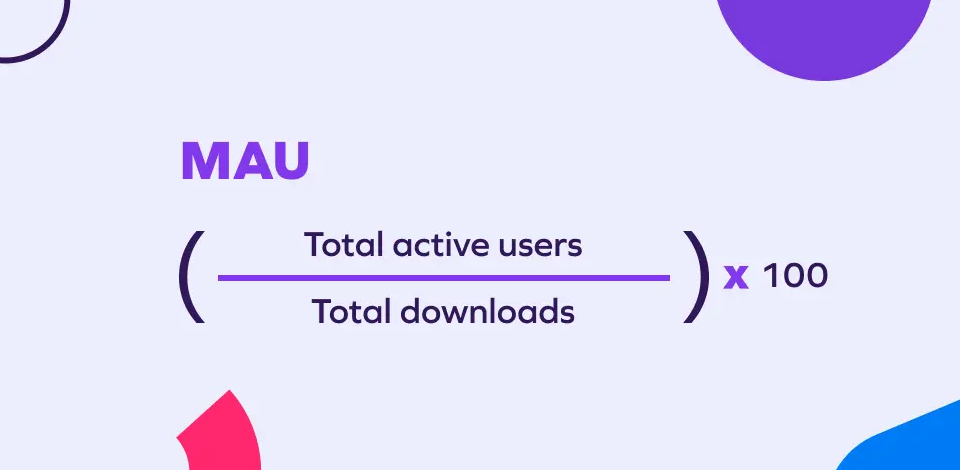
When analyzing MAU over a date range rather than a single point in time, many analytics platforms display daily averages to show trends. This approach helps smooth out day-to-day variations and reveals engagement patterns over time.
Advantages of using MAU metric
MAU offers several significant benefits for app developers and marketers looking to understand their user base and optimize their strategies.
Measuring app engagement and health
A high MAU typically indicates strong user engagement and positive retention over time. The metric serves as a pulse check for your app’s overall health, revealing whether your product continues to deliver value to users month after month.
Evaluating marketing effectiveness
By tracking MAU before, during, and after marketing campaigns, you can assess how effectively your user acquisition and retention strategies are performing. An increase in MAU following a campaign indicates successful outreach, while stagnant numbers might signal the need for strategy adjustments.
Foundation for other key metrics
MAU serves as the basis for calculating other important metrics such as Lifetime Value (LTV), Cost Per Acquisition (CPA), and churn rate. These derived metrics provide deeper insights into revenue potential and customer behavior.
Assessing growth potential
Monitoring MAU trends helps you forecast future growth and identify potential issues before they become critical. Consistent MAU growth suggests your app is gaining traction, while declining numbers serve as an early warning sign requiring attention.
Supporting monetization strategies
For platforms relying on advertising or subscription models, MAU directly impacts revenue potential. A larger active user base creates more monetization opportunities, whether through ad impressions, subscription conversions, or in-app purchases.
DAU/MAU ratio
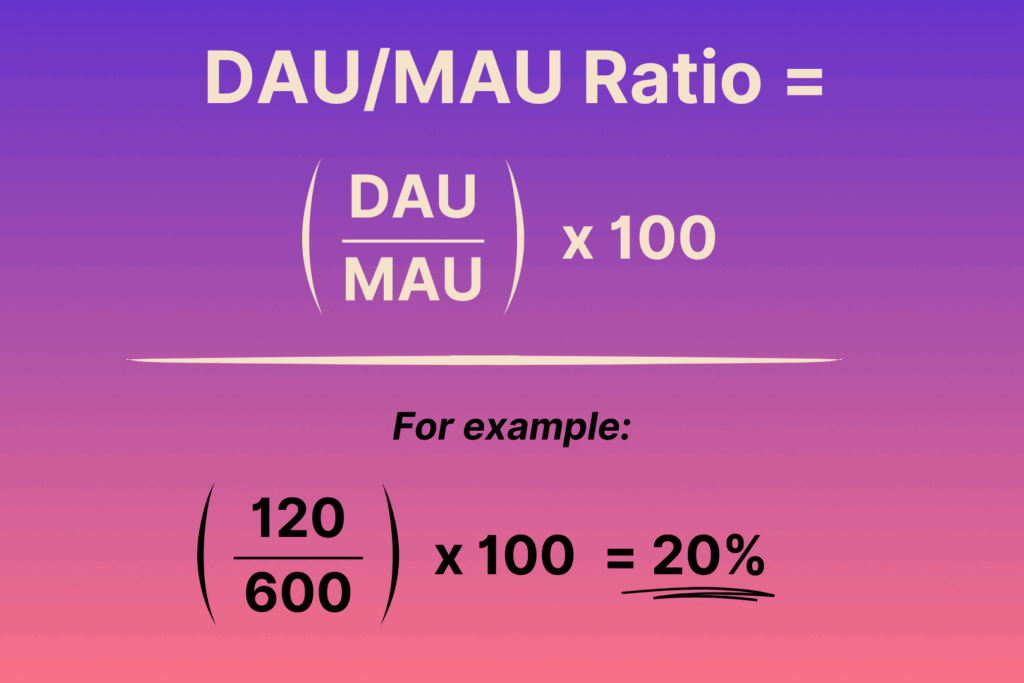
The DAU/MAU ratio, often called the “stickiness ratio,” measures what proportion of your monthly users engage with your app on a daily basis. This metric reveals how integral your app is to users’ daily routines.
Formula: DAU/MAU Ratio = (Daily Active Users ÷ Monthly Active Users) × 100%
For example, if your app has 5,000 DAUs and 20,000 MAUs, your stickiness ratio would be 25% (5,000 ÷ 20,000 × 100).
Here’s what different ratio levels indicate:
- 20% DAU/MAU: Users engage with your app approximately 6 days per month
- 50% DAU/MAU: Users open your app roughly every other day
- 70%+ DAU/MAU: Exceptional stickiness, typical of highly habit-forming apps like messaging or social media platforms
Industry benchmarks vary significantly by category. Social media and gaming apps typically see higher stickiness (20-50%), while e-commerce apps average around 10%, and fintech apps hover between 10-22%. A stickiness average of 20% across industries is generally considered good, while 25% and above is exceptional.
The higher your DAU/MAU ratio, the more frequently users return to your app, indicating stronger user loyalty and potentially higher lifetime value.
How can you improve MAU?
Increasing your MAU requires a multi-channel approach focused on bringing users back to your app consistently.
1. Push notifications
Push notifications remain one of the most effective ways to re-engage users, but they require careful implementation. Focus on delivering genuine value through personalized, relevant messages rather than sending high volumes of generic alerts. Monitor your push notification statistics to identify what resonates with users and what leads to uninstalls. The key is quality over quantity—every notification should offer something meaningful to the recipient.
2. In-app messages
Personalizing the in-app experience significantly impacts retention. Research shows that brands using personalized in-app messages experience retention rates of 61% to 74% within 28 days, compared to just 49% for those sending generic campaigns. Segment your audience based on behavior, preferences, and history to deliver tailored messages with real-time updates and relevant content links.
3. Email and SMS campaigns
Email and SMS provide less intrusive channels for maintaining engagement with users who haven’t visited your app recently. Use these channels to share updates, highlight new features, or deliver personalized content recommendations. For content apps, consider sending links to trending articles or features the user might find valuable based on their past behavior.
4. Deep linking
Attribution-fueled deep linking ensures that when users click through from emails, ads, or notifications, they land exactly where they need to be in your app—not just on the home screen. This removes friction from the user journey and significantly improves conversion rates on re-engagement campaigns.
5. Gamification and rewards
Introducing game-like elements or loyalty programs encourages daily engagement. Daily login bonuses, achievement systems, streak rewards, or loyalty points give users concrete reasons to return regularly. These incentives create habits that translate into sustained MAU growth.
The limitations of using MAU
While MAU is valuable, it comes with inherent limitations that marketers should understand.
Lack of industry standardization
Since every company defines “active” differently and may use varying calculation methods, comparing MAU across competitors can be misleading. There are no universal standards for the individual components of MAU, making cross-company comparisons challenging and potentially deceptive.
Unreliable for new apps
For recently launched apps, MAU figures can be artificially inflated by promotional activities, paid advertising, and launch buzz. These spikes don’t reflect sustainable engagement trends. It’s advisable to wait several months for traffic to normalize before relying heavily on MAU for strategic decisions.
Doesn’t measure engagement depth
Simply logging into an app doesn’t indicate meaningful engagement. Users might open your app briefly without interacting with core features. From a monetization perspective, you can only generate revenue from users who actively engage, making MAU somewhat superficial when viewed in isolation.
Doesn’t measure user quality
Not all active users have equal value. Different acquisition channels produce users with varying engagement behaviors and lifetime values. A marketing campaign might generate impressive MAU numbers, but if those users exhibit poor engagement or high churn rates, the actual business impact could be minimal or even negative through poor reviews and low app store ratings.
Key takeaways
- MAU measures unique monthly engagement: It counts distinct users who interact with your app within a 30-day period, providing insight into your app’s reach and user base size.
- Active user definition matters: How you define “active” significantly impacts the usefulness of your MAU data. Choose criteria that align with your business goals and reflect meaningful engagement.
- MAU reveals quantity, not quality: The metric shows how many users engage, but not how valuable those users are or how deeply they interact with your app.
- Use MAU alongside other metrics: Combine MAU with DAU (for stickiness), LTV (for revenue potential), retention rate (for user loyalty), and churn rate (for attrition) to get a complete picture of app health.
- Industry context is essential: MAU benchmarks vary significantly by app category. What constitutes a “good” MAU depends heavily on your app type, business model, and competitive landscape.
- Improvement requires multiple channels: Boosting MAU involves coordinated efforts across push notifications, in-app messaging, email campaigns, deep linking, and reward systems to keep users returning consistently.