Freemium is a business model where a company provides a basic version of its product or service at no cost, while reserving advanced features, functionality, or content for paying users. The term is a combination of “free” and “premium,” coined in 2006. This pricing strategy allows businesses to attract a large user base quickly and then convert a portion of those free users into paying subscribers. Freemium is widely used in mobile apps, SaaS, gaming, and digital media.
How the freemium model works
The freemium model follows a straightforward funnel: attract users with a free offering, demonstrate value through product usage, and then prompt users to upgrade when they hit limitations or need more powerful features. The free tier acts as a low-friction entry point that eliminates the need for upfront payment, giving users a chance to experience the product before making a financial commitment.
Once users engage with the product and build habits around it, they encounter natural upgrade triggers — usage caps, locked features, or limited support. These triggers are intentionally designed to highlight the gap between the free and paid experience, motivating users to subscribe. The model works best when the free version delivers genuine value on its own, while the premium tier provides a clear step-up that justifies the cost.
In mobile apps, the freemium model typically pairs with paywalls — screens that prompt users to subscribe in order to unlock premium content or features. Optimizing these paywalls through A/B testing is a key part of maximizing conversion rates in freemium apps.
Freemium vs free trial vs paid apps
Freemium is often confused with free trials, but the two models differ in important ways. A free trial gives users full access to all features for a limited time (typically 7–30 days), after which they must pay to continue. Freemium, on the other hand, offers limited features with no time restriction — users can stay on the free plan indefinitely. Each model suits different business scenarios, and many successful apps combine elements of both. For more on how trial models affect revenue, see the guide to free trial conversion rates.
| Criteria | Freemium | Free trial | Paid app |
|---|---|---|---|
| Upfront cost | Free | Free during trial | Paid from day one |
| Feature access | Basic features only | Full features for limited time | Full features permanently |
| Time limit | No limit | 7–30 days typically | No limit |
| Conversion trigger | Feature limitations | Trial expiration deadline | App Store listing and reviews |
| User base size | Very large | Moderate | Smaller, higher intent |
| Typical conversion rate | 2–5% average | 18–60% depending on opt-in/opt-out | N/A (paid upfront) |
| Best for | Apps relying on network effects or viral growth | Apps with clear value shown through full access | Niche tools with high perceived value |
Types of freemium models
Not all freemium implementations look the same. The approach a company takes depends on its product, audience, and monetization goals. Here are the most common variations of the freemium model.
Feature-limited freemium
This is the most common type. Users get access to a core set of features for free, while advanced capabilities remain behind a paywall. Spotify, for example, allows free users to listen to music with ads and shuffle-only mode, while premium subscribers enjoy ad-free listening, offline downloads, and on-demand playback.
Capacity-limited freemium
Here, users have access to most or all features, but with usage caps. Dropbox offers 2 GB of free storage, which is enough to get started but quickly becomes insufficient for power users. Once users run out of space, they need to upgrade to a paid plan.
Time-limited freemium (hybrid with free trial)
Some apps combine freemium and free trial elements. Users can access basic features indefinitely but receive a limited-time trial of premium features. After the trial expires, they revert to the free tier unless they subscribe.
Ad-supported freemium
In this variation, the free version is fully functional but displays advertisements. Paying users can remove ads entirely. YouTube is one of the most well-known examples — free users see ads before and during videos, while YouTube Premium subscribers enjoy an ad-free experience.
Seat-limited or team-limited freemium
Common in B2B SaaS, this model offers the product for free up to a certain number of users or team members. Slack, for instance, allows small teams to use its platform for free with limited message history and integrations, while larger organizations must upgrade to paid plans.
| Freemium type | What’s limited | Example |
|---|---|---|
| Feature-limited | Advanced features locked | Spotify, Canva |
| Capacity-limited | Storage, API calls, or usage quotas | Dropbox, Google Drive |
| Time-limited hybrid | Premium trial expires, basic stays free | Headspace, many mobile apps |
| Ad-supported | Ads shown to free users | YouTube, Hulu |
| Seat-limited | Number of team members or users | Slack, Trello |
Advantages of the freemium model
The freemium model has become the dominant monetization strategy for mobile apps and SaaS products for several reasons.
Rapid user acquisition
Removing the upfront cost barrier makes it significantly easier to attract users. Free products spread through word-of-mouth, organic search, and referral networks far more effectively than paid ones. This is especially powerful for mobile apps, where the majority of downloads in both the App Store and Google Play are free.
Product-led growth
Freemium shifts the burden of proving value from marketing to the product itself. Rather than convincing users to pay based on promises, the product demonstrates its worth through actual usage. Users who convert after experiencing the free tier tend to have higher engagement and lower churn compared to those acquired through traditional marketing.
Large data and feedback loop
A massive free user base provides valuable behavioral data. Product teams can study how users interact with the app, identify popular features, and test improvements. This data-driven approach helps refine both the product and the monetization strategy. For a deeper dive into freemium monetization tactics, see freemium monetization models and strategies.
Multiple revenue streams
Even users who never pay can contribute to revenue through advertising, referrals, and by generating content or network effects that make the platform more valuable for others.
Low marginal cost of serving users
Digital products — especially software and apps — can serve additional users at minimal incremental cost. This favorable cost structure makes freemium economically viable at scale, unlike physical goods where each additional unit has a real production cost.
Disadvantages and challenges
Despite its popularity, the freemium model comes with meaningful risks and operational challenges that businesses need to account for.
Low conversion rates
The average freemium-to-paid conversion rate across SaaS companies ranges from just 2–5%. This means the vast majority of users never pay, and the business must generate enough revenue from a small minority to cover the costs of serving everyone. Without a large enough user base, the math simply doesn’t work.
Cost of supporting free users
Free users consume server resources, storage, bandwidth, and sometimes customer support — all without generating direct revenue. As the free user base grows, these costs can become significant. Companies like Evernote have repeatedly adjusted their free tier limits to manage the cost burden.
Difficulty finding the right balance
If the free tier is too generous, users have no reason to upgrade. If it’s too restrictive, users leave before experiencing enough value to consider paying. Striking the right balance between free and premium features is one of the hardest design decisions in the freemium model.
Risk of devaluing the product
Offering a product for free can create the perception that it isn’t worth paying for. Users may develop an expectation that they should always be able to use it without paying, making it harder to justify premium pricing later.
Cannibalization of paid plans
If free users can accomplish most of their goals without upgrading, the freemium tier effectively cannibalizes revenue from the paid plans. This is particularly dangerous in B2B contexts, where a single power user on a free plan might represent a lost enterprise account.
Freemium conversion benchmarks
Understanding industry benchmarks helps businesses set realistic expectations and measure performance. Conversion rates vary dramatically depending on the product category, target audience, and the quality of the upgrade path. Learn more about how to improve these numbers in our article on freemium to premium conversion techniques.
| Metric | Typical range | Top performers |
|---|---|---|
| SaaS freemium conversion rate | 2–5% | Above 10% |
| Mobile app freemium conversion | 2–5% | 6–8% |
| Exceptional performers (Spotify, Slack) | N/A | Above 30% |
| Hard paywall median conversion | ~12% | Varies |
| Monthly retention (freemium) | ~9% | Above 13% (hard paywall) |
Examples of successful freemium companies
The freemium model has produced some of the most successful companies in tech. Here are notable examples across different industries.
Spotify
Spotify’s free tier offers ad-supported music streaming with shuffle mode and limited skips. Premium subscribers get ad-free listening, offline downloads, higher audio quality, and on-demand playback. With over 600 million total users and a conversion rate above 30%, Spotify is often cited as the gold standard of freemium execution.
Slack
Slack offers a free plan for small teams with a limited message history (90 days) and a cap on integrations. As teams grow and need full message archives, more integrations, and admin controls, they naturally upgrade. Slack’s bottom-up adoption in organizations — starting with a single team and spreading company-wide — is a textbook example of product-led growth fueled by freemium.
Dropbox
Dropbox pioneered the capacity-limited freemium approach by offering 2 GB of free storage. Its referral program, which rewarded users with extra storage for inviting friends, created one of the most successful viral growth loops in tech history.
Canva
Canva’s free design tool is remarkably capable, offering thousands of templates and design elements at no cost. Its premium tier unlocks brand kits, background remover, premium stock assets, and team collaboration features — tools that professional designers and marketing teams willingly pay for.
Duolingo
Duolingo offers its full language-learning course library for free with ads and limited “hearts” (lives). The premium tier removes ads, adds offline lessons, and provides unlimited hearts. Duolingo later introduced a higher-priced “Duolingo Max” tier specifically for AI-powered features like roleplay and smart feedback.
When to use (and when to avoid) the freemium model
Freemium is not the right strategy for every business. Making the right choice depends on your market, product, and unit economics.
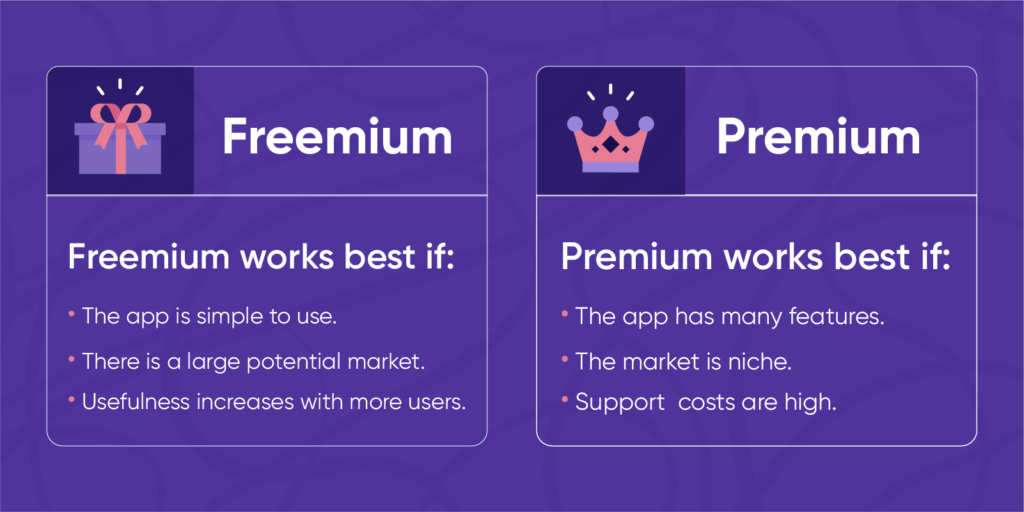
| Freemium works well when | Freemium may not be right when |
|---|---|
| Large total addressable market (TAM) exists | Small niche market with limited users |
| Product is self-serve and easy to onboard | Product requires heavy hand-holding or sales involvement |
| Clear feature differentiation between free and paid | Hard to define meaningful upgrade triggers |
| Low marginal cost per additional user | High per-user infrastructure or support costs |
| Network effects or viral growth potential | No viral loop or referral benefit from free users |
| Venture-funded or can sustain long payback periods | Need immediate revenue or short payback periods |
Key metrics for freemium businesses
Tracking the right metrics is essential for optimizing a freemium model. Here are the most important KPIs that freemium businesses should monitor.
| Metric | What it measures | Why it matters |
|---|---|---|
| Free-to-paid conversion rate | Percentage of free users who become paying customers | Core measure of monetization effectiveness |
| Customer lifetime value (LTV) | Total revenue a user generates over their lifetime | Determines how much you can invest in acquisition |
| Customer acquisition cost (CAC) | Cost to acquire a new user | Must be lower than LTV for the model to be sustainable |
| Monthly recurring revenue (MRR) | Predictable monthly income from subscriptions | Key indicator of business health and scalability |
| Churn rate | Percentage of paying users who cancel | Directly impacts revenue growth and LTV |
| ARPU / ARPPU | Average revenue per user / per paying user | Helps evaluate pricing and monetization efficiency |
Best practices for implementing freemium
Building a successful freemium product requires careful planning across product design, pricing, and user experience.
Design the free tier to demonstrate value, not satisfy all needs
The free version should be useful enough that users develop a habit and understand the product’s core value. But it must leave a clear gap that only the premium tier fills. The goal is to create natural “aha moments” where users see what they’re missing.
Create clear, compelling upgrade triggers
The best freemium products make the transition from free to paid feel like a logical next step rather than a forced upsell. Triggers should align with genuine user needs — hitting a storage limit, needing a collaboration feature, or wanting to remove ads.
Test and iterate on pricing and packaging
What works at launch rarely stays optimal. Continuously A/B test different paywall designs, pricing tiers, trial lengths, and feature bundles. Even small improvements in conversion rate can have a massive impact on revenue when multiplied across a large free user base.
Measure everything
Track the full user journey from signup to conversion (and churn). Understand where users drop off, what features drive upgrades, and how different user segments behave. Use cohort analysis and funnel metrics to identify the highest-leverage optimizations.
Consider hybrid approaches
Many top-performing apps combine freemium with other models. For example, offering a free tier with ads plus a premium subscription that removes ads and adds features. Over 60% of top-grossing apps now use hybrid monetization models that blend subscriptions, consumable purchases, and advertising.
Brief history of freemium
The practice of offering software for free with paid upgrades dates back to the 1980s shareware movement, but the term “freemium” was coined in 2006. Venture capitalist Fred Wilson described a business model built around giving away a service for free and monetizing through premium upgrades. Jarid Lukin, who worked at one of Wilson’s portfolio companies, suggested the name “freemium” for this approach.
In 2009, Chris Anderson’s book Free brought mainstream attention to the economics of free products and digital distribution. By 2012, nearly all of the top 50 grossing games in Apple’s App Store supported in-app purchases, signaling that freemium had become the dominant model in mobile gaming. The model has since expanded well beyond gaming into productivity tools, communication platforms, creative software, streaming services, and enterprise SaaS.