

A free trial is a customer acquisition model that gives prospective users no-cost access to a product or service for a limited period — most commonly 3, 7, 14, or 30 days — so they can experience the value firsthand before committing to a paid subscription. Depending on the setup, the trial may include full or partial product functionality, and users may be asked to enter payment details upfront or sign up without a card. Free trials are widely used by mobile apps and SaaS businesses to lower the barrier to entry, prove product value through actual use, and convert engaged users into paying subscribers.
How a free trial works
A free trial follows a predictable lifecycle from sign-up to conversion. Most implementations move through the same core stages, regardless of whether the product is a SaaS tool, a mobile app, or a streaming service.
The user discovers the offer through a marketing channel, app store listing, or in-product paywall, and then signs up — sometimes with payment details, sometimes without. During the trial window, they get access to a defined set of features and use the product as a real customer would. Before the trial expires, the business typically sends reminder communications. At the end of the period, the user either converts to a paid plan, lets access lapse, or cancels.
| Stage | What happens | Typical duration |
|---|---|---|
| Sign-up | User registers, optionally provides payment details | Day 0 |
| Activation | User completes onboarding and reaches first value | Day 0–1 |
| Active use | User explores features and forms habits | Day 1 through trial end |
| Reminder | Email or push notification before expiration | 1–3 days before end |
| Conversion or churn | User pays, cancels, or lets access lapse | Trial end date |
Free trial vs. freemium
Free trials and freemium models are often confused because both let users start using a product without paying. The fundamental difference is where the limitation lies: a free trial is limited by time, while freemium is limited by features. Each model fits a different customer journey and business goal.
| Aspect | Free trial | Freemium |
|---|---|---|
| Limitation type | Time-based | Feature-based |
| Access duration | Fixed period (e.g., 7 or 14 days) | Indefinite |
| Feature access | Full or near-full functionality | Basic features only |
| Primary goal | Convert before time runs out | Convert when user hits a feature limit |
| Best for | Products with quick time-to-value | Products with strong network effects or low marginal cost |
| Typical examples | Streaming services, productivity SaaS | Spotify, Dropbox, Canva |
Common types of free trials
Not every free trial is structured the same way. The most important design decisions are whether to require a payment method upfront and whether the trial converts automatically or requires action from the user.
Opt-in (cardless) trials
Users start the trial without entering payment details. This removes friction from sign-up and typically produces a higher trial-start rate, but it usually converts at a lower rate because users have not made any commitment. Opt-in trials work well for top-of-funnel growth and for products that need time to demonstrate value.
Opt-out (card-required) trials
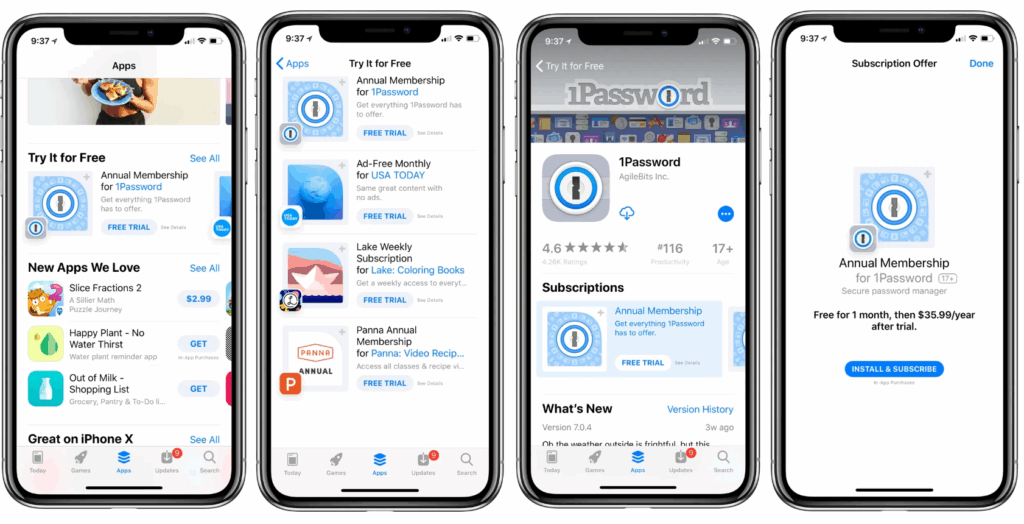
Users must enter payment details to start the trial, and the subscription is automatically charged when the trial ends unless they cancel. This filters out low-intent users and typically drives meaningfully higher conversion — opt-out trials convert at roughly 2.5 to 3 times the rate of opt-in trials, though they attract 3 to 4 times fewer signups. Most mobile app trials function this way by default because the App Store and Google Play handle billing.
Reverse trials
Instead of starting users on a free or limited plan and asking them to upgrade, reverse trials grant full premium access for a limited window and then downgrade users to a free tier when the period ends. The psychology relies on loss aversion — users who have experienced premium features are more motivated to subscribe than users who have never seen them. Apps like Strava and Ladder have used reverse trials successfully.
Paid trials
Users pay a small fee — often $0.99 or $1 — for trial access, instead of getting it for free. Paid trials are less common but can be effective when servicing the trial has a real cost to the business or when the goal is to qualify prospects.
| Trial type | Payment method required | Conversion rate | Sign-up volume |
|---|---|---|---|
| Opt-in (cardless) | No | Lower | Higher |
| Opt-out (card-required) | Yes | Higher | Lower |
| Reverse trial | No | Variable | Higher |
| Paid trial | Yes | Higher | Lower |
Benefits of offering a free trial
Free trials remain one of the most widely used acquisition tactics in subscription businesses for a reason. When the model fits the product, it produces measurable lifts in conversion, customer satisfaction, and lifetime value.
The most cited benefits include reduced perceived risk for the user, a self-serve qualification mechanism that lowers customer acquisition cost, and a stronger early signal of intent than a marketing form fill. Trials also give product teams behavioral data on how real users engage with the product, which can be fed back into onboarding and feature design. From the user’s perspective, the chance to actually use a product before paying for it reduces hesitation and tends to produce a more committed customer when conversion happens.
| Benefit | Why it matters |
|---|---|
| Lower perceived risk | Users commit only after experiencing real value |
| Higher-quality leads | Trial users self-qualify by completing onboarding and using the product |
| Behavioral data | Product teams see what features drive activation and engagement |
| Reduced sales overhead | The product does the convincing instead of a sales rep |
| Stronger retention | Users who convert after a trial tend to renew more reliably |
When a free trial may not be the right fit
Free trials are not universally optimal. Recent benchmark data covering more than 16,000 mobile apps and over $3 billion in subscription revenue shows that the value of offering a trial varies dramatically by category — and in some categories, trial users are actually worth less than direct buyers over a 12-month window. For category-specific data on trials vs. direct purchase, see Adapty’s analysis.
Trials also tend to underperform when the product has a long onboarding curve, when value takes weeks to become apparent, or when the product is so complex that a 7- or 14-day window is not enough for a prospect to form a real opinion. In those situations, a demo, an extended onboarding, or a freemium plan may convert better.
| Scenario | Why trials underperform | Better alternative |
|---|---|---|
| Long time-to-value products | Users churn before realizing benefit | Extended trial or demo |
| Complex enterprise tools | Setup eats most of the trial | Guided pilot or POC |
| High service cost per user | Free users are expensive to support | Paid trial or money-back guarantee |
| Low-engagement Lifestyle apps | Trial users churn before forming habits | Direct purchase with refund window |
How to design a high-converting free trial
A free trial is not a switch you flip — it is a system with several variables, each of which affects the outcome. The variables that matter most are trial length, payment-method requirement, the onboarding flow, the timing and content of reminders, and the conversion offer presented at the end.
For mobile subscription apps, the data suggests Day 0 dominates the funnel: roughly 90% of trial starts happen on the day the user installs the app. That makes onboarding and the first paywall the most important moments in the entire trial lifecycle, not Day 6 or Day 13. Reminder emails and push notifications still matter, but they retain users who are already on the path rather than recruiting new ones. Continuous experimentation on trial length, paywall structure, and offer design is one of the most reliable ways to lift conversion — see A/B testing free trials on iOS for practical implementation guidance.
Set the trial length deliberately
Most modern subscription apps use a 5- to 9-day trial. Longer is not necessarily better; if your product reaches activation in a single session, a shorter trial creates urgency without sacrificing experience.
Reduce onboarding friction
Every form field, permission prompt, and unnecessary step before first value lowers your conversion rate. The goal is to get users to the moment that proves the product as quickly as possible.
Communicate clearly about billing
Surprise charges trigger refunds, chargebacks, and bad reviews. Making it crystal clear when billing starts, how much will be charged, and how to cancel actually improves long-term metrics, even though it may slightly reduce raw conversion.
Run continuous A/B tests
Top-performing apps test trial duration, plan structure, price points, and paywall layout on a regular cadence rather than treating them as one-time decisions.
Key metrics to track for free trial performance
You cannot improve what you do not measure. Free trials sit between acquisition and revenue, so the metrics that matter span both. The core measurement is the trial-to-paid free trial conversion rate, but several supporting metrics add the context needed to interpret it.
| Metric | What it measures | Why it matters |
|---|---|---|
| Trial start rate | Share of visitors or installs that start a trial | Top-of-funnel signal of paywall and offer fit |
| Trial-to-paid conversion rate | Share of trial users who become paying subscribers | The primary measure of trial effectiveness |
| Activation rate | Share of trial users who reach a defined value moment | Predicts conversion and retention |
| Engagement during trial | Sessions, feature use, and depth of usage | Identifies which trial users are likely to convert |
| 12-month LTV | Average revenue from a converted trial user over a year | Reveals whether the trial channel produces valuable subscribers |
| Trial cancellation rate | Share of users who actively cancel before billing | Surfaces friction or unmet expectations |