ARPDAU, or Average Revenue Per Daily Active User, measures the average revenue generated by each active user on a daily basis. This granular monetization metric is particularly valuable for apps expecting frequent user engagement, such as mobile games, social apps, and subscription-based services. Unlike broader metrics like ARPU, ARPDAU provides immediate visibility into how app changes, promotional events, or monetization adjustments impact daily revenue generation.
What is ARPDAU?
ARPDAU stands for Average Revenue Per Daily Active User. It is a key performance indicator (KPI) that calculates the average amount of revenue an app generates from each user who actively engages with the app on a given day. This metric captures revenue from all monetization sources, including in-app purchases (IAP), subscriptions, and in-app advertising (IAA).
Unlike metrics that look at broader timeframes or all users, ARPDAU focuses specifically on daily active users—the most engaged segment of your user base. This makes it a more responsive indicator of monetization health, as changes in ARPDAU can be observed almost immediately after implementing new features, pricing adjustments, or promotional campaigns.
ARPDAU is especially popular in the mobile gaming industry, where daily engagement patterns directly correlate with revenue generation. However, it’s equally valuable for any app with a freemium model or daily usage patterns, including social networking, entertainment, fitness, and productivity apps.

Why is ARPDAU important?
ARPDAU serves as a critical indicator for understanding how effectively your app monetizes its engaged user base. Here’s why this metric matters:
| Benefit | Description | Business impact |
| Real-time feedback | Shows immediate impact of app changes | Enables quick iteration and optimization |
| Monetization health check | Indicates daily revenue efficiency | Identifies underperforming monetization strategies |
| User value assessment | Measures revenue per engaged user | Helps set appropriate user acquisition costs |
| Campaign evaluation | Tracks impact of promotions and events | Validates marketing ROI |
| Trend identification | Reveals patterns in daily revenue | Supports forecasting and planning |
| Revenue source analysis | Can be segmented by IAP, ads, or subscriptions | Optimizes monetization mix |
How to calculate ARPDAU?
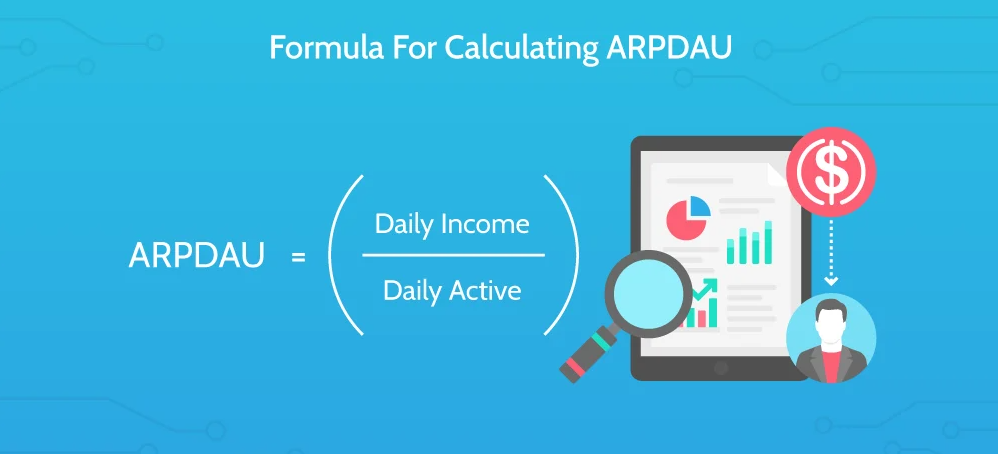
The ARPDAU formula is straightforward:
| ARPDAU = Total Daily Revenue ÷ Total Daily Active Users |
Calculation example
| Component | Value | Notes |
| Total daily revenue | $5,000 | Sum of IAP + ad revenue + subscriptions |
| Daily active users (DAU) | 50,000 | Unique users who opened the app that day |
| ARPDAU | $0.10 | Each active user generates $0.10 on average |
Breaking down ARPDAU by revenue source
For more granular insights, you can calculate ARPDAU separately for each revenue stream:
| Revenue stream | Formula | Example |
| IAP ARPDAU | IAP Revenue ÷ DAU | $2,000 ÷ 50,000 = $0.04 |
| Ad ARPDAU | Ad Revenue ÷ DAU | $2,500 ÷ 50,000 = $0.05 |
| Subscription ARPDAU | Subscription Revenue ÷ DAU | $500 ÷ 50,000 = $0.01 |
| Total ARPDAU | Total Revenue ÷ DAU | $5,000 ÷ 50,000 = $0.10 |
Key benefits of ARPDAU
ARPDAU offers several advantages that make it an essential metric for app monetization:
Immediate feedback loop
ARPDAU responds quickly to changes, allowing you to see the impact of pricing adjustments, new features, or promotions within 24-48 hours. This rapid feedback enables data-driven decision-making and quick course corrections.
Focused on engaged users
By measuring only daily active users, ARPDAU reflects the revenue potential of your most valuable user segment—those who regularly engage with your app. This focus provides a clearer picture of monetization effectiveness than metrics that include inactive users.
Supports A/B testing
The daily granularity of ARPDAU makes it ideal for A/B testing monetization strategies. You can quickly compare different pricing tiers, ad placements, or promotional offers and identify winners within days rather than weeks.
Enables segmentation analysis
ARPDAU can be segmented by user demographics, acquisition source, geography, or behavior patterns. This segmentation reveals which user groups generate the most revenue and helps optimize both acquisition and monetization strategies.
Validates monetization balance
By tracking ARPDAU alongside retention metrics, you can ensure that monetization efforts aren’t harming user experience. A rising ARPDAU with stable retention indicates healthy monetization, while rising ARPDAU with declining retention signals potential over-monetization.
ARPDAU vs. related metrics
Understanding how ARPDAU relates to other revenue metrics helps you choose the right KPI for each situation.
| Metric | Full name | Formula | Time frame | User base | Use case |
| ARPDAU | Average Revenue Per Daily Active User | Daily Revenue ÷ DAU | Daily | Active users only | Daily monetization tracking, A/B testing |
| ARPU | Average Revenue Per User | Total Revenue ÷ Total Users | Monthly/Custom | All users | Overall monetization assessment |
| ARPPU | Average Revenue Per Paying User | Revenue ÷ Paying Users | Variable | Paying users only | Purchase value optimization |
| LTV | Lifetime Value | Projected total revenue per user | Lifetime | All users | UA budget planning, long-term strategy |
| ARPDEU | Average Revenue Per Daily Engaged User | Revenue ÷ Engaged Users | Daily | Users who interact with revenue features | Ad unit or IAP effectiveness |
ARPDAU vs. ARPDEU: Understanding the difference
ARPDEU (Average Revenue Per Daily Engaged User) measures revenue from users who specifically interact with a revenue feature (like watching an ad or visiting the store). The gap between ARPDAU and ARPDEU reveals your feature’s exposure:
| Scenario | ARPDAU | ARPDEU | Interpretation |
| High exposure | $0.10 | $0.12 | Most users encounter monetization features |
| Low exposure | $0.10 | $0.50 | Only a fraction of users see monetization features |
A large gap suggests opportunity to increase monetization by improving feature visibility without increasing pressure on individual users.
What is a good ARPDAU for a mobile app?
ARPDAU benchmarks vary significantly based on app category, business model, platform, and geography. Here are industry reference points:
ARPDAU benchmarks by game genre
| Game genre | ARPDAU range | Notes |
| Hyper-casual | $0.02 – $0.05 | Primarily ad-monetized |
| Casual | $0.05 – $0.15 | Mix of ads and IAP |
| Mid-core | $0.15 – $0.40 | IAP-focused with some ads |
| Hardcore/Strategy | $0.30 – $1.50+ | Heavy IAP, longer sessions |
| Social casino | $0.30 – $0.70 | High IAP spend per user |
| RPG | $0.20 – $0.60 | Strong IAP with gacha mechanics |
ARPDAU benchmarks by app category (non-gaming)
| App category | Typical ARPDAU range | Primary revenue source |
| Subscription apps | $0.05 – $0.25 | Recurring subscriptions |
| E-commerce | $0.10 – $0.50 | Transaction commissions |
| Streaming/Media | $0.05 – $0.15 | Subscriptions and ads |
| Dating | $0.10 – $0.30 | Subscriptions and IAP |
| Fitness | $0.05 – $0.20 | Subscriptions |
| Utility | $0.02 – $0.10 | Ads and premium upgrades |
Factors affecting ARPDAU
| Factor | Higher ARPDAU | Lower ARPDAU |
| Platform | iOS (1.5-2.5x higher) | Android |
| Geography | North America, Japan, Western Europe | Southeast Asia, Latin America, India |
| Day of week | Weekends (10-30% higher) | Weekdays |
| User lifecycle stage | Mature users (Day 30+) | New users (Day 1-7) |
| Seasonality | Holiday periods | Off-peak seasons |
How can you increase ARPDAU?
Improving ARPDAU requires a multi-faceted approach targeting user engagement, monetization optimization, and retention.
Strategy 1: Optimize ad placements and formats
For ad-monetized apps, ad optimization directly impacts ARPDAU:
| Optimization | Description | Potential Impact |
| Rewarded video ads | Offer in-game currency or benefits for watching | 2-5x higher eCPM than banners |
| Strategic placement | Position ads at natural break points | Higher completion rates |
| Frequency optimization | Find the optimal number of ads per session | Balance revenue and retention |
| Ad mediation | Use multiple ad networks to maximize fill rate and eCPM | 10-30% revenue increase |
| Format testing | Experiment with interstitials, rewarded, native ads | Identify best performers |
Strategy 2: Enhance in-app purchase offerings
| Tactic | Description | Expected outcome |
| Personalized offers | Target users based on behavior and preferences | Higher conversion rates |
| Limited-time promotions | Create urgency with flash sales or exclusive bundles | Immediate revenue spikes |
| Price point testing | A/B test different price tiers | Optimize revenue per transaction |
| Starter packs | Offer high-value bundles for first-time purchasers | Increase conversion from free to paying |
| Subscription options | Add recurring revenue alongside one-time purchases | Stable, predictable ARPDAU |

Strategy 3: Segment and target users
Not all users monetize equally. Segment your audience to optimize for each group:
| Segment | Characteristics | Monetization strategy |
| Whales | High spenders, frequent purchasers | Premium offerings, exclusive content |
| Dolphins | Moderate spenders, regular purchasers | Value bundles, progression packs |
| Minnows | Occasional small purchases | Low-price entry points, limited offers |
| Non-payers (engaged) | Active but never purchased | Ad monetization, first-purchase incentives |
| Non-payers (casual) | Low engagement, no purchases | Light ad monetization, engagement focus |
Strategy 4: Improve user engagement
Higher engagement correlates with higher monetization potential:
- Push notifications: Bring users back with personalized, timely messages
- Daily rewards: Encourage daily logins with escalating rewards
- Events and challenges: Create time-limited content that drives engagement
- Social features: Add competition or cooperation with other users
- Content updates: Regular new content keeps users engaged
Strategy 5: Expand to high-ARPDAU markets
Geographic expansion can significantly impact overall ARPDAU:
| Market tier | Examples | Typical ARPDAU multiplier |
| Tier 1 | USA, Japan, South Korea, Western Europe | 1.0x (baseline) |
| Tier 2 | Eastern Europe, China, Brazil | 0.3-0.5x |
| Tier 3 | India, Southeast Asia, Africa | 0.1-0.2x |
What are the limitations of using ARPDAU?
While ARPDAU is valuable, it has important limitations to consider:
Short-term focus
ARPDAU measures only daily revenue and doesn’t capture long-term user value. An aggressive monetization strategy might boost ARPDAU temporarily while damaging retention and LTV. Always monitor ARPDAU alongside retention metrics.
Daily fluctuations
Natural variability in daily usage patterns can create noise in ARPDAU data. Weekend/weekday differences, holidays, and random fluctuations can make day-to-day comparisons misleading. Use 7-day or 30-day moving averages to smooth out noise.
New user distortion
Days with high new user acquisition often show lower ARPDAU because new users typically monetize less than established users. This can mask the true monetization health of your existing user base.
Average limitations
Like all averages, ARPDAU can hide distribution issues. A small percentage of high-value users (whales) often generate the majority of revenue. ARPDAU alone doesn’t reveal this concentration.
Ignores acquisition costs
ARPDAU doesn’t account for how much it cost to acquire users. A high ARPDAU is meaningless if user acquisition costs exceed lifetime revenue. Always consider ARPDAU in the context of CAC and LTV.
Time boundary issues
Users who engage across midnight may be counted in both days, and revenue attribution to specific days can be imprecise. This is especially relevant for apps with global audiences across multiple time zones.