
BibleChat

Welmi
Highlights
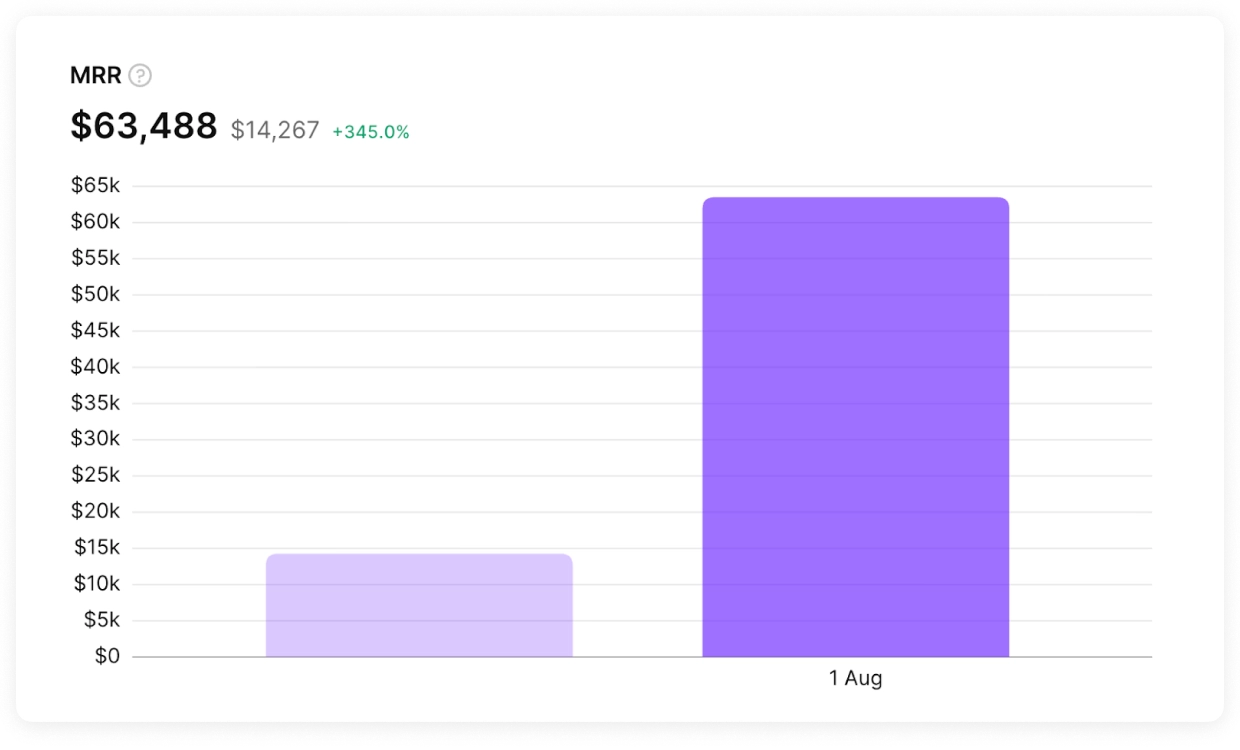
- +345% MRR
- +188.8% increase in installs
- ARPU increased by 253.1%
- $127K from a single paywall
Anton spent 15 years building startups that failed. He launched five of them, and none took off.
In 2023, Anton and his team were working on yet another new project. They noticed apps appearing on the market that used OpenAI’s Whisper to transcribe audio, then ChatGPT to reformat it into whatever you needed: emails, lists, briefs, anything. All these products were rough around the edges, but the idea seemed promising.


That’s how Letterly was born. Today Letterly makes $215,000 a month while ChatGPT and dozens of other transcription tools remain free. How did Anton build a business on something people can get for free?
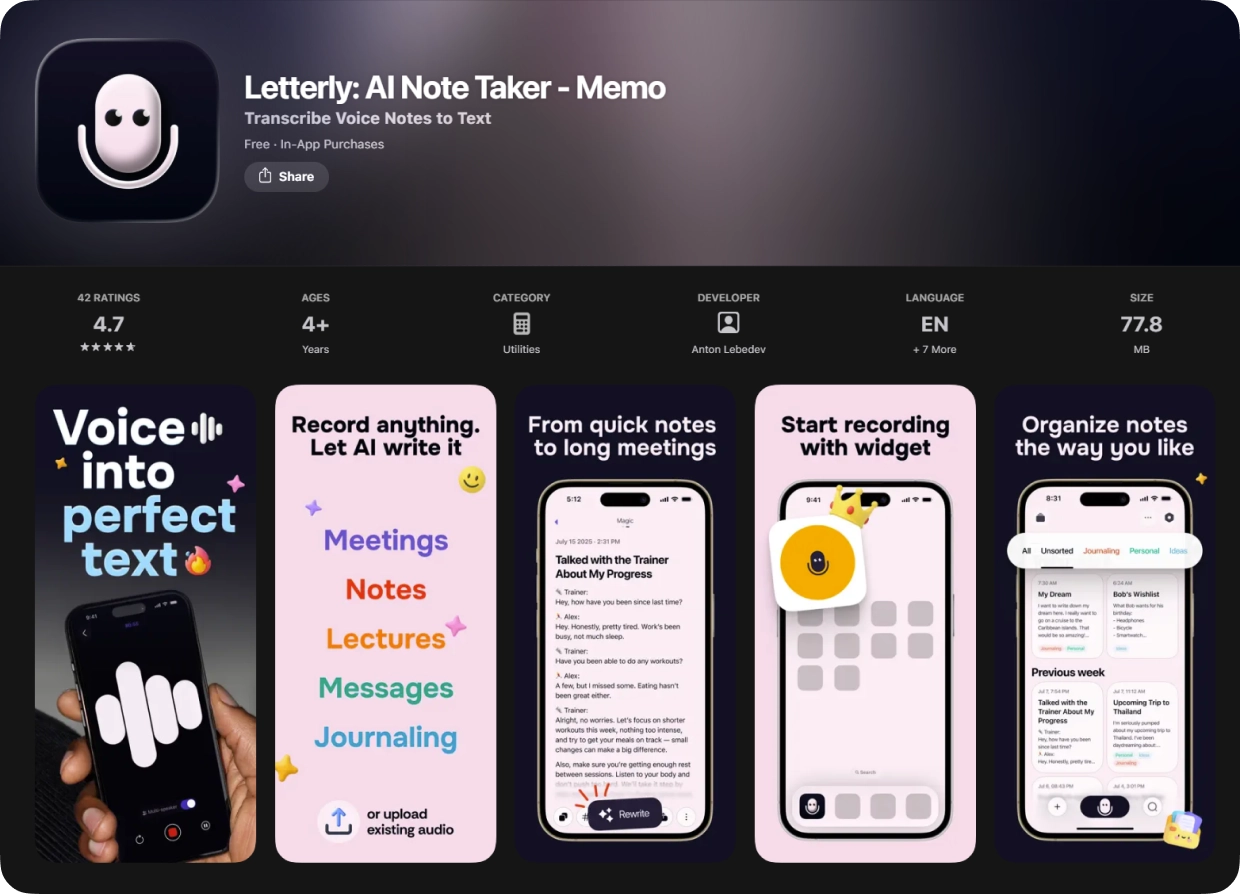
Letterly’s advantage is that you can actually use it without wanting to throw your phone. While competitors piled on features, Anton obsessed over stripping everything down. Every screen, every interaction had to serve one principle: radical simplicity.
Failed launches taught Anton that you don’t need a product that’s never existed before — he’d tried that every time and built innovative products nobody used. With Letterly, he chose a market-validated idea and focused entirely on execution. Make it so simple and intuitive he’d want to use it himself. That turned out to be enough.
The problem: Infrastructure overhead
That obsession with simplicity came with a constraint. Letterly runs a lean team of 10 people. When you’re that focused on product, something has to give. Usually, it’s the infrastructure work.
Setting up analytics, building paywalls, managing subscriptions across platforms — this stuff eats engineering time. And engineering time was their scarcest resource. They needed to iterate fast, run experiments, figure out what worked and what didn’t. But that meant tracking cohorts, calculating ARPU and churn, understanding which product decisions actually drove revenue.
To solve the bottleneck, Anton started looking for a tool that could handle both pieces: infrastructure and analytics. Something that would let them see the full picture without rebuilding every time they wanted to test something new. Adapty fit.
Fast iteration when it mattered most
When Letterly started gaining momentum and bringing in waves of new users, they needed two things immediately: clarity on what was working and the ability to change course without waiting on developers.
Adapty handled the unglamorous stuff — payments, receipt validation, cross-platform subscription management. With that covered, Anton’s team could focus entirely on capitalizing on growth.
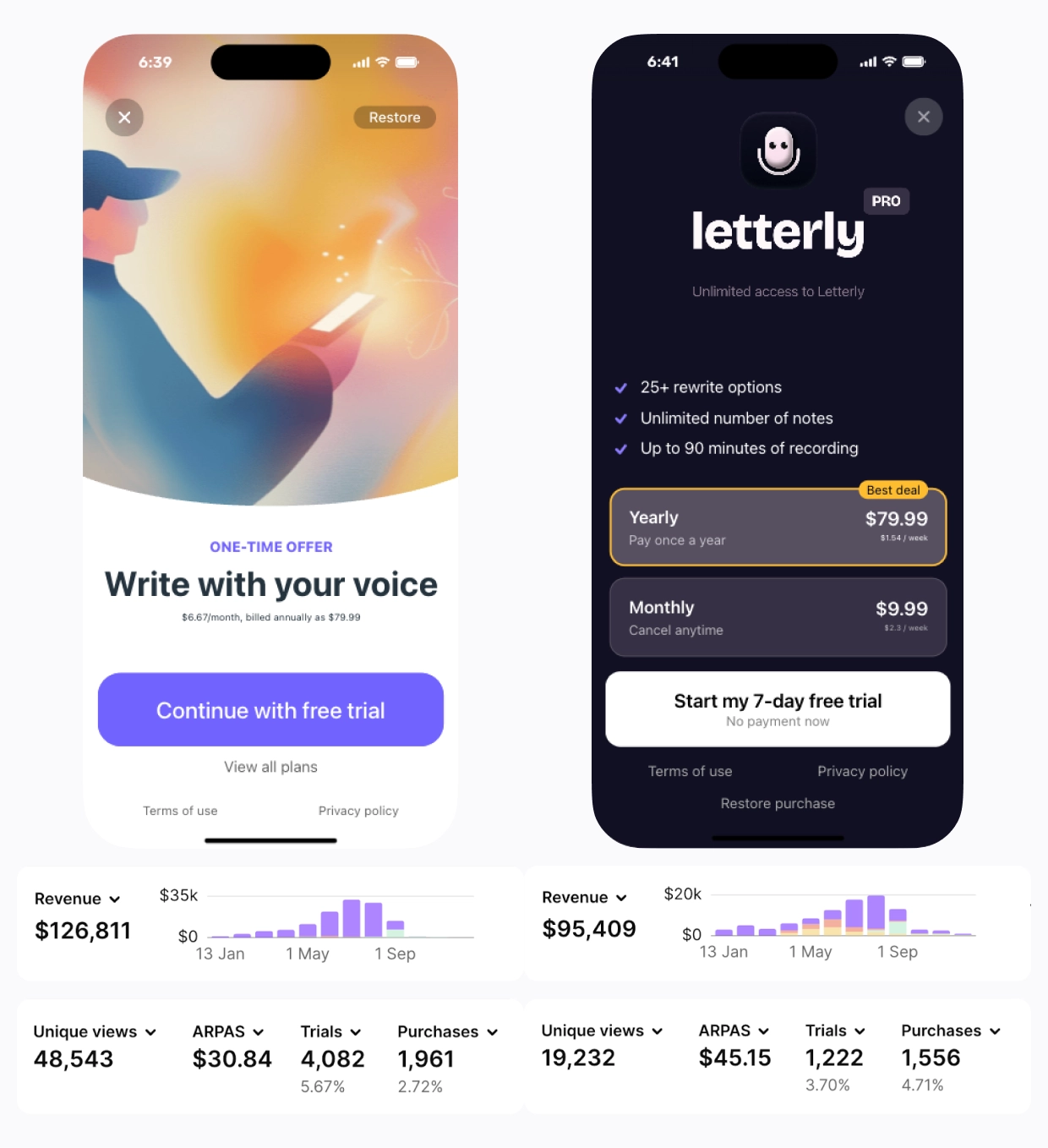
Tools like Adapty’s Paywall Builder became useful for speed. Anton’s team still designed the paywalls themselves. But instead of waiting for developer cycles to implement those designs, they could assemble and ship them in twenty minutes. Two of their winning paywalls brought in $127K and $95K.
The analytics piece mattered just as much. Adapty became Letterly’s ground truth for decision-making. They could track MRR, ARPU, and churn by country and product in real time. Cohort breakdowns showed how different user groups renewed over charging periods.
The numbers: 345% MRR growth in five months
Letterly tried a lot before finding what worked. Eventually they cracked their growth formula — advertising played a major role. Adapty took care of infrastructure and analytics so they could iterate without slowing down.
From April to August 2025:
- Letterly’s MRR jumped 345%
- ARPU climbed 253%
- By August, total three-month revenue increased from $60K to $600K (Mar – May vs. Jun – Aug)
Most apps get more complicated as they grow. More users usually means more bloat. Edge cases, support tickets, features that seem necessary but aren’t. Letterly avoided that trap. Adapty absorbed the infrastructure complexity and handled analytics so Anton’s team could stay focused on growth.
What this means for small teams
Letterly proves something important: you can still win by being noticeably better at one specific thing. Not revolutionary. Just better enough that people choose you over free alternatives.
Past experience taught Anton what doesn’t work. Letterly taught him what does. Find your edge. For Letterly, it was ruthless simplicity. Then move fast enough to capitalize when momentum shows up.
The hard part isn’t having a good product. It’s moving fast when it matters, investing in distribution and marketing, and looking for new ways to earn a larger market share. Infrastructure work doesn’t give you an edge, but it will slow you down if you’re building it yourself.
That’s the problem Adapty solves. Letterly focused on making the best voice-to-text experience possible. Adapty handled everything else. This division of labor works regardless of your specific edge.