App pricing: Guide to pricing tiers and strategies

If your app is your business, your pricing model is your business model — plain and simple. By correctly understanding the needs of your customers and dividing them into segments with similar purchasing power, you can conquer the market in no time. You essentially create several products out of thin air — and all you need is just a good strategy.
We wrote this guide to help you do just that. We discuss the features and benefits of different pricing approaches, give you several examples, share the latest industry benchmarks, and explore the psychological principles that drive purchasing decisions. By the end of this guide, you should be fully versed in app pricing. Let's go!
What is tiered pricing?
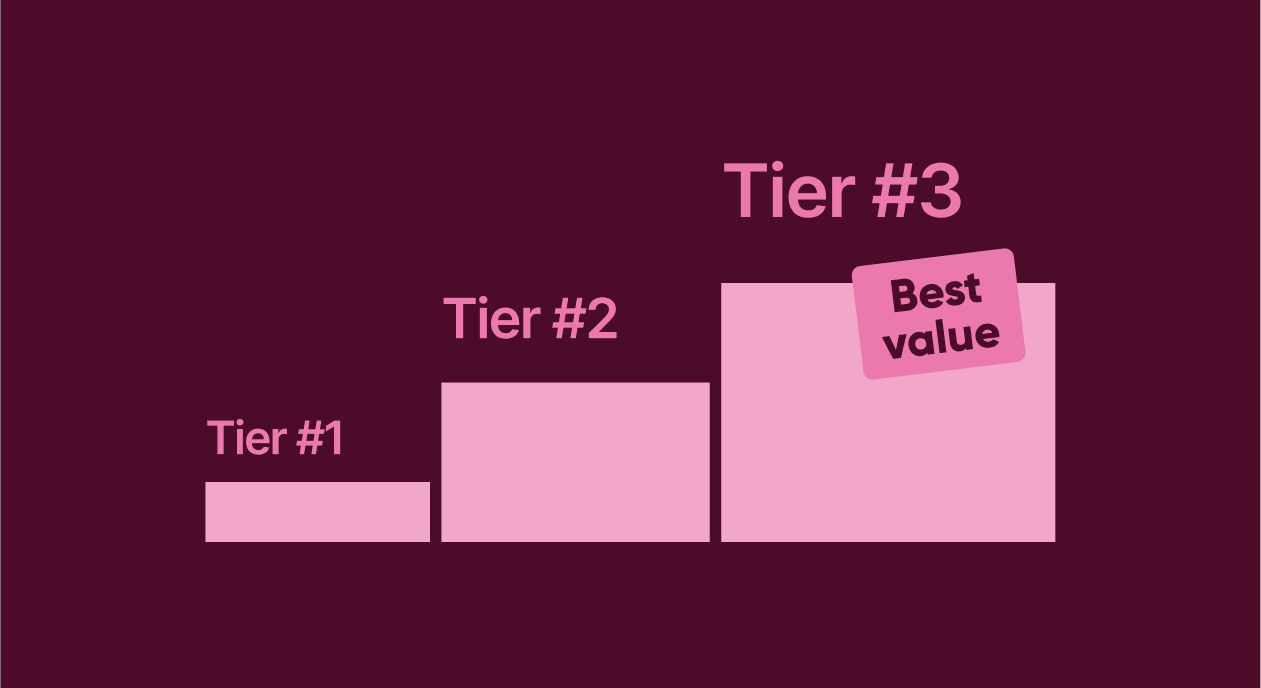
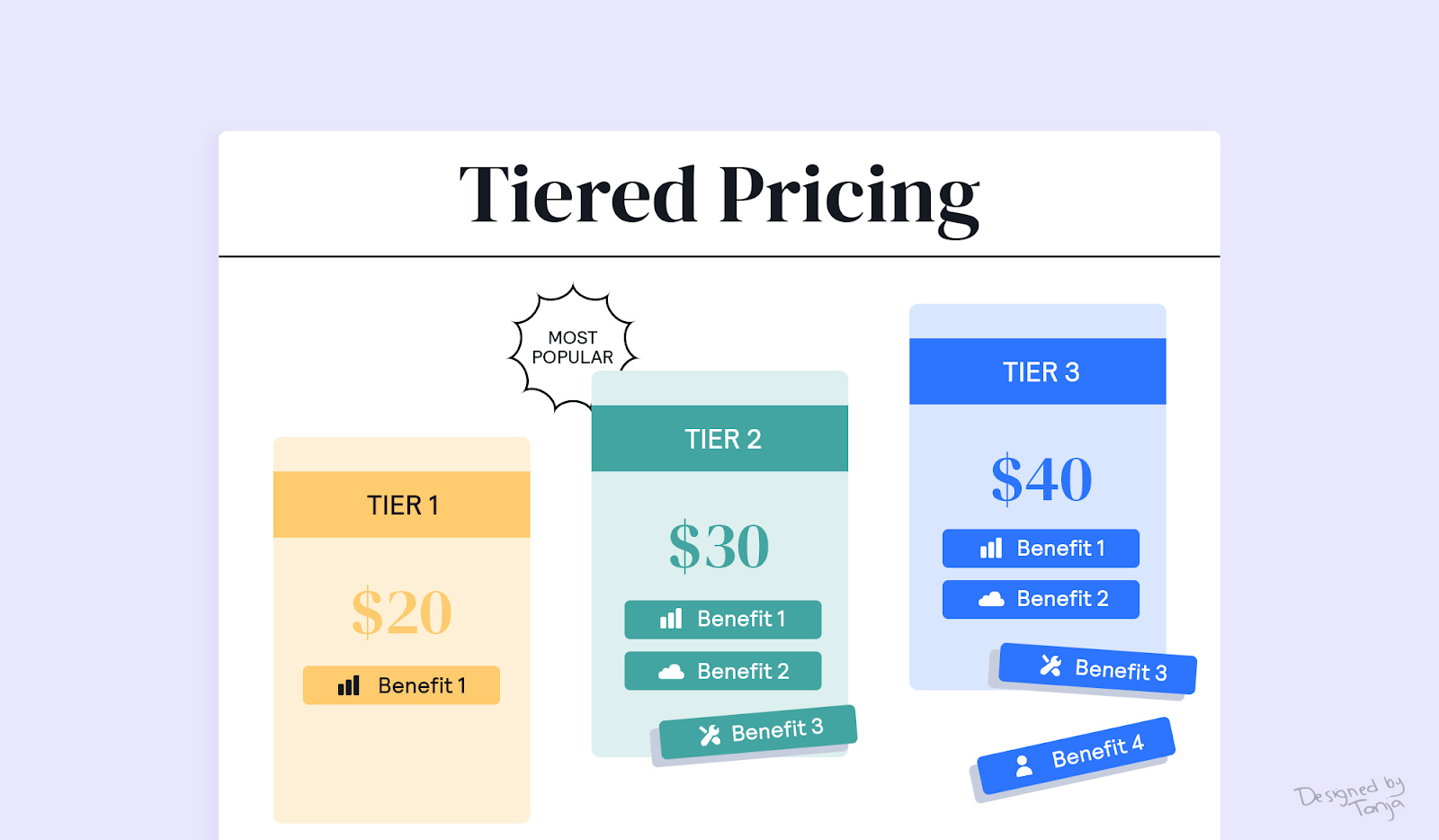
Tiered pricing is a strategy where you offer different levels of your product or service at varying prices. As an app developer, this means you can create several versions of your app, each with its own set of features and prices, to appeal to different types of users.
Here's how it works: you start with a basic version of your app that includes essential features at a lower price. Then, you create higher-priced versions that offer more advanced features or greater usage limits. For example, a basic plan might be $10 a month for limited access, while a premium plan could be $50 a month with all features and unlimited access. This way, users can choose the plan that best fits their needs and budget, and you can attract a wider audience.
The main benefit of tiered pricing is that it helps you reach different segments of the market. Beginners might start with the basic plan, while power users opt for premium features. This approach not only increases your revenue by encouraging users to upgrade, but it also provides flexibility, allowing customers to find the right balance between cost and value.
Tiered pricing benchmarks 2026
Before diving into strategies, let's look at the current state of subscription pricing. Understanding these benchmarks will help you position your tiers effectively.
The subscription app market has evolved significantly. Here are the numbers that matter in 2026:
Subscription mix trends:
- Weekly subscriptions now account for approximately 50% of all subscriptions (up 10% from 2024)
- 35% of apps mix subscriptions with consumables or lifetime purchases
- Over 60% of top-grossing apps use hybrid monetization models
- 62% of companies plan to convert at least one product into a subscription service
Trial duration patterns:
- 52% of all trials are offered for 5-9 days (up from 48.5% in 2023)
- Gaming apps favor shorter trials: 96.3% last 4 days or less
- Education and Health & Fitness apps lead with longer trials: 80%+ lasting 7+ days
Churn reality:
- Nearly 30% of annual subscriptions are canceled in the first month
- 65% of weekly subscribers cancel within 30 days
- Monthly retention under hard paywall: 12.8% vs 9.3% for freemium
- Average subscription churn rate: 5.3% monthly; top performers maintain under 3%
Revenue gap:
- The top 5% of newly launched apps earn over 400x more than the bottom 25% in their first year
- AI apps see revenue per install above $0.63 after 60 days — double the overall median of $0.31
- Higher-priced plans consistently deliver stronger LTV across all regions
Subscription pricing benchmarks by region
| Region | Weekly avg | Monthly avg | Annual avg | YoY change (Weekly) |
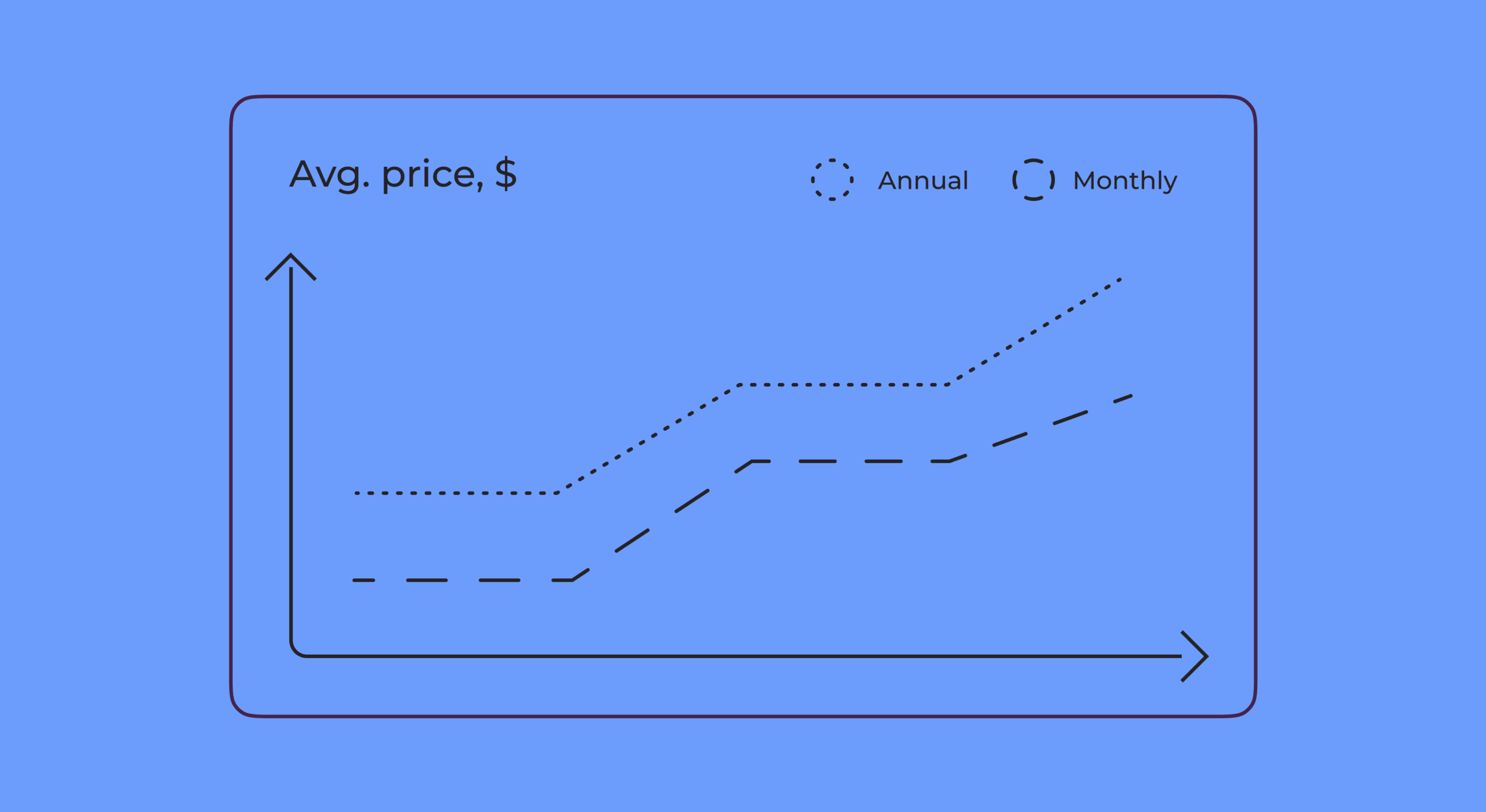
| United States | $8.10 | $15.20 | $44.60 | +12.5% |
| Europe | $8.30 | $13.30 | $42.00 | +12.2% |
| Asia | $5.50 | $9.80 | $35.00 | +8.3% |
| LATAM | $4.20 | $8.50 | $28.00 | +15.1% |
Key insight: Willingness to pay varies 2-3x between countries. Localized pricing is no longer optional — it's essential for maximizing revenue.
Benefits of using tiered pricing models
Implementing tiered pricing models offers several key advantages for app developers.
Significant revenue increase. By offering multiple price points, businesses can attract a broader range of customers, from budget-conscious buyers to those willing to pay more for premium features. Research shows tiered pricing can increase revenue by 25-40% compared to single-tier models. This approach not only brings in more customers but also encourages existing customers to upgrade to higher-priced tiers as they see the value in the additional features or services offered.
Effective customer segmentation. By creating different tiers, businesses can cater to the specific needs and preferences of various customer groups. For instance, a basic tier might appeal to casual users or small businesses, while a premium tier attracts power users or larger organizations. This segmentation allows businesses to better understand their customers and tailor their marketing and development efforts accordingly.
Enhanced perceived value. When customers see a range of options, they can compare features and benefits more easily, which helps them appreciate the value of higher-priced tiers. This comparison often makes the premium options seem more attractive and worthwhile, leading to higher customer satisfaction and loyalty.
Predictable revenue streams. Unlike one-time purchases, subscriptions provide predictable monthly and annual recurring revenue (MRR and ARR), making financial planning more reliable and sustainable.
Psychology of tiered pricing
Understanding why users make purchasing decisions is just as important as setting the right price points. These psychological principles can dramatically improve your conversion rates.
Price anchoring
Price anchoring involves showcasing a higher price point first to make other options feel more affordable. When users see a premium plan at $99/month before being shown a standard plan at $29/month, the standard option feels like a great deal.
How to apply it:
- Present your highest-priced option first on pricing pages
- Show the full price before displaying discounts
- Use annual pricing as an anchor to make monthly seem like "small payments"
Research shows this technique can increase mid-tier conversions by 25-60%. Software companies commonly list enterprise plans first — the higher price makes mid-tier plans feel like a steal.
Decoy effect
The decoy effect (also called asymmetric dominance) occurs when adding a third, strategically inferior option influences users toward your target tier.
Classic example: The Economist once offered:
- Web-only: $59
- Print-only: $125
- Web + Print: $125
The print-only option at $125 was clearly inferior to web + print at the same price. Yet its presence made web + print seem like incredible value. Results:
- Without decoy: 32% chose the most expensive option
- With decoy: 84% chose the most expensive option (a 163% increase)
A 2025 study found that well-structured decoy pricing can boost sales of the premium tier by up to 30%.
Center-stage effect
Users naturally gravitate toward the middle option when presented with multiple choices. This cognitive bias makes the center position on your pricing page prime real estate.
How to apply it:
- Position your most profitable or desired plan in the center
- Use visual emphasis (badges like "Most Popular" or "Best Value")
- Ensure the middle option offers clear value over the basic tier
Companies like Dropbox and Slack position their target plans in the center with visual highlighting to capture this effect.
Loss aversion
People are more motivated to avoid losses than to acquire equivalent gains. This principle can be applied to upgrade prompts and limited-time offers.
How to apply it:
- Frame messaging around what users lose by not upgrading: "Don't miss out on advanced analytics"
- Use countdown timers for promotional pricing
- Show what features expire after a trial ends
Charm pricing vs. Prestige pricing
Charm pricing ($9.99 vs $10) works best for entry-level tiers where users are price-sensitive. The left-digit bias makes prices feel significantly lower.
Prestige pricing ($50, $100) signals quality and exclusivity for premium tiers. Users associate round numbers with premium quality.
| Tactic | Description | Best for | Expected impact |
| Price anchoring | Show highest price first | All tiers | +25-60% mid-tier conversions |
| Decoy effect | Add inferior option near premium | Premium tier sales | +30% premium conversions |
| Center-stage effect | Position target plan in middle | Standard/Pro tiers | Higher selection rate |
| Charm pricing | $9.99 vs $10 | Entry-level tiers | Lower perceived cost |
| Prestige pricing | $50, $100 | Premium tiers | Signal quality/exclusivity |
| Loss aversion framing | "Don't miss out" messaging | Upgrade prompts | Higher conversion urgency |
How to calculate tiered pricing for your app
- Analyze your costs and value proposition. Start by understanding the costs involved in running your app, including both fixed costs like development and server maintenance, and variable costs such as customer support and transaction fees. Additionally, clearly define the value your app provides to users.
- Segment your market. Identify different user segments based on their needs and willingness to pay. Consider what features or services each segment values the most, such as essential features for basic users, additional features for standard users, and comprehensive features for premium users.
- Define your tiers. Create different pricing tiers that cater to these segments. Research suggests three tiers is optimal for most apps — a "rule of three" (Basic, Standard, Premium) simplifies decision-making while covering different customer needs. A 2024 study found that excessive pricing choices create decision fatigue and can lower conversions.
- Set pricing based on value and costs. Determine the pricing for each tier by considering the value provided to users and your costs. Make sure each tier is profitable by including both the fixed and variable costs, along with a desired profit margin. Remember: higher-priced plans consistently deliver stronger LTV across all regions.
- Test and adjust. Launch your pricing tiers and monitor user feedback and sales data. Be ready to adjust your pricing and tiers based on how users respond. Constant A/B testing is essential — apps with more tests generate more revenue.
- Communicate Value. Ensure that users understand the value they get at each pricing tier. Use clear descriptions and comparisons to highlight the benefits of upgrading to higher tiers, making it easy for users to see why they should choose a more expensive option.
Types of tiered pricing models
As an app developer, you can use various tiered pricing models to appeal to different user segments. Each model offers unique features and pricing to match the needs of various customers.
Starter
The 'Starter' tier is designed for new or casual users who need basic features. This tier typically includes essential functionalities at no cost, making it accessible to individuals or small businesses with limited budgets. The goal is to attract users with no entry cost, encouraging them to try your app without a significant financial commitment.
Important consideration: Data shows monthly retention under hard paywall (12.8%) outperforms freemium (9.3%). If you're early-stage, need cash flow, or don't have a clear freemium strategy, consider testing a hard paywall instead.
Standard tier
The 'Standard' tier is aimed at regular users who need more features and higher usage limits. It strikes a balance between cost and value and is often the most popular choice. This tier usually includes additional features and better support, catering to small to medium-sized businesses or more serious individual users.
Psychological note: Position this tier in the center of your pricing page to leverage the center-stage effect.
Premium tier
This tier targets users who need the full range of features and are willing to pay a higher price. It includes all advanced functionalities, highest usage limits, and premium support options. Users at this level are looking for maximum performance and are less price-sensitive.
Key insight: Higher-priced subscriptions have the highest reactivation rate (11.9%), suggesting that users who leave premium plans may still see enough value to return.
Emerging tiered pricing trends in 2026
The subscription landscape is shifting rapidly. Here are the trends reshaping tiered pricing strategies:
1. Hybrid monetization models
Over 60% of top-grossing apps now use hybrid models combining subscriptions with consumables or advertising. The single-model approach is becoming obsolete.
- Gaming leads at 61.7% hybrid adoption
- Social & Lifestyle follows at 39.4%
- Adobe offers both full Creative Cloud subscription plus pay-as-you-go for individual apps
- Disney+ introduced ad-supported tiers for cost-conscious users
2. "Hollowing middle" effect
The £5-10/month subscription tier is declining as users cut generic utility apps. Successful apps in 2026 are moving toward:
- Premium pricing ($30+/month) for apps delivering measurable outcomes
- High-volume ad-supported models for casual use cases
- The middle ground is increasingly hollow — users want either clear value or clear savings
3. Micro-subscriptions and flexible pricing
Users are getting tired of one-size-fits-all subscriptions. Winning strategies combine smarter pricing with offerings that feel tailored:
- Weekly plans for emerging markets and lower-intent buyers
- The New Yorker offers $1/week digital subscription
- 59% of mobile subscribers prefer annual plans when offered a 30-40% discount
4. AI-driven personalized pricing
Artificial intelligence is now integrated into subscription apps for:
- Tailored pricing based on user behavior, location, and engagement
- Predictive pricing strategies that maximize satisfaction
- Dynamic adjustments based on usage patterns
Duolingo created "Duolingo Max" at a higher price point specifically for AI features rather than bundling them into existing subscriptions.
5. Localization as a revenue driver
With smartphone adoption accelerating in Africa, Latin America, and Southeast Asia, successful apps are introducing:
- Localized pricing (2-3x willingness-to-pay differences between countries)
- Regional payment methods
- Content tailored to cultural needs
6. Retention-first economy
As UA costs rise due to market saturation, 2026 is accelerating the shift toward retention over acquisition:
- Global remarketing spend reached $31.3 billion in 2025 (up 37% YoY)
- Remarketing's share of app marketing spend rose from 25% to 29%
- Teams optimizing for retention outperform those focused purely on acquisition volume
7. Web-to-app billing
Web stores have become an essential part of the growth funnel:
- Reduces payment processing fees from Apple/Google's 15-30% to ~3%
- Enables real-time pricing tests
- Provides direct customer data for marketing
- Offers promotional flexibility without platform restrictions
Example: How we use tiered pricing at Adapty
Adapty is a platform that allows app developers to supercharge their monetization strategy. We also employ tiered pricing to effectively meet the diverse needs of our clients:
- Free Plan costs $0 per month and is ideal for businesses with up to $10K in monthly revenue. It includes basic features to help you get started without any initial investment.
- Pro Plan charges 1% of your revenue with a minimum fee of $99 per month. It includes advanced features like A/B testing for paywalls, integrations, advanced analytics, and chat support, making it suitable for growing businesses.
- Pro+ Plan costs 1.2% of your revenue with a minimum fee of $499 per month. It includes all Pro Plan features plus ETL integrations, LTV and revenue prediction, and priority chat support, designed for larger businesses needing comprehensive support and analytics.
As you can see, while we have a minimum monthly fee, the payment actually depends on the size of your app. This is fair for both developers and the company — the bigger you are, the more features you need, and the higher our costs are.
Client success stories
Moonly scaled from $0 to $2.45M in annual recurring revenue (ARR) by utilizing Adapty's infrastructure for in-app subscriptions and analytics. This allowed them to make data-driven decisions and continuously experiment with their paywalls, ultimately improving conversion rates and user retention.
Union Apps used Adapty to grow the revenue of Prime Fasting from $205k to $2.5M ARR in just six months. By leveraging Adapty's analytics and A/B testing capabilities, they optimized onboarding processes and paywall designs to significantly boost their app's monetization.
Avatarify grew from $0 to over $200k in monthly recurring revenue (MRR). They benefited from Adapty's accurate subscription data and fallback paywalls, which ensured they captured revenue even when users faced connectivity issues.
Popular tiered pricing strategies
Here are strategies you can use as inspiration for your app.
Three-tier pricing
A three-tier pricing strategy offers products or services in three distinct levels: Basic, Standard, and Premium. This approach helps businesses cater to different customer needs and budgets, maximizing revenue and customer satisfaction.
| Aspect | Basic tier | Standard tier | Premium tier |
| Structure | Essential features at lowest price | Additional features at moderate price | Full range of features at highest price |
| Target users | Cost-conscious, beginners | Regular users, SMBs | Power users, enterprises |
| Benefits | Low barrier to entry | Best value perception | Comprehensive solution |
| Conversion role | Entry point | Primary target (center-stage) | Anchor for value perception |
Spotify includes a free Basic tier with ad-supported listening. The Premium tier provides ad-free music, offline downloads, and enhanced sound quality. Their Premium Family tier caters to households at a discounted rate.
Dropbox offers a Basic tier with free storage. Their Plus tier provides additional storage and features at a moderate price. The Professional tier offers advanced sharing options and priority support for power users.
Adobe includes a Single App plan for specific needs, an All Apps plan for the full suite, and Premium plans for businesses with enhanced collaboration and support.
Multiple-tier pricing
A multiple-tier pricing strategy involves offering several pricing levels (4+), each with different features and benefits. This approach gives customers more options but requires careful management.
Advantages:
- Precise market segmentation
- More upsell opportunities
- Better coverage of diverse user needs
Challenges:
- Decision fatigue risk (excessive choices lower conversions)
- Complex to manage and communicate
- May confuse users if differences aren't clear
Best for: Enterprise SaaS, complex B2B products with varied organizational needs.
Feature-based tiers
In feature-based tiering, each tier provides a different set of features, and customers choose based on the functionalities they need.
Canva offers Free (basic design tools), Pro (brand kits, premium templates), and Enterprise (team collaboration, dedicated support).
Slack provides Free (limited history), Standard (unlimited history, group calls), Plus (advanced administration), and Enterprise Grid (security and compliance for large organizations).
Usage-based tiers
Customers are charged based on their level of usage or consumption. This approach is effective for services where usage varies significantly among customers.
Benefits
- Perceived fairness — users pay only for what they consume
- Attracts users with variable needs
- Higher revenue potential from heavy users
Best for: Cloud computing (AWS, Azure), API services, utility apps.
| Model | Pros | Cons | Best For |
| Three-tier | Simple, clear upgrade path | May miss niche segments | Most apps |
| Multiple-tier (4+) | Precise segmentation | Decision fatigue risk | Enterprise SaaS |
| Feature-based | Clear value differentiation | Can confuse if unclear | Feature-rich apps |
| Usage-based | Fair, pay-for-what-you-use | Unpredictable revenue | API, cloud services |
| Hybrid (Tiered + Usage) | Flexible, maximizes revenue | Complex to manage | Mature products |
A/B testing priority for tiered pricing
Not all tests are created equal. Here's what to prioritize:
| Test element | Impact level | Priority |
| Trial duration | High | 1st |
| Plan durations (weekly/monthly/annual) | High | 2nd |
| Price points | Medium-High | 3rd |
| Number of plans | Medium | 4th |
| Feature distribution | Medium | 5th |
| Visual design/layout | Low-Medium | 6th |
Testing best practices:
- Run tests long enough for meaningful data (1-2 weeks for fast categories, 4-6 weeks for subscription flows with trials)
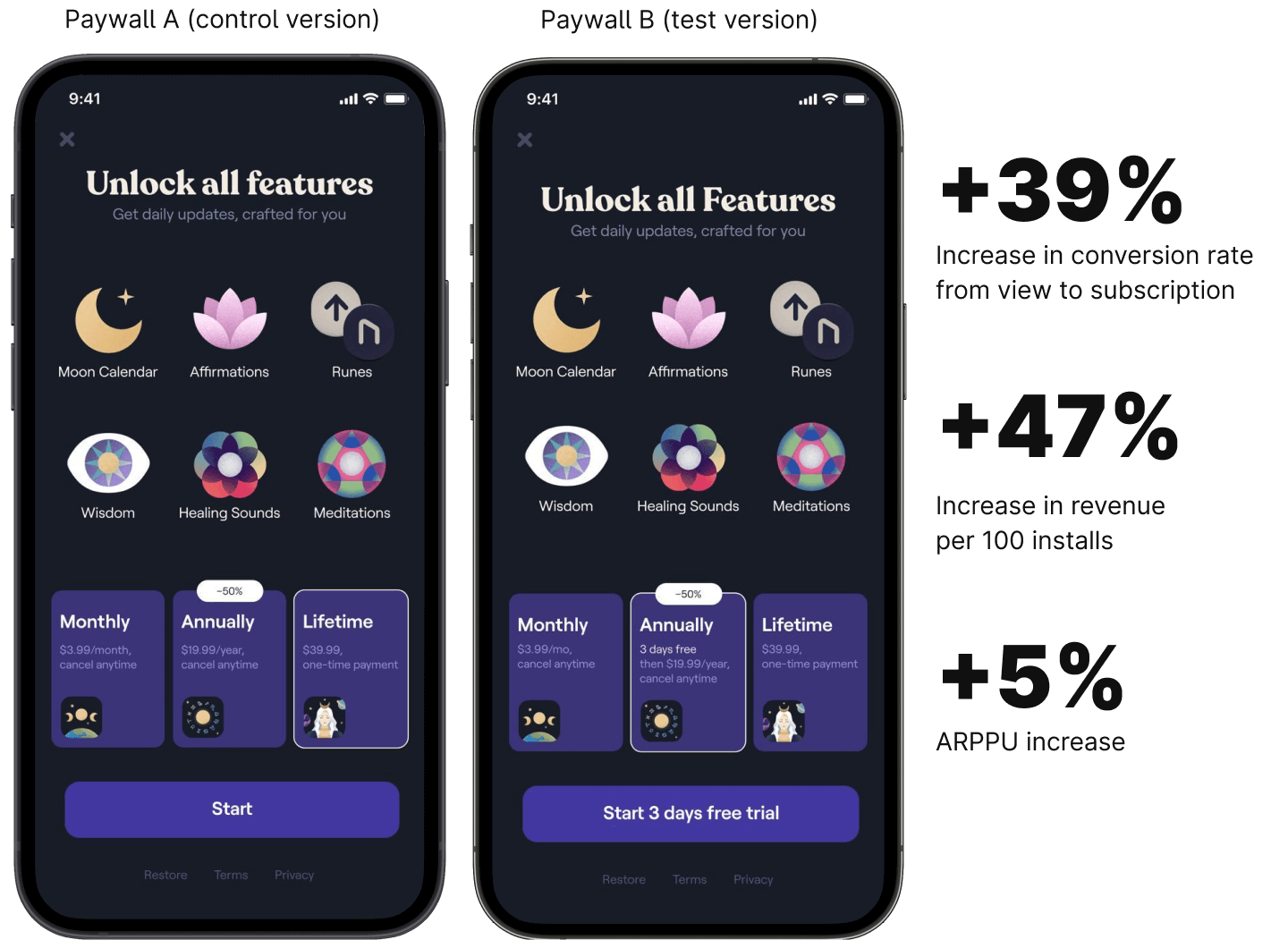
- Look past raw conversion rates — sometimes CR dips, but ARPPU and LTV rise
- Paywalls with three plans (weekly, monthly, annual) tend to drive stronger LTV
- Make sure your offer converts before testing visuals
- Iterate in small increments (~$1-2 monthly, $5-10 annually)
Challenges of using tiered pricing
Tiered pricing models present several challenges that require careful management:
Subscription fatigue
41% of consumers report experiencing subscription fatigue. Users are becoming more selective about which apps they'll pay for. By 2026, "subscription fatigue" is forcing companies to innovate with flexible tiers, pause options, and hybrid models.
Customer confusion
Users might find it difficult to understand the differences between tiers. This confusion can lead to frustration and potential loss of sales. Provide clear, concise information and visual comparison tables.
"Mid-tier trap"
Data shows mid-priced plans often underperform both low and high tiers in retention and refund rates. Users want either a clear deal or a clear reason to pay premium. Ensure your mid-tier has compelling, differentiated value.
Churn management
Retaining subscribers beyond the first month remains one of the toughest challenges:
- 65% of weekly subscribers cancel within 30 days
- Nearly 30% of annual subscribers cancel in the first month
- Nearly 70% of new app users stop using an app within three days of installation
Regional price sensitivity
LATAM and US lead in refund volume (>3%), while Europe and MEA are lower (~2.3%). One-size-fits-all pricing no longer works — customize for regional behavior.
Regulatory scrutiny
Global regulations now demand transparency in auto-renewals, cancellation processes, and data usage. Ensure your pricing and billing practices comply with evolving requirements.
Tiered pricing vs Other pricing models
Tiered pricing allows businesses to attract a wide range of customers and encourage upgrades by providing various features at different price points. While effective, it can be complex to manage and may confuse customers if differences aren't clearly communicated.
Flat-rate pricing charges a single price regardless of usage. Simple and easy to understand, but may not capture full revenue from heavy users or provide enough value differentiation for lighter users.
Freemium pricing offers a basic version for free with paid tiers for advanced features. Can attract a large user base quickly, but conversion challenge is real: mobile subscription apps have only 4.8% average conversion from free trial.
Per-user pricing charges based on the number of users, scaling with business growth. Straightforward for B2B but might deter smaller teams.
Usage-based pricing charges based on actual consumption. Fair and flexible, but revenue is less predictable.
Tips to create an effective tiered pricing plan
1. Conduct comprehensive market tesearch
Understand your industry landscape and competitor pricing strategies. Use tools like SensorTower or AppMagic to survey the market. If top meditation apps price annual subscriptions at $60-70, pricing at $30 looks suspicious while $120 seems risky.
2. Gather and apply customer feedback
Collect feedback continuously through surveys, customer support, and social media. Pay attention to pain points and feature requests. Use this data to adjust tiers and ensure each level offers features that resonate with users.
3. Define clear value propositions
Ensure each pricing tier is clearly differentiated. The differences should be easy to understand and compelling enough to justify price differences. Use comparison tables and visual aids to highlight benefits.
4. Leverage psychological principles
Apply anchoring (show premium first), decoy effect (add strategic inferior options), and center-stage effect (position target plan in middle). These techniques can increase conversions by 25-60%.
5. Localize your pricing
Adjust pricing tiers to fit local economic contexts:
- Weekly plans for emerging markets (lower commitment)
- Premium annual tiers for North America and Europe
- Use purchasing power parity data
- Consider regional payment methods
6. Optimize continuously
Regularly analyze sales data, customer behavior, and market trends. Key metrics to track:
- Conversion rate by tier
- Trial-to-paid conversion by tier
- ARPU and LTV by tier
- Churn rate by tier and time period
- Refund rate by tier
- Upgrade/downgrade rates between tiers
Critical reminder: If you haven't tested pricing in the last 6-9 months, it's time to run new experiments.
Conclusion
In 2026, tiered pricing remains one of the most effective strategies for app monetization — but execution matters more than ever. The gap between winners and the rest is growing, with top performers earning 400x more than bottom-quartile apps.
Success requires understanding both the data and the psychology:
- Use the benchmarks to price competitively within your category and region
- Apply psychological principles like anchoring, decoy effect, and center-stage positioning
- Embrace hybrid models — over 60% of top apps combine multiple revenue streams
- Localize strategically — willingness to pay varies 2-3x between markets
- Test continuously — if you haven't tested pricing in 6-9 months, start now
- Prioritize retention — as acquisition costs rise, keeping users matters more than finding them
The winning strategies of 2026 combine smarter pricing with relevant offerings that feel tailored and fair to users. Those who master tiered pricing psychology while staying data-driven will not only drive revenue but build lasting customer loyalty.
Ready to optimize your app's tiered pricing? With Adapty, you can design, A/B test, and adapt paywalls with no hustle and extra code. Start experimenting today.