How to increase LTV and ROI from in-app traffic: Performance marketing strategies

TL;DR:
- Installs stopped being the goal. Acquisition costs are climbing and not every user pays back, so the campaigns worth scaling are the ones bringing in users who stay and convert, not the ones with the biggest install counts.
- The single highest-leverage move: optimize for revenue events, not CPI. Shifting the optimization signal from install to subscription_purchased on AppLovin cut CPA by 30-40% inside two weeks and lifted D7 ROAS by 22%.
- Scale in small steps. A 15% max budget increase per step (timed Tuesday-Wednesday before the weekend) keeps the algorithm's learning phase intact. Bigger jumps trigger a 20-35% performance dip.
- Run a 72-hour quality check on every sub-source: D1 retention, a real in-app event beyond install, clean install timing, and ARPU trending above CPI. Pausing the sub-sources that failed killed 18% of zero-revenue install volume and produced 3x better D7 ROAS in the same cycle.
- Shorter trials can win. A 3-day trial beat a 7-day trial by 12% conversion among ad-network users, since the lower commitment threshold filters for real purchase intent.
Traffy, a performance marketing agency, breaks down what works.
The in-app economy continues to grow rapidly, with mobile apps generating the majority of digital revenue: in 2023, global in-app ad spending reached $315 billion, with double-digit growth expected through 2027 (Statista). At the same time, user acquisition is becoming more competitive, and driving installs alone is no longer enough to ensure profitability.
In this environment, success depends on the ability to acquire high-quality users and maximize their lifetime value. In this article, we explore practical strategies to improve LTV and ROI from in-app traffic — combining performance marketing expertise with subscription analytics tools like Adapty.
Why LTV & ROI are critical
Focusing solely on user acquisition is no longer sufficient. As acquisition costs rise, not every user contributes equally to revenue.
Instead of optimizing for volume, marketers need to focus on quality. Key metrics to monitor include:
- LTV (1-day, 7-day, 30-day)
- ARPU / ARPPU
- Retention rates (D1, D7, D30)
- ROI / ROAS
High-performing campaigns are not the ones driving the most installs — they are the ones attracting users who stay, engage, and convert into paying customers. Without visibility into post-install behavior, scaling becomes inefficient and unpredictable.
Segmenting users for higher LTV
Not all users generate the same value. One of the most effective ways to improve ROI is to focus on high-value segments.
Common segmentation approaches include:
- Paying vs. non-paying users
- High-value vs. low-value users
- Behavioral segmentation (feature usage, engagement patterns)
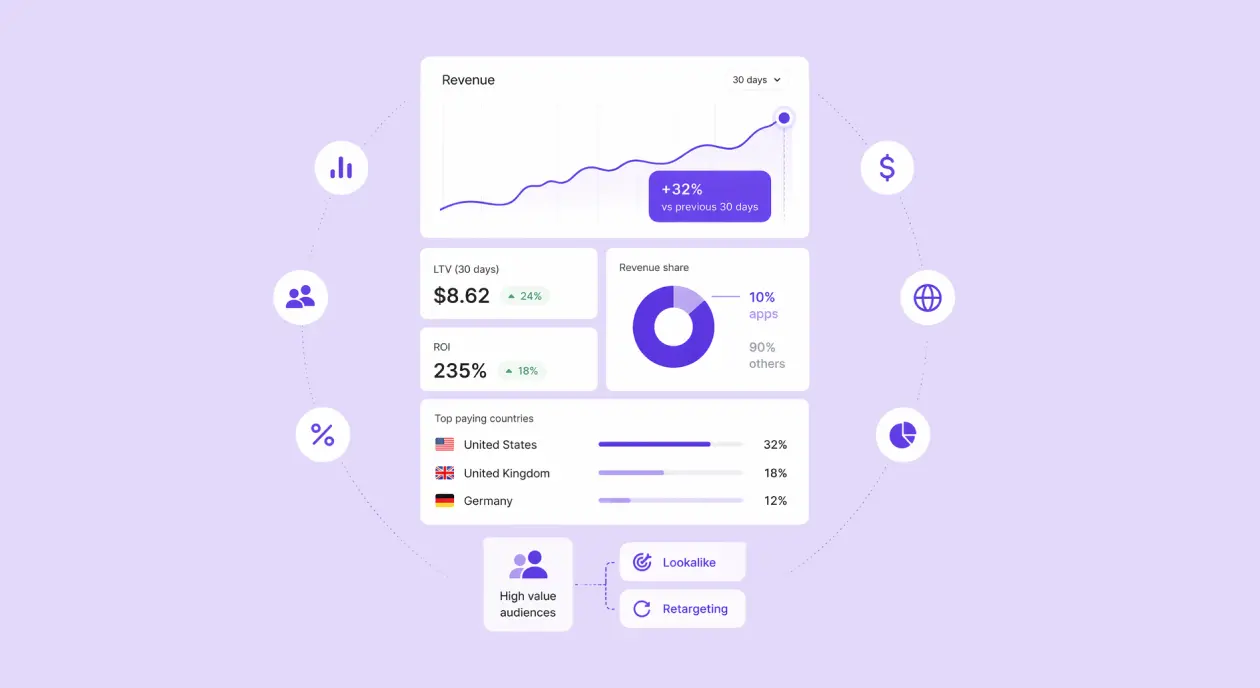
Without proper subscription analytics, it's difficult to understand which users actually drive long-term revenue. This is where tools like Adapty become essential, helping teams identify high-value users early and analyze subscription behavior.
These insights can then be used to build lookalike audiences, refine targeting, and shift budget toward high-LTV users. Even small improvements in user quality at the acquisition stage can significantly impact overall revenue.
Practical example: building lookalike audiences on AppLovin and DSPs
In AppLovin (Axon), you can pass subscription-level revenue events — such as trial_started or subscription_purchased — back to the algorithm via your MMP. Once you accumulate enough conversion signals (typically 50+ events per ad set), the algorithm self-optimizes toward users with similar behavioral patterns. In our experience working on Tier-1 campaigns, shifting the optimization event from install to subscription_purchased сan reduce CPA by 30-40% within the first two weeks, while D7 ROAS improves by 22%. Results will vary by vertical, but the directional shift is consistent: revenue-event optimization outperforms install optimization on mid-to-large budget campaigns.
On DSP-level sources like Moloco or Bidease, lookalike targeting operates differently — you supply your own seed audience via a CSV or S2S segment, so the quality of your seed list is critical. We build seed segments from users who completed a qualifying revenue event within D3, not D30. The reason: fresher signal reflects current traffic quality and campaign context, while 30-day cohorts may mix users from campaigns with very different setups.
Optimizing performance marketing campaigns
Performance marketing becomes significantly more effective when campaigns are aligned with downstream revenue signals, not just installs.
From Traffy's experience, one of the most common mistakes is optimizing campaigns purely for CPI. While this approach can drive volume, it often leads to lower-quality users and early performance saturation.
Key strategies include:
- Revenue-focused optimization: shift from CPI to metrics like cost per subscription or cost per revenue event
- Lookalike audiences based on high-LTV users: use your most valuable users as a signal for scaling
- Retargeting campaigns: re-engage users who installed but didn't convert
- Deep linking and personalized onboarding: bring users directly to relevant in-app experiences
In practice, campaigns optimized for revenue tend to scale more sustainably, as they prioritize long-term value over short-term volume.
To support this approach, it's no longer enough to rely on basic campaign setups. Scaling today requires a well-built infrastructure that combines data tracking, automation, and strict traffic quality control.
Budget scaling mechanics and fraud control
One of the most effective scaling disciplines for algorithmic networks like AppLovin/Axon is budget increment management. We apply a maximum 15% budget increase per step, timed to Tuesday–Wednesday ahead of high-traffic weekends. Larger jumps — even on well-performing campaigns — tend to reset the algorithm's learning phase and cause a temporary performance dip of 20–35%. Consistent small steps preserve optimization stability and protect ROAS during the scaling window.
Fraud control is not a one-time setup — it is a continuous process. We run weekly traffic audits using publisher-level data, flagging sub-sources with abnormal patterns:
- Install-to-first-event gap under 60 seconds
- D1 retention below 8%
- Click-to-install rate above 30%
Sub-sources matching these signals go onto a campaign-level blacklist. On some networks, automated blacklisting handles this in near-real-time, allowing teams to react faster than any manual audit cycle.
Retention & Engagement: The hidden LTV multiplier
Retention is one of the strongest drivers of LTV. Improving retention directly increases the lifetime value of users and enhances campaign efficiency. A significant share of users drops off within the first days after install, making early engagement critical.
Effective tactics include:
- Push notifications and in-app messaging
- Personalized offers and promotions
- Feature-driven onboarding
- Incentives for key in-app actions
With Adapty, teams can run A/B tests on paywalls, experiment with pricing and trials, and optimize conversion flows. Even incremental improvements in early retention can compound into meaningful long-term revenue growth.
Paywall A/B test example: trial length and conversion
Testing a 3-day free trial against a 7-day trial on a mid-size subscription app (10,000+ installs per cohort) showed a counterintuitive result — the shorter trial converted at a 12% higher rate among users acquired from in-app ad networks. The likely explanation: a lower commitment threshold attracts users with stronger purchase intent, while a longer trial period can attract lower-intent users who explore the app with no plan to subscribe.
Measuring & Iterating
Sustainable growth requires continuous measurement and iteration. One of the key challenges today is evaluating user quality early. Leading teams focus on the first 24-72 hours to identify high-potential users and adjust campaign strategies.
To do this effectively, marketers rely on mobile measurement partners or platforms like Adapty.
A simple framework
- Measure user behavior and revenue
- Analyze high-value segments
- Optimize campaigns and monetization
- Repeat continuously
72-hour quality checklist: what to look at and when to pause
In practice, our 72-hour quality checklist covers four signals:
- D1 retention ≥ 20% (benchmark for mid-core apps; adjust threshold per vertical)
- At least one in-app event beyond install (tutorial complete, registration, first deposit, or equivalent)
- No anomalies in install timing distribution (a fraud signal — installs clustering in seconds is a red flag)
- ARPU trending positive relative to campaign CPI
If a sub-source fails two or more of these signals by hour 72, it gets paused — regardless of install volume. In one campaign on AppLovin, applying this discipline helped eliminate 18% of install volume that was generating zero revenue events downstream. Reallocating that budget to sub-sources with stronger early signals resulted in 3x better D7 ROAS within the same campaign cycle.
Conclusion
Maximizing LTV and ROI from in-app traffic requires more than increasing installs. It requires a deep understanding of user behavior, strong segmentation, and alignment between acquisition and monetization.
By combining performance marketing expertise with subscription analytics tools like Adapty, teams can attract higher-quality users, improve retention, and drive sustainable growth.
Key takeaway: In today's market, success is defined not by how much traffic you buy, but by how well you understand its quality.