TL;DR:
- Most subscription apps only monetize 5% of their users — the ones who pay. The other 95% generate zero revenue.
- Hybrid monetization adds ad revenue from non-subscribers without hurting your subscription business.
- Ad quality matters more than ad volume: a single bad ad can cause 6-7% user churn.
If you run a subscription app, you’ve probably accepted an uncomfortable truth: most of your users will never pay you a cent.
Industry data suggests only 5% of users convert to paying subscribers. That number varies — some apps hit 10%, others barely scrape 2%, but the pattern holds. The majority of your active users enjoy your app for free, and no amount of paywall optimization changes their behavior.
Which raises an obvious question: why aren’t you monetizing them?
In a recent webinar with Arina Biryukova and Berk Ulusoy from Google AdMob, we explored practical strategies to scale revenue without compromising user experience. The core insight: hybrid monetization lets you capture value from non-subscribers through ads while preserving (and sometimes improving) retention and engagement.
What is hybrid monetization?
Hybrid monetization combines subscription revenue with ad revenue from non-paying users. Instead of treating non-subscribers as a cost center (server load, support tickets, zero revenue), you create a second revenue stream through carefully placed advertisements.
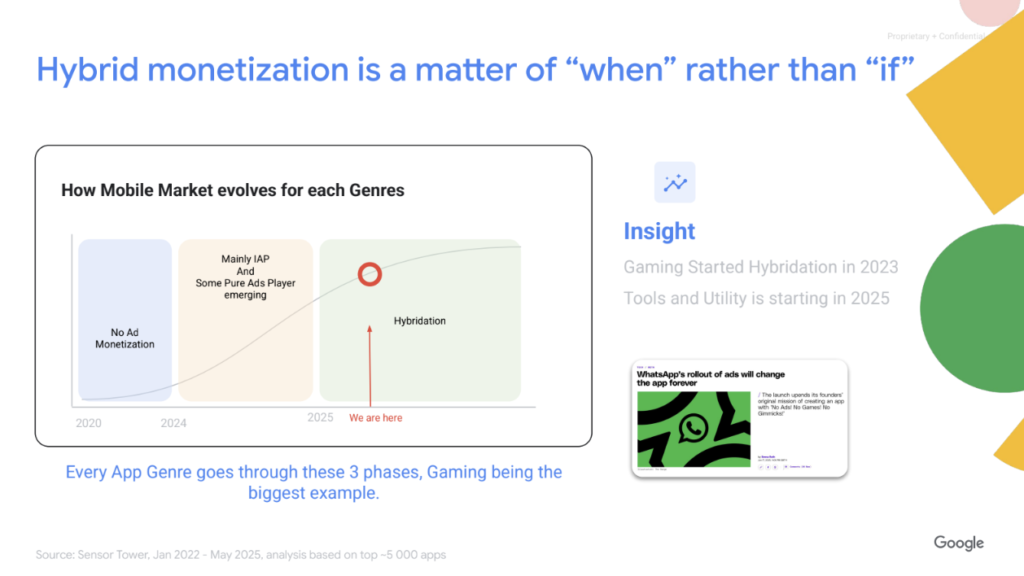
This isn’t a new concept. Gaming apps have run hybrid models for years. But subscription apps in categories like productivity, health, entertainment, and utilities have been slower to adopt it — often because of concerns about user experience or fear that ads will cannibalize subscription conversions.
Those concerns aren’t baseless. Implemented poorly, ads destroy retention. But the data shows that, implemented well, ads can increase both revenue and engagement without touching your subscription metrics.
Does hybrid monetization work for subscription apps?
ShortMax, a drama shorts app, offers a clear example of hybrid monetization at work.
The app lets users watch episodic drama content. Some users subscribe to unlimited access. Most don’t. ShortMax integrated ads for non-paying users and tracked what happened:
- 80% of non-paying users started generating revenue through ad impressions
- 20% increase in average session length (users stuck around longer)
- Improvements in retention and ARPU across the board
Here’s what made this work: ShortMax placed ads at natural breaks in the user experience — between episodes, when users returned to the main menu, and at app open. They avoided interrupting active viewing. The result was monetization that felt like part of the flow, not an intrusion.
The key metric isn’t just “how much ad revenue did we generate?” It’s “Did ad revenue increase total revenue per user without hurting subscription conversion or retention?”
For ShortMax, the answer was yes.
Why does ad quality matter more than ad volume?
Google and Deloitte conducted a study on ad quality across 7,000 app users (focused on gaming, but the findings apply to all app categories). The results were striking:
- 6-7% churn after a single exposure to a disruptive ad
- 20% app abandonment after one interaction with a non-functional ad (e.g., close button doesn’t work, forced redirects)
- 3x higher quit rates when rewarded ads included multiple disruptive features
On the flip side, high-quality ads had the opposite effect:
- 72% of users continued using apps with high-quality ads (no impact on retention)
- 20% of users increased usage when ad experiences were clean and predictable
- 37% of users became higher spenders when ad quality met expectations
Bad ads cost you users. Good ads don’t. Prioritize ad quality over ad volume, or you’ll trade long-term LTV for short-term ad revenue.
Where and when should you show ads in your app?
The webinar hosts repeated one word throughout: balance. Hybrid monetization works when you respect the user experience and avoid ad overload.
Where to place ads
Ads belong in natural stops in your user flow — moments where the user pauses, transitions, or completes a task. Examples:
- Between content sections (articles, videos, episodes)
- After completing an action (saving a file, finishing a workout)
- When returning to the main menu or home screen
- At app open (for returning users, not first-time users)
Avoid placing ads during active engagement. If a user is mid-task, mid-content, or in a critical workflow, don’t interrupt them.
When to show ads and when not to
Never show ads during onboarding. First impressions matter. Users who see ads before they understand your app’s value will churn faster.
After onboarding, introduce ads gradually. For apps with multiple daily sessions (e.g., social apps, habit trackers, content apps), you can show ads on the second or third session of the day. For apps with less frequent usage, be more conservative.
Ad format selection
Different ad formats work for different apps:
- App open ads: Monetize your splash screen while the app loads in the background. Works well for apps with frequent daily sessions. Users can close these immediately once the app is ready.
- Interstitial ads: Full-screen ads that appear between content or actions. Best for apps with clear transition points (between articles, levels, episodes). Keep them short (5 seconds) with a clear close button.
- Rewarded ads: Users watch an ad in exchange for premium features, extra content, or in-app currency. This format works even for paying subscribers because it feels like a choice. It adds engagement and gamification without feeling intrusive.
- Native ads: Ads that match your app’s design and flow (e.g., sponsored content in a feed). Less disruptive but also less noticeable.
- Banner ads: Persistent ads at the top or bottom of the screen. Lower revenue per impression, but less disruptive.
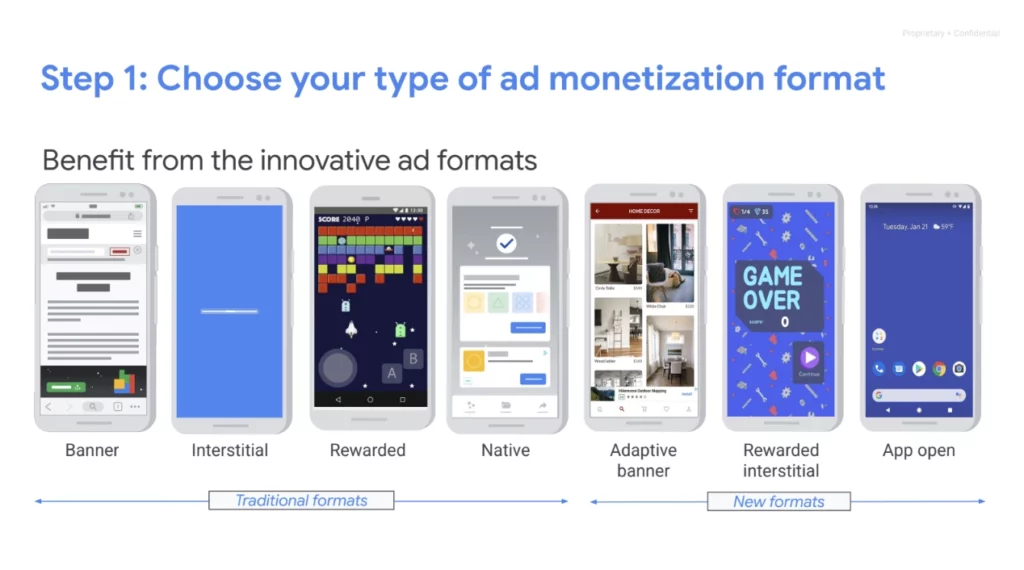
Choose formats that align with your app’s UX. Drama shorts apps use interstitials between episodes. Productivity apps might use rewarded ads to unlock premium features. Habit trackers might use app open ads for returning users.
How do you segment users for hybrid monetization?
Hybrid monetization requires segmentation. You need to identify which users to monetize with ads and which to monetize with subscriptions (or both).
Basic Segmentation: Paying vs. Non-Paying
At a minimum, segment users based on subscription status:
- Non-subscribers: Show ads
- Active subscribers: Don’t show ads (except rewarded ads if they make sense)
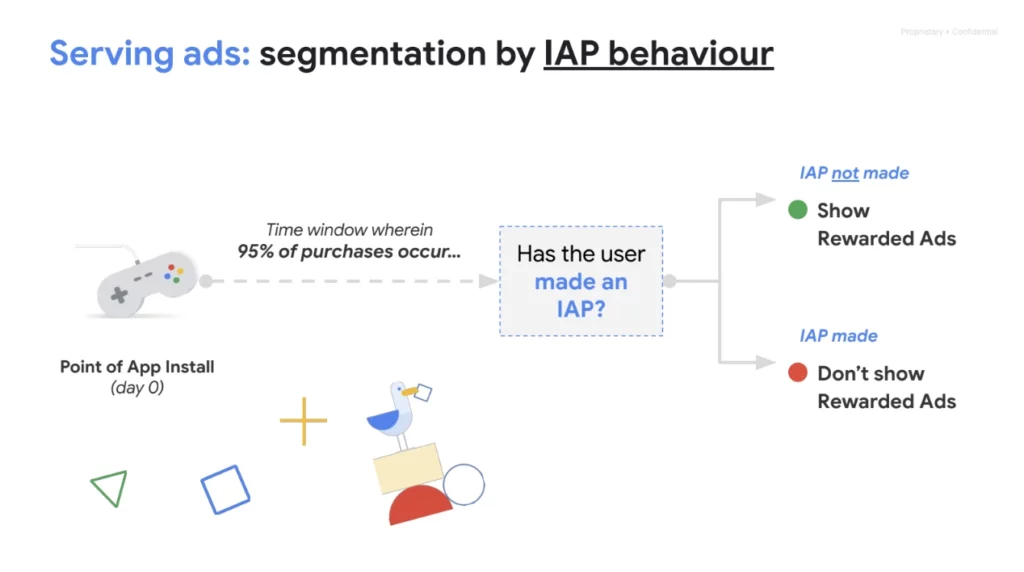
Users who subscribed last year might cancel this year. Users who haven’t converted after 30 days probably won’t convert at all. Behavioral segmentation lets you refine your strategy.
Advanced segmentation: Behavior and geography
Use Firebase, Google Analytics, or your app’s analytics stack to segment by:
- Time since install: Users who haven’t subscribed after 14-30 days are unlikely to convert without a trigger event. Show them ads.
- Session frequency: High-frequency users who don’t subscribe are ideal for ad monetization. They engage often, which means more ad impressions.
- Geography: Users in Tier 1 markets (US, UK, Canada, Australia) have higher subscription willingness and higher ad CPMs. Users in Tier 2 markets (India, Brazil, Southeast Asia) may convert to subscriptions at lower rates but still generate ad revenue.
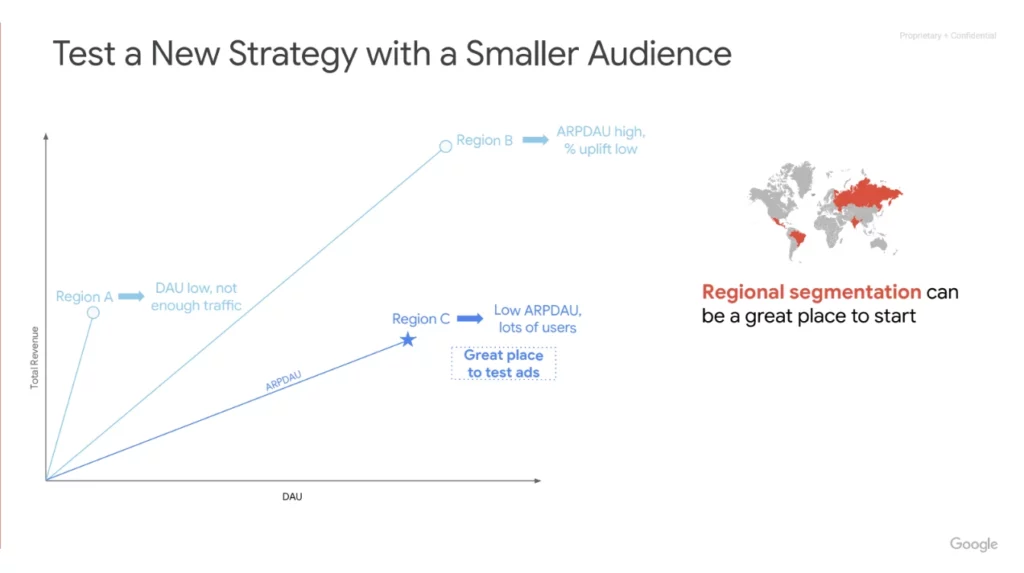
- Content consumption: In content apps, users who consume a lot of free content but never subscribe are perfect candidates for ads.
Set up Firebase Remote Config to dynamically adjust which users see ads without requiring app updates. This lets you test different segmentation strategies and adjust in real time.
The edge case: Ads for paying users
In some cases, it makes sense to show ads even to subscribers, specifically, rewarded ads.
ShortMax kept rewarding ads live for paying users. Why? Because rewarded ads create engagement. A user who watches a 30-second ad to unlock bonus content spends more time in the app, which improves retention. The ad revenue is secondary; the real win is higher LTV through sustained engagement.
This only works if:
- The rewarded ad is truly optional
- The reward is meaningful (exclusive content, feature access, in-app currency)
- The user experience doesn’t feel degraded
Don’t force ads on paying subscribers. But don’t assume they won’t engage with rewarded ads if the value exchange is clear.
How do you implement hybrid monetization successfully?
Hybrid monetization isn’t “turn on ads and watch revenue go up.” It requires testing, measurement, and iteration.
Start conservative
If you’re new to ads, start with:
- One ad format (e.g., rewarded ads or app open ads)
- A small segment (e.g., users who haven’t converted after 30 days)
- A single placement (e.g., between content sections)
Measure the impact on retention, session length, and subscription conversion before expanding.
Measure what matters
Track these metrics:
- Ad revenue per user (for non-subscribers)
- Total revenue per user (ad revenue + subscription revenue)
- Retention (D1, D7, D30) for users who see ads vs. users who don’t
- Subscription conversion rate for users exposed to ads vs. users not exposed
- Session length and frequency (are ads hurting engagement?)
If ad revenue increases but retention drops, you’re trading short-term revenue for long-term LTV. That’s a bad trade.
If ad revenue increases and retention holds steady (or improves), you’ve found the balance.
Iterate based on data
Run A/B tests to optimize:
- Ad frequency (how many ads per session?)
- Ad placement (where in the user flow?)
- Ad format (interstitial vs. rewarded vs. native?)
- Segmentation logic (which users see ads?)
Don’t assume what works for one app will work for yours. Test everything.
When should you avoid hybrid monetization?
Hybrid monetization isn’t right for every app.
Skip ads if:
- Your subscription conversion rate is already high (>10%). You’re already monetizing most of your users effectively.
- Your app targets enterprise or B2B users. Ads undermine the professional positioning.
- Your user sessions are short and infrequent. Low session frequency means low ad impressions, which means low revenue.
- Your app’s value prop is “ad-free experience.” Meditation apps, premium productivity tools, and luxury apps shouldn’t compromise their brand with ads.
Hybrid monetization works best for:
- Apps with high daily active usage
- Apps with clear content consumption patterns (media, entertainment, utilities)
- Apps with low subscription conversion (<5%)
- Apps with a large non-paying user base that engages regularly
If your non-paying users are dormant, ads won’t save you. Focus on activation and engagement first.
What tools do you need to implement hybrid monetization?
You don’t need to build a custom ad infrastructure. Platforms like Google AdMob handle ad serving, mediation, and optimization.
For subscription apps, you’ll need:
- AdMob SDK for ad delivery
- Firebase Remote Config for dynamic user segmentation (show ads to specific user cohorts without app updates)
- Analytics integration to track ad performance alongside subscription metrics
If you’re using a subscription management platform like Adapty, make sure your ad segmentation logic syncs with subscription status. The last thing you want is to show ads to active subscribers because of a data lag.
Hybrid monetization is about creating a sustainable revenue model that respects user experience while capturing value from users who won’t subscribe.
The 95% of users who don’t pay for your app aren’t deadweight. They’re an untapped revenue stream if you implement ads thoughtfully, measure obsessively, and prioritize user experience over short-term ad revenue.
Balance is everything.
Want more expert insights like this? Check out our webinar recordings where we break down practical monetization strategies with industry leaders and top-performing subscription apps.
FAQ
- Do I have a large non-paying user base that engages regularly?
- Is my subscription conversion rate below 5-10%?
- Can I identify natural breaks in the user flow where ads won’t disrupt engagement?