How subscription apps add 7% MRR by converting non-payers through AI-generated emails

TL;DR:
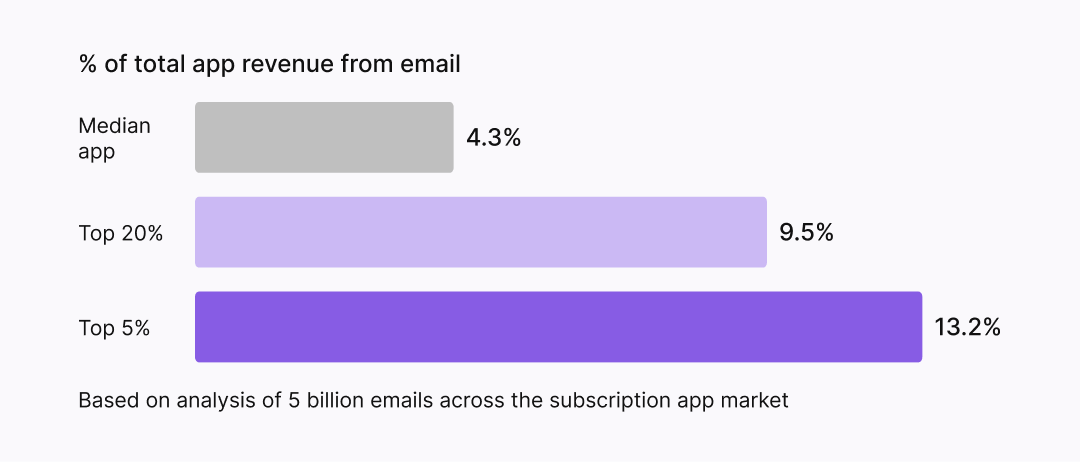
- Top subscription apps generate 13.2% of revenue from email. The median app generates 4.3%. Most apps have a list. The gap is automation: most apps have users who signed up and never paid — and no emails are going out to them.
- Any email tool not built for subscription apps needs you to feed it your user data manually: who signed up but never paid, when their trial expires, who's at risk of leaving. That setup takes a developer and breaks every time your app changes.
- Adapty already has all of this data. Adapty Mail uses it directly. We gave it one App Store link. It built a 7-email campaign in 97 seconds.
Subscription apps run push notifications, in-app messaging, and paywall tests as a matter of course. Email is the channel most teams haven’t touched, even though users already opted in.
Our internal analysis of 5 billion emails across the subscription app market shows the top 5% of apps generate 13.2% of revenue from email, against 4.3% for the median. The difference comes down to one habit: Top apps email users who signed up and never paid. Most apps leave that group untouched. At $100K MRR, that gap is $84,000 a year. At $500K MRR, it's $420,000.
In this article, we break down why that gap exists and how to close it without a team.
Why email is the channel most subscription apps are leaving empty
Most subscription apps have an email list that sits unused.
Running the lifecycle email requires three people. A developer updates the subscription data, a designer builds templates, and an email marketer writes sequences. For most teams, that's 4-6 weeks before a single send goes out. So it stays on the roadmap.
The apps at 13.2% built around this. They send the right email before the trial window closes.
Three apps from that top 5% — and what they actually send.
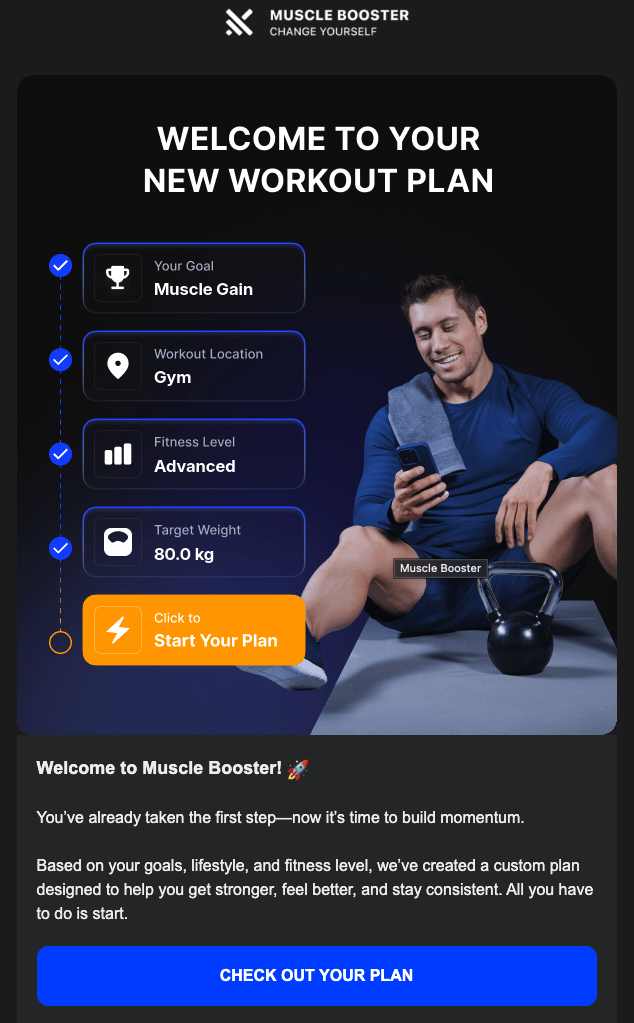
Day 0. Muscle Booster sends a welcome email that looks like a system notification — goal, workout location, fitness level, target weight, all confirmed. The subject line is "Your plan is ready." Users open it because it feels like something happened in the app.
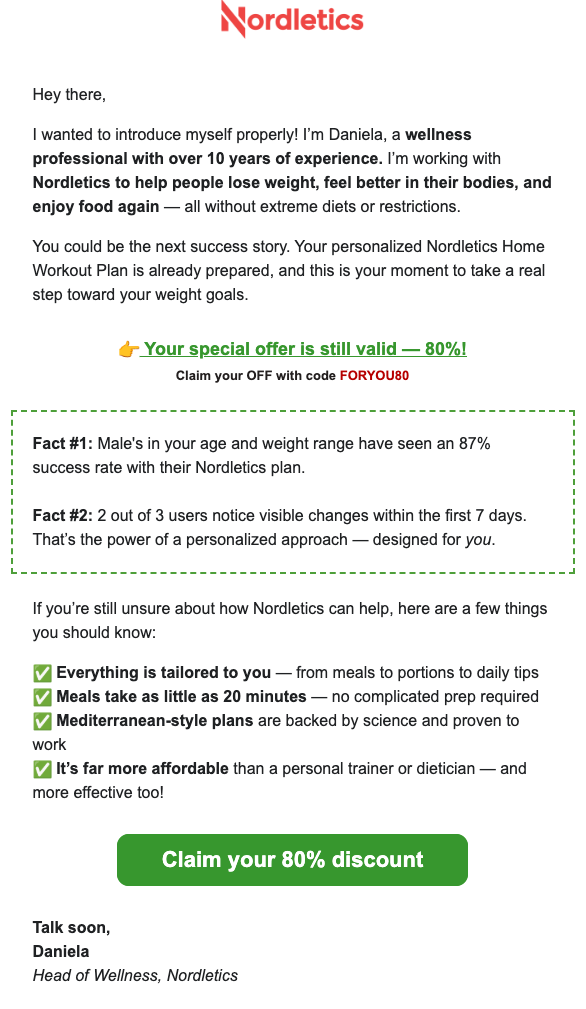
Mid-trial. Nordletics sends a letter from Daniela, Head of Wellness. First-person, no hero image, personal signature at the bottom. The email could have come from a real coach.
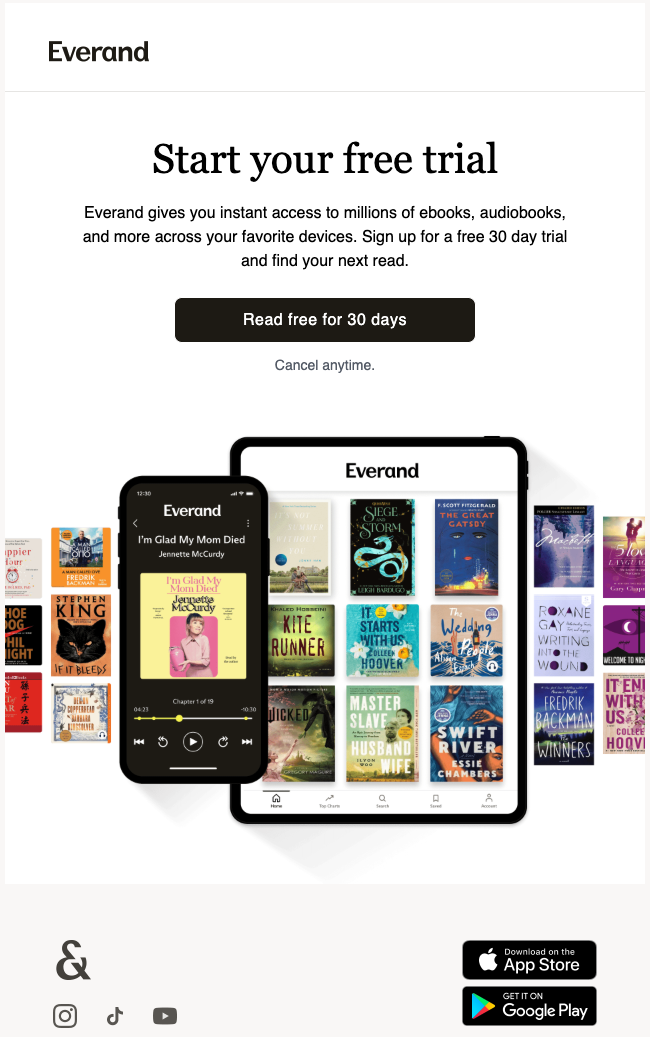
Before expiry. Everand: one headline, one CTA, one sentence. "Read free for 30 days."
Apps running emails like these hit open rates of 30-50%, with 2-7% converting to paid. For context on where trial conversion benchmarks sit across app categories, see The trial vs. direct question: what $3B in revenue says.
What changes when subscription data is native to the email tool?
Other tools can get to the same data through integrations. Getting the data is the easy part. The team still has to decide which events trigger which emails, write the copy, handle deliverability, and build attribution. That's weeks of work even after the integration is in place.
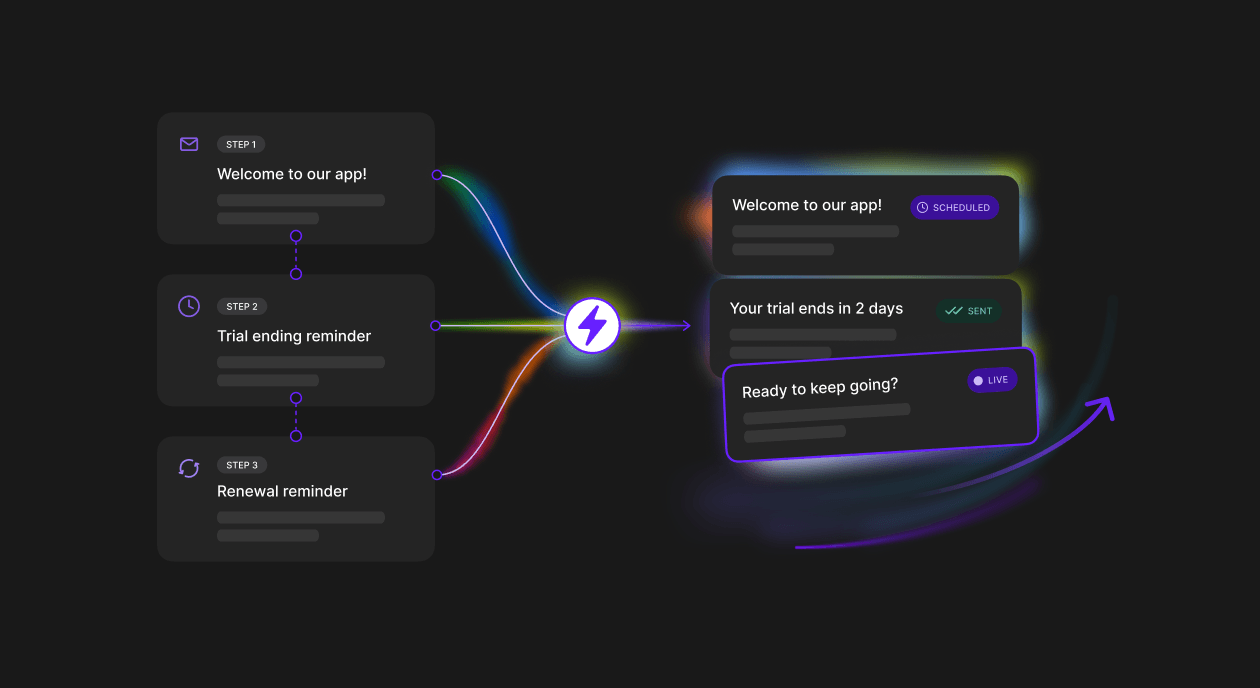
Adapty Mail does all of that on Adapty data. Your "trial ends tomorrow" email reflects the actual expiry date. Re-engagement triggers fire when a user goes inactive. Churn-risk sequences target users whose behavior matches historical churn patterns. All three triggers ship configured out of the box, with no manual setup. The whole setup takes one evening.
How does Adapty Mail go from App Store link to live campaign?
Four steps inside Adapty Mail. The fifth connects to your sending domain registrar, which takes about 10 minutes.
Step 1 — Connect your domain.
Enter the domain you want to send from. Adapty Mail generates three authentication records (DKIM, SPF, and DMARC). These are short text entries you paste into your domain registrar. Without them, your emails land in spam.
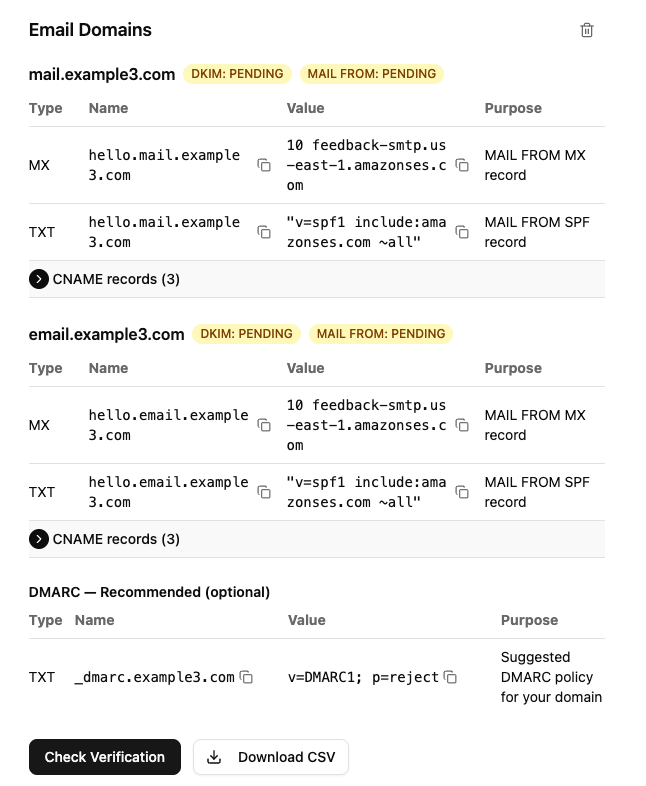
Once the domain is verified, the SMTP Warm-up Bot takes over. It ramps up spending over 2-4 weeks, so inbox providers learn to trust the new domain, then keep monitoring your sender score in the background after launch.
Step 2 — Build the brief. Paste your App Store link. Adapty Mail reads your app name, category, screenshots, description, and brand colors. Then the AI identifies who in your user base is most likely to pay and which sequence to build for them. You can upload brand guidelines or set tone preferences before generating.
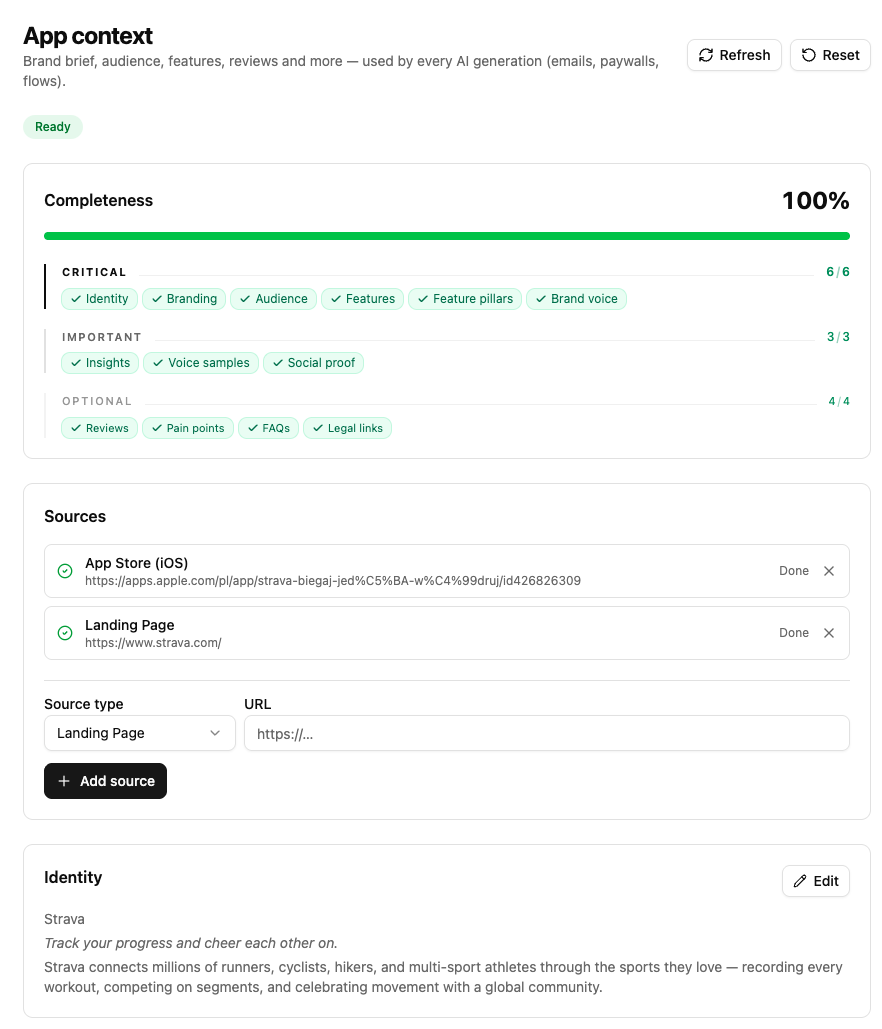
The AI uses this data to figure out who in your user base is most likely to pay, then decides how many emails to send, in what order, and with what tone before writing anything.
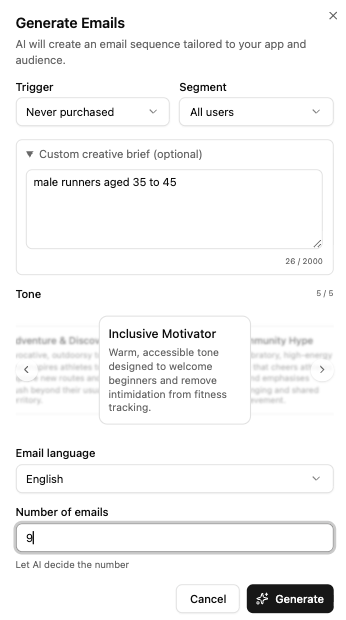
Step 3 — Generate the sequence. The planner decides on 3-15 emails with purpose, timing, tone, and image directions. A Copywriter writes the subject lines, headlines, body, and CTAs. AI generates hero images in your brand colors. The output is production-ready HTML you can regenerate or edit before launch. Total time: under 2 minutes.
Step 4 — Checkout integration. Each email links to a web paywall that Adapty Mail generates in your brand colors. The link carries the user's profile_id, so when someone subscribes, the purchase traces back to the exact email and sequence that drove it. Standard web tracking loses the thread at the App Store handoff. Profile-level attribution doesn't.
Step 5 — Launch and optimize. Click Launch. Adapty Mail pulls the audience from Adapty, inserts personalized links, and sends. A/B tests run across sequence variants. Pick the winner in the dashboard and roll it out.
What does an email sequence look like?
We ran Strava through Adapty Mail with one input: the App Store link. 97 seconds, 9 emails.
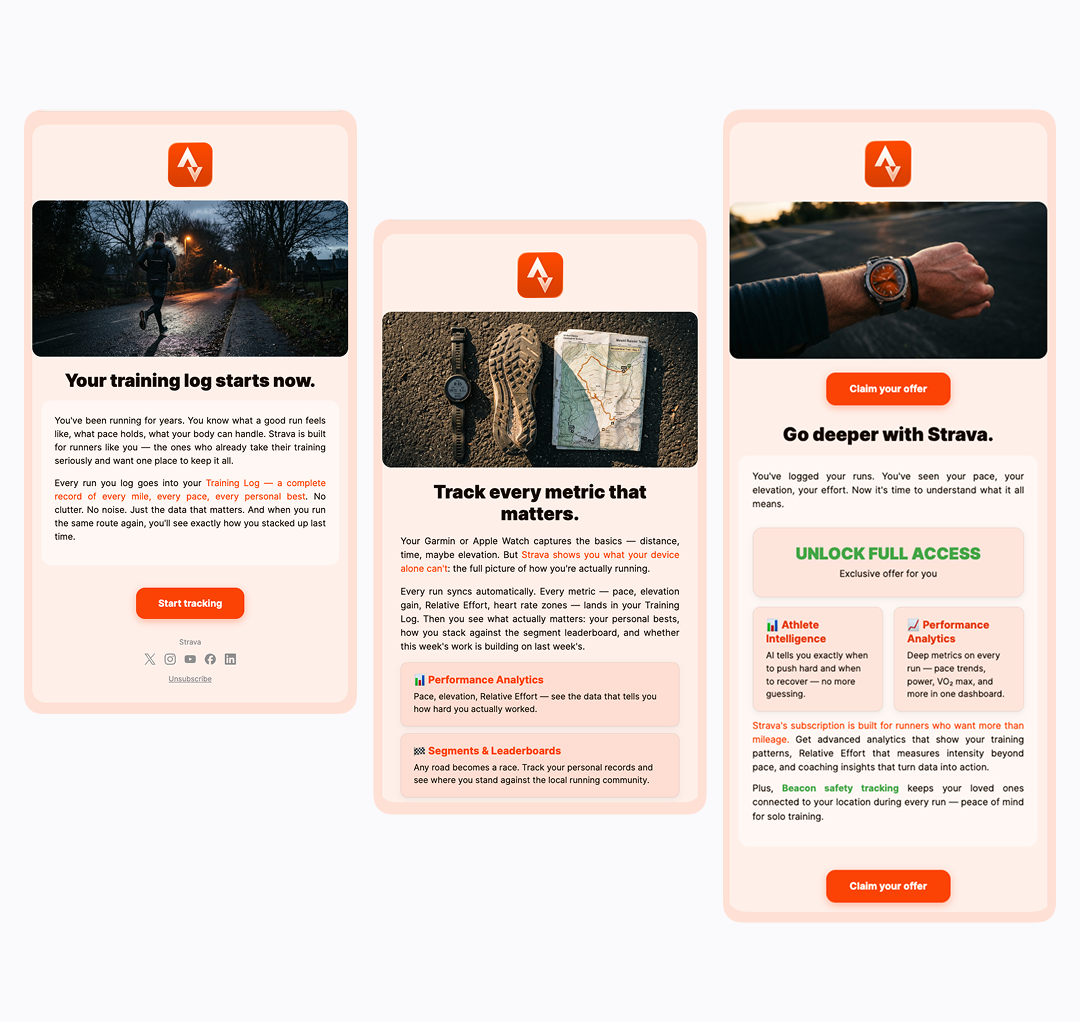
The order isn't random. Early emails build product familiarity. The middle shifts tone with a coach letter in first person, then with App Store data pulled from the listing. The last three are conversion emails: a community angle, a hard deadline, and a direct upsell. Each uses a different layout and tone.
| Type | Subject | Content | Goal |
| Welcome | "Your training log starts now." | Night run hero image + copy for serious runners who already know their pace | Frame Strava as the one place that holds your entire training history |
| Product discovery | "Track every metric that matters." | Three feature cards: Performance Analytics, Segments & Leaderboards, Device & App Sync | Show what Strava sees that your watch alone can't |
| Educational | "Train smarter, not harder." | Side-by-side hero + cards: Relative Effort, Athlete Intelligence, Performance Analytics | Reframe training from mileage to precision — targets runners 45+ |
| Coach letter | "Running in your 40s is its own thing." | Pure text from "Marcus" — two decades of coaching, routes, local clubs, motivation | Shift tone to personal at the moment motivation starts to dip |
| Social proof | "One runner. One segment. One PR." | Marcus's story: 47 years old, broke 10K record at 37:19, 4.62★ from 5,279 runners | Remove doubt with a real story from someone the reader recognizes as themselves |
| Community | "You're joining something real." | 100M+ athletes stats row + testimonial quote + Clubs & challenges block | Reinforce the social layer before the conversion ask |
| Win-back | "Your segments are live. Join in." | Countdown bar + copy about the leaderboard moving without them | Create FOMO around real activity happening on their local routes |
| Final chance | "This is your last 24 hours." | 24H countdown block + "no extensions, no second chances" | Hard deadline, no softening |
| Upsell | "Go deeper with Strava." | Athlete Intelligence + Performance Analytics cards + exclusive offer banner | Convert free users to paid with feature-specific value props |
The system identified runners 45+ as the core segment from the App Store listing and wrote every email for that person.
Most marketing emails don't render properly. Internal analysis of 500+ emails from 45 top mobile senders found only 3% have proper dark mode CSS, and only 22% use VML buttons for correct Outlook rendering. Every Adapty Mail sequence includes both, plus 3 subject line variants per email, and responsive HTML.
A human strategist and copywriter take weeks to build this. Before launching, you can upload your own brand guidelines, regenerate any individual email, or edit a copy directly.
What's the actual ROI math?
Apps running four flows — onboarding, trial-to-paid, win-back, and churn recovery — see a 7% MRR lift on average, based on internal analysis across the Adapty user base. Most run none of them.
The biggest opportunity is users who downloaded the app and never paid. That group usually outnumbers trial users, and it's where win-back has the most room to move.
| MRR | 7% annual lift | Your cost at 20% rev share |
| $10,000 | $8,400/year | $1,680/year |
| $50,000 | $42,000/year | $8,400/year |
| $100,000 | $84,000/year | $16,800/year |
| $500,000 | $420,000/year | $84,000/year |
What your first Adapty Mail campaign could look like
Setup takes one evening. The first send goes out two weeks later — inbox providers need time to build trust in a new domain before you hit your full list.
- Step 1: Connect your domain — 10 minutes. Paste your App Store link — the sequence is ready in under 2 minutes. Review the emails, connect to checkout.
- Step 2 1-14: The SMTP Warm-up Bot runs in the background.
- Step 3: Launch. Adapty Mail pulls your trial audience from Adapty, inserts personalized checkout links, and sends.
Open rates, clicks, and revenue show up in the dashboard. Each purchase traces back to the email that drove it.