The landscape of App Store payments has fundamentally changed in 2025. What started as a legal battle between Epic Games and Apple has evolved into a global regulatory reckoning that’s reshaping how developers monetize their iOS apps.
In April 2025, a U.S. court ruled that Apple “willfully violated” previous court orders by maintaining anticompetitive barriers to external payments. Meanwhile, the European Union fined Apple €500 million for failing to comply with the Digital Markets Act. These twin pressures have forced Apple to make unprecedented concessions — though the company continues to fight back with complex fee structures and appeals.
This guide covers everything you need to know about alternative payments in the App Store: the current rules in each major market, the fee structures, practical implementation considerations, and what’s likely coming next.
The Current State of Alternative Payments
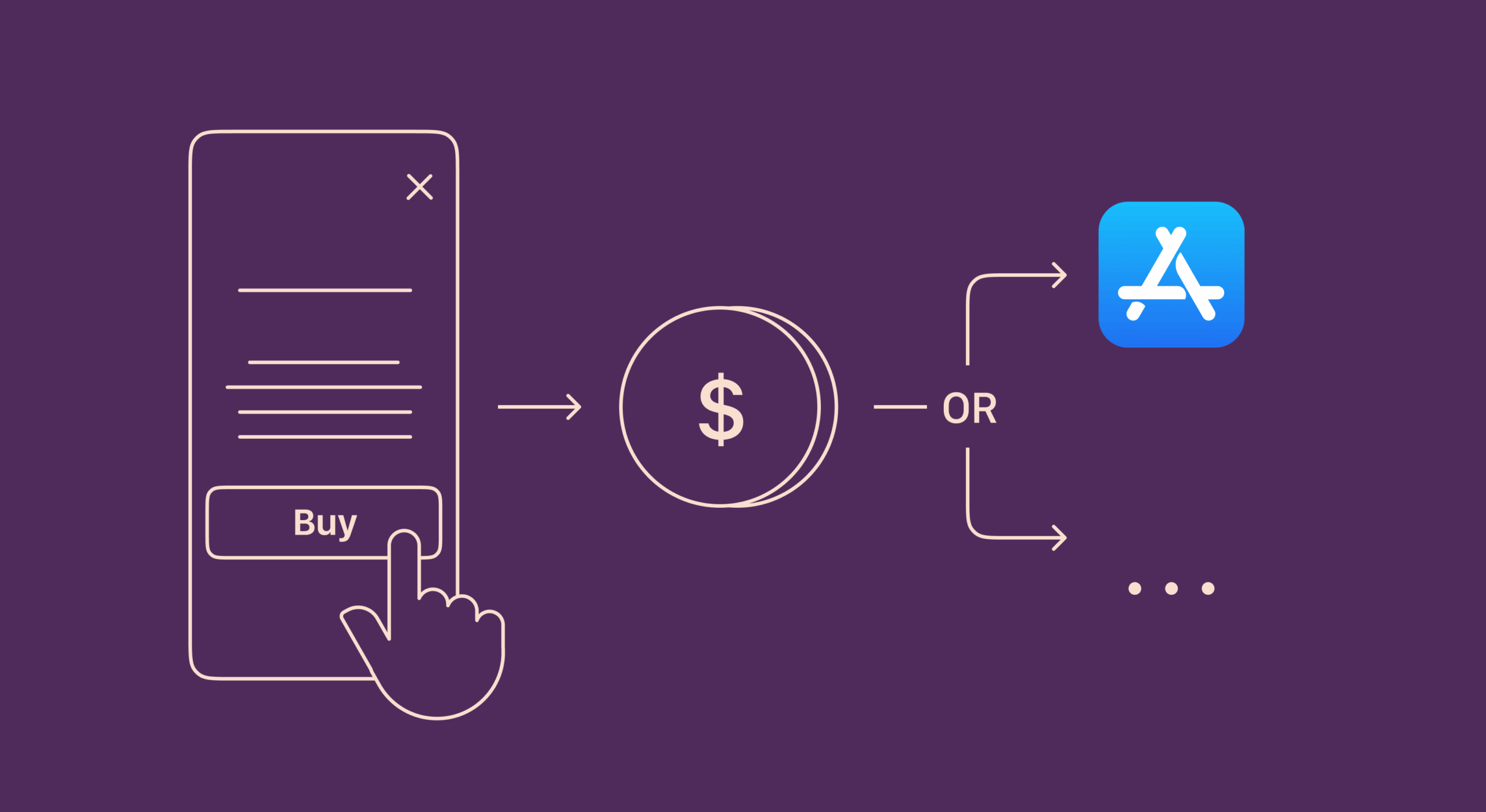
For years, Apple maintained near-total control over iOS app monetization. Developers had one option: use Apple’s In-App Purchase (IAP) system and pay a 30% commission (or 15% for small businesses and subscription renewals). Any attempt to direct users to external payment methods was grounds for app removal.
That monopoly is now cracking — but the cracks look different depending on where your users are located.
Here’s the quick summary:
| Region | External Payment Links | Apple’s Commission on External Sales | Status |
|---|---|---|---|
| United States | ✅ Fully allowed | 0% (temporarily) | Active, pending appeal |
| European Union | ✅ Allowed with restrictions | Up to 20% | Active since June 2025 |
| South Korea | ✅ Allowed | 26% | Active since 2022 |
| Netherlands (dating apps) | ✅ Allowed | 27% | Active since 2022 |
| Rest of World | ❌ Not allowed | N/A | Standard IAP only |
Let’s dive into each market.
United States: The Epic v. Apple Ruling
The most dramatic change happened on April 30, 2025, when U.S. District Judge Yvonne Gonzalez Rogers ruled that Apple had “willfully violated” her 2021 injunction against anti-steering practices.
What the Court Found
The judge determined that Apple’s previous “compliance” — allowing a single external link while charging a 27% commission and displaying warning screens — was designed to discourage developers from using alternative payments rather than enable fair competition. In her 80-page ruling, she found that Apple acted “with the express intent to create new anticompetitive barriers” to maintain its revenue stream.
The ruling referred Apple’s VP of Finance to the U.S. Attorney’s office for possible criminal contempt charges.
What Changed Immediately
As of May 1, 2025, Apple updated its App Store Guidelines with the following changes:
Developers can now:
- Include buttons, banners, and calls-to-action for external payments anywhere in their apps
- Use any design or placement for external payment links
- Communicate freely with users about external payment options through any channel
- Use dynamic URLs for attribution, coupons, and pre-authentication
- Advertise discounts available on their websites directly in the app
Apple cannot:
- Charge any commission on purchases made through external links (temporarily)
- Restrict the design or placement of external payment links
- Display “scare screens” beyond a neutral message: “You’re about to go to an external website. Apple isn’t responsible for the privacy or security of purchases made on the web.”
- Retaliate against developers who use external payment systems
The December 2025 Appeal
In December 2025, the U.S. Court of Appeals partially modified the lower court’s ruling. The appeals court agreed that Apple had violated the injunction but found the complete commission prohibition “too broad.”
Key changes from the appeal:
- Apple can charge a “reasonable, non-prohibitive commission” on external purchases
- Apple can require that external links not be more prominent than IAP options
- The case was remanded to determine what constitutes a “reasonable” commission
As of this writing, the exact commission rate Apple can charge has not been determined. Developers should proceed with caution, as the fee structure may change.
Fortnite Returns
Following the April ruling, Epic Games submitted Fortnite to the App Store on May 9, 2025. After initial delays — Apple claimed unresolved submission issues — Fortnite returned to the U.S. App Store on May 20, 2025, with its own payment system intact.
European Union: DMA Compliance
The European Union took a different approach through regulation rather than litigation. The Digital Markets Act (DMA), which took effect in 2024, designates Apple as a “gatekeeper” platform and requires it to allow alternative payment methods and app distribution.
The €500 Million Fine
In April 2025, the European Commission fined Apple €500 million for failing to comply with DMA requirements. Regulators specifically cited Apple’s “anti-steering provisions” that prevented developers from promoting external payment options.
Facing an additional €50 million per day in potential penalties, Apple announced sweeping changes to its EU App Store policies on June 26, 2025 — hours before the deadline.
The New EU Fee Structure
Apple replaced its original €0.50 per-install Core Technology Fee (CTF) with a multi-layered commission system. Critics have called it “compliance theater” — technically meeting the law’s requirements while creating enough complexity to discourage adoption.
The new fees for apps using external payments:
| Fee Type | Rate | When It Applies |
|---|---|---|
| Initial Acquisition Fee | 2% | First 6 months after user installs app |
| Store Services Fee (Tier 1) | 5% | Basic services: app review, fraud protection |
| Store Services Fee (Tier 2) | 13% | Full services: auto-updates, discovery, analytics |
| Core Technology Commission | 5% | Replaces CTF from January 2026 |
Maximum combined fees: Up to 20% (2% + 13% + 5%)
For comparison, standard IAP in the EU now costs:
- 20% commission (reduced from 30%)
- 10% for Small Business Program members
What EU Developers Can Do
Starting June 26, 2025, EU developers can:
- Link to external payment options from within their apps
- Use web views to display payment pages (new in 2025)
- Communicate offers through websites, alternative marketplaces, or other apps
- Choose between Tier 1 (basic) and Tier 2 (full) App Store services
EU Restrictions That Remain
Despite the changes, significant limitations persist:
- No mixing: Developers must choose between IAP and external payments for each app/storefront combination — no A/B testing
- Disclosure screens: Apple still requires a “disclosure sheet” before external purchases
- Reporting requirements: All external transactions must be reported to Apple within 15 days
- No Family Sharing: External purchases don’t support Family Sharing features
Core Technology Fee Transition
The original €0.50 per-install CTF (after 1 million downloads) will be phased out by January 1, 2026, replaced entirely by the percentage-based Core Technology Commission.
Other Markets
South Korea
South Korea was the first country to force Apple’s hand. In 2022, following legislation requiring app stores to allow third-party payments, Apple began permitting external payment systems for Korean developers.
Current terms:
- 26% commission on external purchases (vs. 30% for IAP)
- Requires a separate app version for the Korean App Store
- Warning screens still displayed
The 4% savings rarely justify the additional complexity and reduced conversion rates.
Netherlands (Dating Apps Only)
Following a Dutch court order, dating app developers in the Netherlands can use third-party payment systems.
Current terms:
- 27% commission on external purchases
- Limited to dating app category
- Apple paid €50 million in fines before complying
Japan
Japan has pressured Apple to allow “reader” apps (like Netflix and Spotify) to link to external subscription pages. Changes are more limited than in the EU or U.S.
Australia
In August 2025, an Australian court found Apple in violation of the Competition and Consumer Act. The full implications are still developing.
Commission Comparison by Region
| Region | Standard IAP | Small Business / Year 2 | External Payments | Net Savings |
|---|---|---|---|---|
| USA | 30% / 15% | 15% | 0%* | Up to 30% |
| EU | 20% | 10% | 12-20% | 0-8% |
| South Korea | 30% / 15% | 15% | 26% | 4% |
| Netherlands | 30% / 15% | 15% | 27% | 3% |
| Rest of World | 30% / 15% | 15% | N/A | N/A |
*USA rate is temporary pending appeal determination of “reasonable” commission
What’s Allowed vs. What’s Prohibited
United States (Post-April 2025)
| Action | Allowed? |
|---|---|
| External payment buttons in app | ✅ Yes |
| Multiple external links | ✅ Yes |
| Custom link design/placement | ✅ Yes |
| In-app web views for payment | ❓ Not explicitly addressed |
| Promoting website discounts | ✅ Yes |
| Email/push about external options | ✅ Yes |
| Apple commission on external sales | ❓ “Reasonable” rate TBD |
| Scare screens | ❌ Only neutral message allowed |
| A/B testing IAP vs. external | ✅ Yes |
European Union (Post-June 2025)
| Action | Allowed? |
|---|---|
| External payment links in app | ✅ Yes, with disclosure |
| In-app web views for payment | ✅ Yes (new) |
| Promoting external offers | ✅ Yes |
| Apple commission on external sales | ✅ Yes, up to 20% |
| Disclosure/warning screens | ✅ Required (less scary than before) |
| A/B testing IAP vs. external | ❌ No, must choose one |
| Family Sharing for external purchases | ❌ No |
Practical Considerations for Developers
Before jumping into external payments, consider what you’re taking on.
What Apple’s IAP Handles (That You’ll Need to Replace)
Payment processing:
- Global payment method support (credit cards, Apple Pay, carrier billing)
- Currency conversion
- PCI DSS compliance
Fraud prevention:
- Chargeback protection
- Fraudulent purchase detection
- Account verification
Subscription management:
- Trial periods and introductory offers
- Renewal processing
- Grace periods for failed payments
- Cancellation handling
Tax compliance:
- VAT/GST calculation and collection
- Tax remittance in 170+ countries
- Tax documentation and reporting
Customer support:
- Refund processing
- Purchase dispute resolution
- Receipt generation
Options for External Payment Infrastructure
Merchant of Record (MoR) services like Paddle, Stripe, or FastSpring can handle most of these complexities. They take on legal responsibility for transactions and manage tax compliance, fraud protection, and customer billing.
Direct payment processing through Stripe or similar gives you more control but requires you to handle tax compliance, fraud prevention, and customer support yourself.
Web2App strategies — acquiring users through web checkout before they download the app — can avoid Apple’s fees entirely in markets where the Core Technology Commission only applies to in-app promoted sales.
Conversion Impact
Early data suggests external payment flows convert at lower rates than native IAP:
- Additional steps (leaving app, logging in, entering payment info)
- User trust concerns about leaving Apple’s ecosystem
- Loss of Apple Pay convenience
For many apps, the 3-4% commission savings in markets like South Korea don’t offset the conversion drop. The calculus is different in the U.S. where (temporarily) there’s no commission at all.
Recommendation: Test and Measure
The U.S. ruling creates an opportunity to experiment:
- Set up external payment infrastructure
- Run controlled tests comparing IAP vs. external conversion rates
- Measure revenue per user across both paths
- Make data-driven decisions about where to direct users
Timeline: How We Got Here
| Date | Event |
|---|---|
| August 2020 | Epic bypasses Apple’s payment system in Fortnite; Apple removes app |
| August 2020 | Epic files antitrust lawsuit against Apple |
| September 2021 | Judge rules Apple’s anti-steering policy violates California law |
| January 2022 | Apple allows external links in South Korea (26% commission) |
| March 2022 | Apple allows external links for Dutch dating apps (27% commission) |
| January 2024 | Apple allows external links in U.S. (27% commission) |
| March 2024 | EU Digital Markets Act takes effect |
| March 2024 | Epic files motion to enforce 2021 ruling |
| April 2025 | EU fines Apple €500 million for DMA violations |
| April 30, 2025 | U.S. court finds Apple in willful violation of injunction |
| May 1, 2025 | Apple updates U.S. App Store guidelines, removes commission |
| May 20, 2025 | Fortnite returns to U.S. App Store |
| June 4, 2025 | Appeals court denies Apple’s emergency stay request |
| June 26, 2025 | Apple announces new EU fee structure |
| December 2025 | Appeals court allows Apple to charge “reasonable” commission |
| January 2026 | EU Core Technology Fee transitions to Commission (planned) |
What’s Next
Short-term (2025-2026)
- U.S. commission determination: Courts will define what “reasonable” commission Apple can charge on external purchases
- EU enforcement: European Commission will evaluate whether Apple’s new fee structure truly complies with DMA
- More markets: Japan, Australia, and potentially others may implement similar requirements
Medium-term
- Google implications: Google faces similar pressure following its loss to Epic in December 2023
- Industry standardization: Payment processors and MoR services will develop more streamlined iOS external payment solutions
- Developer adoption: As infrastructure matures, more developers will likely experiment with external payments
The Bottom Line
Apple’s grip on iOS payments is loosening, but it’s not gone. The company continues to fight every regulatory and legal challenge while implementing the minimum required changes — often in ways designed to discourage developer adoption.
For developers, the opportunity is real but requires careful analysis. The best approach:
- Understand the specific rules in each market where you operate
- Build or adopt payment infrastructure that can handle the complexity
- Test external payments against IAP to measure actual revenue impact
- Stay informed as regulations and Apple’s policies continue to evolve
Related Resources
- Apple’s EU In-App Purchase Fee System Explained: 2025 Update
- New U.S. Ruling on External iOS Payments
- Can You Use Stripe for In-App Purchases in 2025?
- Third-Party Payment Methods for iOS Apps
How Adapty Can Help
Navigating alternative payments doesn’t mean building everything from scratch. Adapty offers seamless integration with external payment providers like Stripe, helping you manage subscriptions across both Apple’s IAP and external payment systems from a single dashboard.
Whether you’re experimenting with external payments in the U.S., implementing DMA-compliant flows in the EU, or optimizing your existing IAP setup, Adapty provides the infrastructure to monetize your app effectively.
Learn more about Adapty’s Stripe integration →